
Acid-Carbonate Reactions: Predicting Products and Balancing Equations
Learn how to predict the salt, water, and carbon dioxide formed in acid-carbonate reactions, then write and balance the equations correctly.
A spoonful of sodium carbonate is added to hydrochloric acid. It fizzes. The obvious question is: where did the gas come from, and how could you predict the other products before doing the experiment?
Before reading on, make a prediction. If the reactants are an acid and a carbonate, which three types of product should you expect?
The reliable pattern is:
\[
\ce{acid + carbonate -> salt + water + carbon dioxide}
\]
The difficult part is usually not remembering \(\ce{H2O}\) or \(\ce{CO2}\). It is working out the correct salt formula, then balancing the equation without changing any chemical formulas.
01Why does an acid make a carbonate fizz?
Consider hydrochloric acid reacting with sodium carbonate:
\[
\ce{HCl + Na2CO3 -> ?}
\]
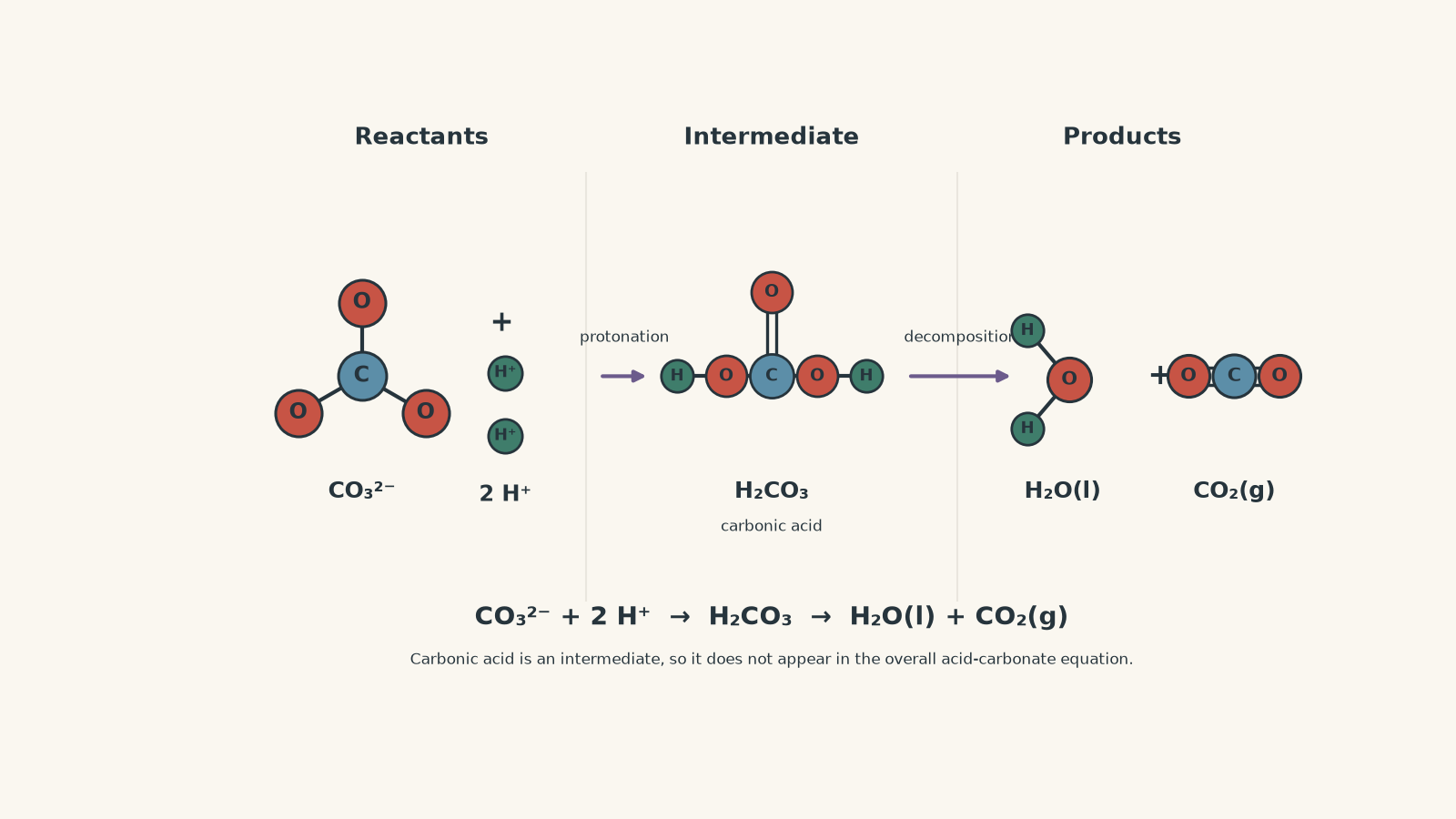
The carbonate ion is \(\ce{CO3^2-}\). Hydrochloric acid supplies \(\mathrm{H}^{+}\) ions.
A useful first picture is that the carbonate ion needs two \(\mathrm{H}^{+}\) ions because it has a \(2-\) charge:
\[
\ce{CO3^2- + 2H+ -> H2CO3}
\]
The product \(\ce{H2CO3}\) is carbonic acid. It does not remain as the main product under these conditions. It decomposes:
\[
\ce{H2CO3 -> H2O + CO2}
\]
Combine those two steps and the important change is:
\[
\ce{CO3^2- + 2H+ -> H2O + CO2}
\]
That explains the fizzing. The bubbles are carbon dioxide gas escaping from the mixture.
You can picture \(\ce{CO3^2-}\) as having two units of negative charge that need two \(\mathrm{H}^{+}\) ions to neutralise them. That picture is useful for counting protons, but it is only charge bookkeeping. The carbonate ion does not literally contain two empty “proton seats”.
This proton-transfer idea connects directly to acid-base reactions and neutralisation.
02Where does the salt come from?
The carbonate part produces \(\ce{H2O}\) and \(\ce{CO2}\), but the other ions have not disappeared.
Suppose the reaction is between sodium carbonate and hydrochloric acid.
- Sodium carbonate contains \(\mathrm{Na}^{+}\) and \(\ce{CO3^2-}\).
- Hydrochloric acid supplies \(\mathrm{H}^{+}\) and \(\mathrm{Cl}^{-}\).
- The \(\mathrm{H}^{+}\) reacts with the carbonate.
- The remaining \(\mathrm{Na}^{+}\) and \(\mathrm{Cl}^{-}\) form sodium chloride, \(\ce{NaCl}\).
So:
\[
\ce{Na2CO3 + HCl -> NaCl + H2O + CO2}
\]
The products are correct, but the equation is not balanced yet.
There are two sodium atoms on the left, so we need two \(\ce{NaCl}\) on the right. That requires two chlorine atoms, so we also need two \(\ce{HCl}\):
\[
\ce{Na2CO3 + 2HCl -> 2NaCl + H2O + CO2}
\]
Now every element is balanced.
03A reliable method for acid-carbonate equations
You do not need to guess the whole equation at once. Use the same sequence each time.
Step 1: identify the carbonate compound
A carbonate contains the carbonate ion:
\[
\ce{CO3^2-}
\]
Examples include:
- \(\ce{Na2CO3}\), sodium carbonate
- \(\ce{K2CO3}\), potassium carbonate
- \(\ce{CaCO3}\), calcium carbonate
- \(\ce{MgCO3}\), magnesium carbonate
The positive ion in the carbonate will later become part of the salt.
Step 2: identify the acid’s negative ion
The \(\mathrm{H}^{+}\) from the acid reacts with carbonate. The acid’s negative ion becomes part of the salt.
| Acid | Formula | Negative ion | Salt name ends in |
|---|---|---|---|
| hydrochloric acid | \(\ce{HCl}\) | \(\mathrm{Cl}^{-}\) | chloride |
| nitric acid | \(\ce{HNO3}\) | \(\ce{NO3-}\) | nitrate |
| sulfuric acid | \(\ce{H2SO4}\) | \(\ce{SO4^2-}\) | sulfate |
For example, magnesium carbonate reacting with nitric acid produces magnesium nitrate.
Step 3: write the salt formula from ion charges
This is where many errors occur.
If the positive ion is \(\mathrm{Mg}^{2+}\) and the negative ion is \(\ce{NO3-}\), one nitrate ion is not enough to make a neutral compound.
You need two:
\[
\ce{Mg(NO3)2}
\]
Do not choose subscripts because they make the overall equation easier to balance. The ionic charges determine the chemical formula first.
Step 4: add water and carbon dioxide
Once you have the salt, add:
\[
\ce{H2O + CO2}
\]
So the general structure is:
\[
\ce{acid + carbonate -> salt + H2O + CO2}
\]
Step 5: balance using coefficients only
Change the numbers in front of formulas.
Do not alter subscripts inside a formula.
For example, changing \(\ce{CaCl2}\) into \(\ce{CaCl}\) does not balance an equation. It changes calcium chloride into an incorrect formula.
Balancing preserves the substances involved because a chemical reaction rearranges atoms rather than changing one element into another. That idea is developed further in tutorgum’s guide to the rearrangement of atoms in reactions.
04Worked example: Sodium carbonate and hydrochloric acid
Write a balanced chemical equation for the reaction between aqueous sodium carbonate and hydrochloric acid.
Step 1
An acid reacting with a carbonate gives a salt, water, and carbon dioxide.
Hydrochloric acid forms chloride salts, so sodium carbonate forms sodium chloride:
\[
\ce{Na2CO3 + HCl -> NaCl + H2O + CO2}
\]
Step 2
There are two sodium atoms in \(\ce{Na2CO3}\), so place a coefficient of 2 before \(\ce{NaCl}\):
\[
\ce{Na2CO3 + HCl -> 2NaCl + H2O + CO2}
\]
Step 3
Two \(\ce{NaCl}\) units contain two chlorine atoms, so we need two \(\ce{HCl}\):
\[
\ce{Na2CO3 + 2HCl -> 2NaCl + H2O + CO2}
\]
Step 4
Left side:
- Na: 2
- C: 1
- O: 3
- H: 2
- Cl: 2
Right side:
- Na: 2
- C: 1
- O: \(1 + 2 = 3\)
- H: 2
- Cl: 2
The balanced equation is therefore:
\[
\ce{Na2CO3(aq) + 2HCl(aq) -> 2NaCl(aq) + H2O(l) + CO2(g)}
\]
The coefficient 2 before \(\ce{HCl}\) also makes chemical sense. Each carbonate ion requires two \(\mathrm{H}^{+}\) ions, and each \(\ce{HCl}\) supplies one.
05Worked example: Potassium carbonate and sulfuric acid
Write a balanced equation for potassium carbonate reacting with sulfuric acid.
This one contains a tempting trap. You may predict that sulfuric acid needs a coefficient of 2 because carbonate needs two \(\mathrm{H}^{+}\) ions. Check that prediction carefully.
Step 1
Potassium carbonate contains \(\mathrm{K}^{+}\).
Sulfuric acid contains the sulfate ion, \(\ce{SO4^2-}\).
Two \(\mathrm{K}^{+}\) ions are needed for one \(\ce{SO4^2-}\), so the salt is:
\[
\ce{K2SO4}
\]
Write the products:
\[
\ce{K2CO3 + H2SO4 -> K2SO4 + H2O + CO2}
\]
Step 2
Left side:
- K: 2
- C: 1
- S: 1
- H: 2
- O: \(3 + 4 = 7\)
Right side:
- K: 2
- C: 1
- S: 1
- H: 2
- O: \(4 + 1 + 2 = 7\)
Everything is already balanced:
\[
\ce{K2CO3(aq) + H2SO4(aq) -> K2SO4(aq) + H2O(l) + CO2(g)}
\]
Why did we not need \(2\ce{H2SO4}\)?
One sulfuric acid molecule already contains two acidic hydrogen atoms. In this overall reaction, one \(\ce{H2SO4}\) can supply the two \(\mathrm{H}^{+}\) needed by one \(\ce{CO3^2-}\).
So the rule is not “put a 2 before every acid”. The rule is “balance the atoms after writing the correct formulas”.
06The most common mistake: predicting the salt incorrectly
Consider calcium carbonate reacting with nitric acid.
A student might write:
\[
\ce{CaCO3 + HNO3 -> CaNO3 + H2O + CO2}
\]
The instinct is understandable. Calcium came from one reactant and nitrate came from the other, so \(\ce{CaNO3}\) can look reasonable.
But chemical formulas must be electrically neutral.
Calcium forms \(\mathrm{Ca}^{2+}\), while nitrate is \(\ce{NO3-}\). One nitrate leaves an overall \(+1\) charge.
Two nitrate ions are required:
\[
\ce{Ca^2+ + 2NO3- -> Ca(NO3)2}
\]
Only after getting that formula right should you balance the reaction:
\[
\ce{CaCO3 + 2HNO3 -> Ca(NO3)2 + H2O + CO2}
\]
A useful decision rule is:
Formula first. Coefficients second.
If the salt formula is wrong, balancing cannot rescue the equation.
07Why carbonic acid is often missing from the final equation
You may wonder why we discussed \(\ce{H2CO3}\) but normally write:
\[
\ce{acid + carbonate -> salt + H2O + CO2}
\]
rather than stopping at carbonic acid.
Carbonic acid is useful as an intermediate model:
\[
\ce{CO3^2- + 2H+ -> H2CO3}
\]
It then converts to water and carbon dioxide:
\[
\ce{H2CO3 -> H2O + CO2}
\]
Because the overall reaction produces \(\ce{H2O}\) and \(\ce{CO2}\), those are the products usually shown in the overall molecular equation.
This is an important distinction: an intermediate can help explain the pathway without appearing in the final overall equation.
08What about state symbols?
For HSC questions, state symbols may matter.
Typical possibilities are:
- acids in solution: \((aq)\)
- soluble carbonates such as sodium carbonate: \((aq)\)
- many other metal carbonates such as calcium carbonate: \((s)\)
- water: \((l)\)
- carbon dioxide: \((g)\)
The salt’s state depends on its solubility.
For example:
\[
\ce{CaCO3(s) + 2HCl(aq) -> CaCl2(aq) + H2O(l) + CO2(g)}
\]
Calcium carbonate is a solid, while calcium chloride is soluble in water.
Do not assume every salt is aqueous. If the salt has low solubility, precipitation can complicate the situation. Solubility and ionic equations are covered more fully in the guide to precipitation reactions and net ionic equations.
09A compact checklist
When you see acid + carbonate, use this sequence:
- Identify the positive ion in the carbonate.
- Identify the negative ion supplied by the acid.
- Combine those ions in the correct ratio to make a neutral salt.
- Add \(\ce{H2O}\) and \(\ce{CO2}\).
- Balance the equation using coefficients only.
- Check every element.
- Add state symbols if the question requires them.
The key reaction underneath all of this is:
\[
\ce{CO3^2- + 2H+ -> H2O + CO2}
\]
But remember the limitation: that equation highlights the reacting acid-carbonate particles. A full molecular equation must also account for the ions that form the salt.
10Questions and solutions
Question 1
Nitric acid reacts with magnesium carbonate.
Write the correct salt formula and then write a balanced chemical equation for the reaction.
Solution 1
The salt is magnesium nitrate, \(\ce{Mg(NO3)2}\), and the balanced equation is:
\[
\ce{MgCO3 + 2HNO3 -> Mg(NO3)2 + H2O + CO2}
\]
Magnesium forms \(\mathrm{Mg}^{2+}\), while nitrate is \(\ce{NO3-}\). Two nitrate ions are therefore required to make a neutral salt:
\[
\ce{Mg^2+ + 2NO3- -> Mg(NO3)2}
\]
After the product formulas are correct, balancing requires two \(\ce{HNO3}\):
\[
\ce{MgCO3 + 2HNO3 -> Mg(NO3)2 + H2O + CO2}
\]
Checking the atoms gives one Mg, one C, two H, two N, and nine O atoms on each side.
The main trap is writing \(\ce{MgNO3}\). That formula is not electrically neutral.
Question 2
A student writes the following equation for calcium carbonate reacting with hydrochloric acid:
\[
\ce{CaCO3 + 2HCl -> CaCl + H2O + CO2}
\]
They argue that the equation has enough chlorine atoms because there are two \(\ce{HCl}\) molecules.
Identify the error and write the correct balanced equation.
Solution 2
The error is the formula \(\ce{CaCl}\). The correct equation is:
\[
\ce{CaCO3 + 2HCl -> CaCl2 + H2O + CO2}
\]
Calcium forms \(\mathrm{Ca}^{2+}\), while chloride is \(\mathrm{Cl}^{-}\). A neutral calcium chloride formula therefore requires two chloride ions:
\[
\ce{Ca^2+ + 2Cl- -> CaCl2}
\]
The student’s reasoning confuses coefficients with subscripts. The coefficient in \(2\ce{HCl}\) tells us that two formula units of hydrochloric acid react. It cannot justify writing an incorrect salt formula.
Once \(\ce{CaCl2}\) is used, the equation is already balanced:
\[
\ce{CaCO3 + 2HCl -> CaCl2 + H2O + CO2}
\]
The chemical formula must come from ion charges. Balancing comes afterwards.
Question 3
A student says:
Carbonate always needs two hydrogen ions, so every acid-carbonate equation must have a coefficient of 2 before the acid.
Test this claim using sodium carbonate and sulfuric acid. Write the balanced equation and explain whether the claim is correct.
Solution 3
The claim is incorrect. The balanced equation is:
\[
\ce{Na2CO3 + H2SO4 -> Na2SO4 + H2O + CO2}
\]
One carbonate ion does require two \(\mathrm{H}^{+}\) ions:
\[
\ce{CO3^2- + 2H+ -> H2O + CO2}
\]
However, one \(\ce{H2SO4}\) formula unit contains two acidic hydrogen atoms. In the overall reaction, one mole of sulfuric acid can therefore provide the required two moles of \(\mathrm{H}^{+}\) per mole of carbonate.
The atom count confirms the \(1:1\) ratio:
- Na: 2 on each side
- H: 2 on each side
- S: 1 on each side
- C: 1 on each side
- O: 7 on each side
The misconception comes from memorising the “two hydrogen ions” fact without asking how many acidic hydrogens each acid molecule can supply.
Question 4
A metal carbonate has the formula \(\ce{XCO3}\). It reacts with nitric acid to form a nitrate salt.
Without being told what metal \(X\) is:
- determine the charge on the \(X\) ion,
- determine the formula of the nitrate salt, and
- write the balanced acid-carbonate equation.
Solution 4
The ion \(X\) must have a \(2+\) charge, the nitrate salt is \(\ce{X(NO3)2}\), and the balanced equation is:
\[
\ce{XCO3 + 2HNO3 -> X(NO3)2 + H2O + CO2}
\]
For part 1, carbonate is \(\ce{CO3^2-}\). Since \(\ce{XCO3}\) is electrically neutral, \(X\) must provide a \(2+\) charge:
\[
\ce{X^2+ + CO3^2- -> XCO3}
\]
For part 2, nitrate is \(\ce{NO3-}\). Two nitrate ions are needed to balance \(\mathrm{X}^{2+}\):
\[
\ce{X^2+ + 2NO3- -> X(NO3)2}
\]
For part 3, inserting the predicted products gives:
\[
\ce{XCO3 + HNO3 -> X(NO3)2 + H2O + CO2}
\]
Two nitrate groups are required in the salt, so two \(\ce{HNO3}\) molecules are needed:
\[
\ce{XCO3 + 2HNO3 -> X(NO3)2 + H2O + CO2}
\]
The useful idea here is that a chemical formula can reveal an ion’s charge even when the element itself is unknown.
Question 5
A student learns the rule
\[
\ce{acid + carbonate -> salt + water + carbon dioxide}
\]
and concludes that adding any amount of hydrochloric acid to sodium carbonate must immediately convert all the carbonate into carbon dioxide.
Is that conclusion justified? Explain the hidden assumption in the usual product rule.
Solution 5
No. The usual product rule assumes that enough acid is available for the carbonate to undergo complete acidification to \(\ce{CO2}\) and \(\ce{H2O}\).
The overall reaction is:
\[
\ce{Na2CO3 + 2HCl -> 2NaCl + H2O + CO2}
\]
The equation shows that complete reaction of one mole of \(\ce{Na2CO3}\) requires two moles of \(\ce{HCl}\).
At the particle level, carbonate is protonated in stages. The first proton can form hydrogen carbonate:
\[
\ce{CO3^2- + H+ -> HCO3-}
\]
A second proton allows the system to form carbonic acid, which then gives water and carbon dioxide:
\[
\ce{HCO3- + H+ -> H2CO3 -> H2O + CO2}
\]
So if acid is severely limited, you cannot simply assume that every carbonate ion has received the two \(\mathrm{H}^{+}\) ions needed to reach the final \(\ce{CO2}\) product.
This does not make the standard HSC product rule wrong. It tells you the condition under which it is being used: acid is available in sufficient quantity for the acid-carbonate reaction to proceed to the usual final products.
That distinction becomes useful when you move from simply writing equations to analysing reacting quantities, limiting reagents, and the acid-base behaviour of carbonate species.