
Calorimetry and q = mcΔT: HSC Chemistry Guide
Learn how to use calorimetry and q = mcΔT to calculate experimental enthalpy changes, handle calorimeter heat capacity, and evaluate sources of error.
Mix 50 mL of hydrochloric acid with 50 mL of sodium hydroxide and the temperature jumps from \(23.5^\circ\text{C}\) to \(30.2^\circ\text{C}\). The reaction clearly released energy. But the thermometer did not tell you how many kilojoules were released, and it definitely did not give you an enthalpy change in \(\text{kJ mol}^{-1}\).
Before using an equation, predict this: if the same amount of energy were released into twice as much solution, would the temperature rise be the same?
No. More matter has to share the energy, so the temperature rise would be smaller. That is the idea behind calorimetry. We measure a temperature change in something whose thermal behaviour we know, then work backwards to infer the heat transferred by the reaction.
01The thermometer does not measure heat
A thermometer measures temperature. It does not measure heat.
That distinction is easy to lose because hotter things often contain more thermal energy. But temperature tells you about the thermal state of a substance, while heat, \(q\), is energy transferred because of a temperature difference.
Picture a mug of water and a bathtub of water, both warming by \(5^\circ\text{C}\). The bathtub needs far more energy because there is far more water to heat. Same temperature change, very different heat transfer.
That mental model becomes:
\[
q = mc\Delta T
\]
where:
- \(q\) is the heat transferred, in joules, \(\text{J}\)
- \(m\) is the mass being heated or cooled, usually in grams, \(\text{g}\)
- \(c\) is the specific heat capacity, in \(\text{J g}^{-1}\text{K}^{-1}\)
- \(\Delta T = T_{\text{final}}-T_{\text{initial}}\)
A temperature difference of \(1^\circ\text{C}\) has the same numerical size as a temperature difference of \(1\text{ K}\), so either can be used for \(\Delta T\) when the units for \(c\) are consistent.
For dilute aqueous solutions, HSC questions often tell you to assume
\[
c = 4.18\text{ J g}^{-1}\text{K}^{-1}
\]
which is approximately the specific heat capacity of water. This is an approximation. A concentrated acid, salt solution, or other mixture does not necessarily have exactly the same specific heat capacity as pure water.
The sign of \(q\) comes directly from \(\Delta T\):
| What happens to the measured substance? | \(\Delta T\) | \(q\) for that substance |
|---|---|---|
| It warms | positive | positive |
| It cools | negative | negative |
That is the sign for the substance being measured, usually the solution. The reaction itself gets the opposite sign.
02Run the calorimetry experiment in your head
Start with a simple solution calorimeter.
A polystyrene cup contains one reactant solution. A lid sits over the cup, with a thermometer or temperature probe passing through it. A second reactant is added through the lid. The mixture is stirred, and the temperature is recorded before, during, and after mixing.
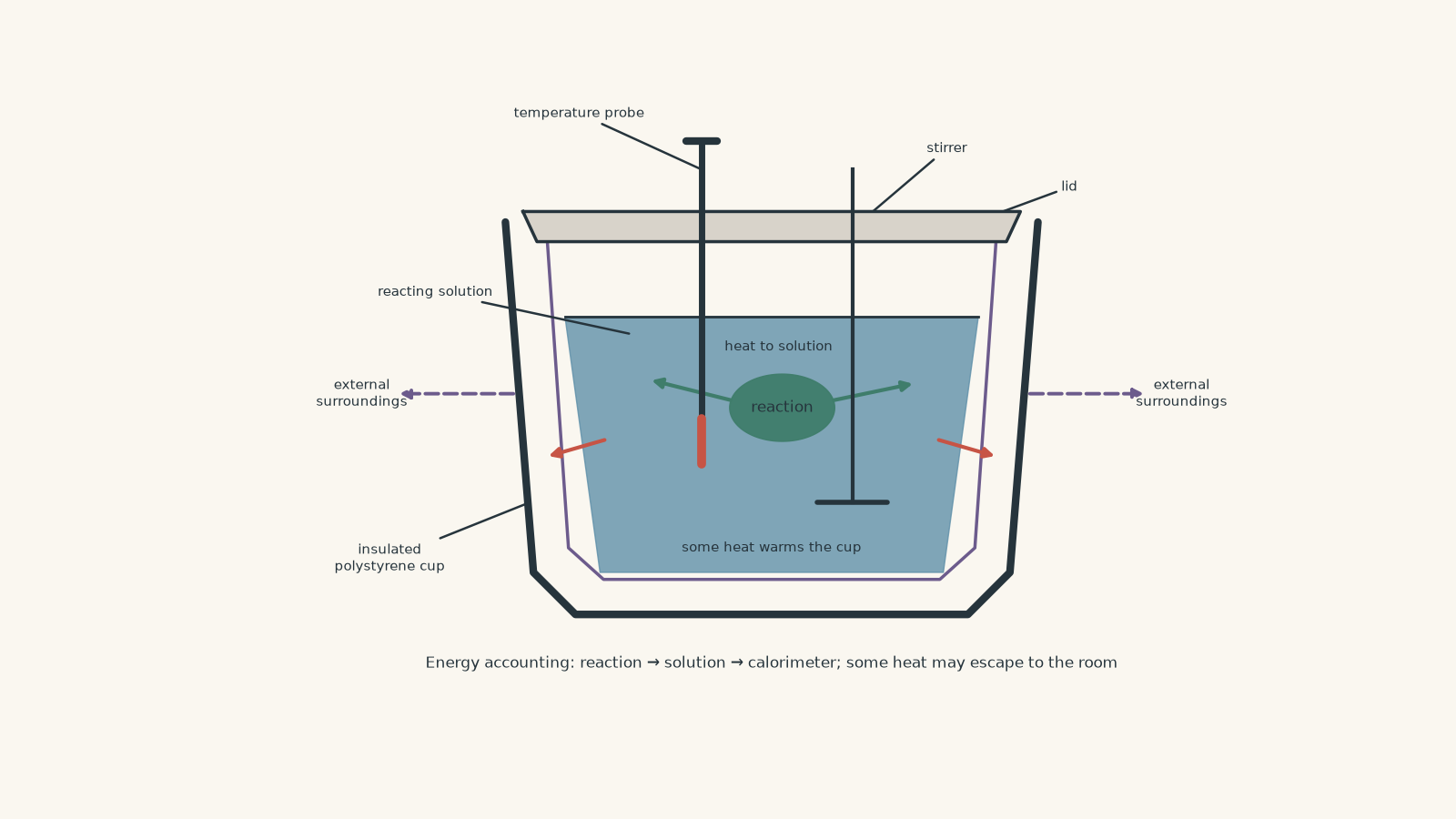
Suppose an acid and base react inside it. What should you see if the reaction is exothermic?
The solution should warm. Energy leaves the reacting chemicals and enters the surrounding solution.
Chemists separate those two parts mentally:
- the reacting chemicals are the system
- the solution, calorimeter, and external environment are the surroundings
In a deliberately simplified calorimeter, we first pretend that all the heat released by the reaction goes into the solution:
\[
q_{\text{reaction}} + q_{\text{solution}} \approx 0
\]
so
\[
q_{\text{reaction}} \approx -q_{\text{solution}}
\]
and therefore
\[
q_{\text{reaction}} \approx -mc\Delta T
\]
If the solution gets hotter, \(q_{\text{solution}}>0\), so \(q_{\text{reaction}}<0\). The reaction is exothermic.
If the solution gets colder, \(q_{\text{solution}}<0\), so \(q_{\text{reaction}}>0\). The reaction is endothermic.
If that sign convention still feels backwards, the useful question is always: “Whose \(q\) am I calculating?” The solution and the reaction have opposite signs because energy leaving one enters the other. You can refresh the underlying ideas in Endothermic and Exothermic Reactions for HSC Chemistry.
At approximately constant atmospheric pressure, the heat transferred by the reaction can be related to its enthalpy change. Once the reaction heat is known, a molar enthalpy can be found using
\[
\Delta H = \frac{q_{\text{reaction}}}{n}
\]
where \(n\) is the number of moles corresponding to the reaction amount being reported.
Be careful here. For a neutralisation, you might report \(\Delta H\) per mole of water formed. For another reaction, the question may ask for the enthalpy per mole of limiting reactant. The units \(\text{kJ mol}^{-1}\) are meaningless unless you know what the “per mole” refers to.
Worked example: enthalpy of neutralisation
\(50.0\text{ mL}\) of \(1.00\text{ mol L}^{-1}\) \(\ce{HCl(aq)}\) is mixed with \(50.0\text{ mL}\) of \(1.00\text{ mol L}^{-1}\) \(\ce{NaOH(aq)}\). Both solutions begin at \(23.5^\circ\text{C}\), and the maximum temperature is \(30.2^\circ\text{C}\). Assume the combined solution has a density of \(1.00\text{ g mL}^{-1}\), a specific heat capacity of \(4.18\text{ J g}^{-1}\text{K}^{-1}\), and that the calorimeter itself absorbs negligible heat. Calculate the molar enthalpy of neutralisation per mole of water formed.
The reaction is
\[
\ce{HCl(aq) + NaOH(aq) -> NaCl(aq) + H2O(l)}
\]
Step 1
The total volume is
\[
50.0 + 50.0 = 100.0\text{ mL}
\]
Using the assumed density of \(1.00\text{ g mL}^{-1}\),
\[
m = 100.0\text{ g}
\]
Step 2
\[
\Delta T = 30.2-23.5 = 6.7\text{ K}
\]
Step 3
\[
q_{\text{solution}}
=mc\Delta T
=(100.0)(4.18)(6.7)
=2.80\times10^3\text{ J}
=2.80\text{ kJ}
\]
The solution gained \(2.80\text{ kJ}\), so the reaction released approximately the same amount:
\[
q_{\text{reaction}}=-2.80\text{ kJ}
\]
Step 4
For either reactant,
\[
n=cV=(1.00)(0.0500)=0.0500\text{ mol}
\]
The reactants are present in the required \(1:1\) ratio, so \(0.0500\text{ mol}\) of water forms.
Step 5
\[
\Delta H
=\frac{-2.80}{0.0500}
=-56.0\text{ kJ mol}^{-1}
\]
The negative sign tells us that the neutralisation is exothermic. The numerical value means that, under this experimental model, about \(56.0\text{ kJ}\) is released for each mole of water formed.
03The first model is useful, but it is not exact
There is an obvious problem with our first energy balance. The solution is not the only thing that changes temperature.
The cup warms. The lid warms. The thermometer warms. Some energy leaks into the room.
Imagine splitting a restaurant bill with someone who quietly ordered three desserts. If you calculate your share using only the two main meals, the arithmetic can be flawless and the answer can still be wrong because you left part of the bill out.
That is what happens when we use only \(mc\Delta T\) for the solution. The equation itself is fine. Our boundary around the surroundings was incomplete.
A better model includes the heat absorbed or released by the calorimeter:
\[
q_{\text{reaction}}
=-(q_{\text{solution}}+q_{\text{calorimeter}})
\]
The heat capacity of the calorimeter is often written \(C_{\text{cal}}\), with units of \(\text{J K}^{-1}\):
\[
q_{\text{calorimeter}}=C_{\text{cal}}\Delta T
\]
Notice the difference between \(c\) and \(C\).
Specific heat capacity \(c\) describes energy required per gram per kelvin. Heat capacity \(C\) describes the whole object or assembly.
For a simple object of fixed mass,
\[
C=mc
\]
but a calorimeter can contain several materials, so experimentally determining a single \(C_{\text{cal}}\) can be much easier than finding the mass and specific heat capacity of every part.
Worked example: an endothermic dissolution with calorimeter heat capacity
\(5.35\text{ g}\) of \(\ce{NH4Cl(s)}\) is dissolved in \(100.0\text{ g}\) of water. The temperature falls from \(24.8^\circ\text{C}\) to \(21.7^\circ\text{C}\). Assume the final solution has a specific heat capacity of \(4.18\text{ J g}^{-1}\text{K}^{-1}\). The calorimeter has a heat capacity of \(40.0\text{ J K}^{-1}\). Calculate the molar enthalpy of dissolution. The molar mass of \(\ce{NH4Cl}\) is \(53.49\text{ g mol}^{-1}\).
Step 1
The solution contains the water and dissolved solute:
\[
m=100.0+5.35=105.35\text{ g}
\]
and
\[
\Delta T=21.7-24.8=-3.1\text{ K}
\]
Step 2
\[
q_{\text{solution}}
=(105.35)(4.18)(-3.1)
=-1.365\times10^3\text{ J}
\]
The negative sign means the solution lost thermal energy.
Step 3
\[
q_{\text{calorimeter}}
=(40.0)(-3.1)
=-124\text{ J}
\]
The calorimeter also cooled, so it also lost energy.
Step 4
\[
\begin{aligned}
q_{\text{reaction}}
&=-(q_{\text{solution}}+q_{\text{calorimeter}})\\
&=-(-1365-124)\\
&=+1489\text{ J}\\
&=+1.489\text{ kJ}
\end{aligned}
\]
The positive sign is important. The dissolution absorbed energy from its surroundings.
Step 5
\[
n=\frac{5.35}{53.49}=0.1000\text{ mol}
\]
Step 6
\[
\Delta H
=\frac{1.489}{0.1000}
=+14.9\text{ kJ mol}^{-1}
\]
The dissolution is endothermic. Ignoring the cooling of the calorimeter would have made the measured magnitude too small.
04What if the reactants start at different temperatures?
A common shortcut is to add all the masses together and use one \(\Delta T\).
That only works when the materials can reasonably be treated as starting at the same temperature.
Suppose one solution begins at \(20^\circ\text{C}\) and another at \(30^\circ\text{C}\). There is no single initial temperature for the combined solution. Even without a chemical reaction, the warmer solution would cool and the colder solution would warm when they were mixed.
The correct idea is to calculate the heat change of each part separately:
\[
q_{\text{surroundings}}
=\sum_i m_i c_i(T_{\text{final}}-T_{i,\text{initial}})
\]
and add any calorimeter term as well.
Worked example: separating thermal mixing from reaction heat
A calorimeter contains \(40.0\text{ g}\) of hydrochloric acid solution at \(20.0^\circ\text{C}\). It contains \(0.0300\text{ mol}\) of \(\ce{HCl}\). Then \(60.0\text{ g}\) of sodium hydroxide solution at \(30.0^\circ\text{C}\), containing \(0.0500\text{ mol}\) of \(\ce{NaOH}\), is added. The calorimeter itself begins at \(25.0^\circ\text{C}\) and has \(C_{\text{cal}}=60.0\text{ J K}^{-1}\). The final temperature is \(29.4^\circ\text{C}\). Assume both solutions have \(c=4.18\text{ J g}^{-1}\text{K}^{-1}\). Calculate the molar enthalpy of neutralisation per mole of water formed.
Step 1
The reaction requires \(\ce{HCl}\) and \(\ce{NaOH}\) in a \(1:1\) ratio.
There are \(0.0300\text{ mol}\) of \(\ce{HCl}\) and \(0.0500\text{ mol}\) of \(\ce{NaOH}\), so \(\ce{HCl}\) is limiting. Therefore,
\[
n(\ce{H2O})=0.0300\text{ mol}
\]
Step 2
\[
q_{\ce{HCl\ solution}}
=(40.0)(4.18)(29.4-20.0)
=+1572\text{ J}
\]
It warms substantially.
Step 3
\[
q_{\ce{NaOH\ solution}}
=(60.0)(4.18)(29.4-30.0)
=-150\text{ J}
\]
This solution actually cools slightly.
Step 4
\[
q_{\text{cal}}
=(60.0)(29.4-25.0)
=+264\text{ J}
\]
Step 5
\[
\begin{aligned}
q_{\text{surroundings}}
&=1572-150+264\\
&=1685\text{ J}
\end{aligned}
\]
Therefore,
\[
q_{\text{reaction}}=-1685\text{ J}=-1.685\text{ kJ}
\]
Step 6
\[
\Delta H
=\frac{-1.685}{0.0300}
=-56.2\text{ kJ mol}^{-1}
\]
The tempting shortcut is to search for one overall \(\Delta T\). There isn’t one. Each part of the surroundings began at a different temperature, so each needs its own energy calculation.
05Why the experiment gets redesigned
Imagine the crudest possible calorimetry experiment: react two solutions in an uncovered glass beaker and watch a thermometer.
For an exothermic reaction, your prediction is straightforward. The thermometer should rise.
It does. So the basic idea works.
But now ask a harder experimental question: does the measured temperature rise account for all the energy released?
Almost certainly not. A glass beaker conducts heat into the bench and surrounding air. Warm air above the liquid carries energy away. Evaporation removes energy. The thermometer itself takes time to respond.
The observation therefore supports the claim that the reaction is exothermic, but the apparatus is weak if you want an accurate numerical \(\Delta H\).
The revised design tackles those losses one at a time:
- use polystyrene rather than an exposed glass beaker to reduce conduction
- use a lid to reduce convection and evaporation
- stir so the measured temperature better represents the whole solution
- use a fast temperature probe
- determine the calorimeter’s heat capacity instead of pretending it is zero
- collect temperature against time rather than relying on one reading
None of these makes the calorimeter perfectly isolated. They make the model closer to the real energy transfers.
Correcting for heat loss using temperature against time
For an exothermic reaction, the real maximum temperature may occur before the thermometer records its highest value. Meanwhile, the hot mixture is already losing energy to the room.
A better experiment records temperature for some time after mixing. Once the reaction is effectively complete, the cooling trend can sometimes be extrapolated backwards to estimate what the temperature would have been at the mixing time without that heat loss.
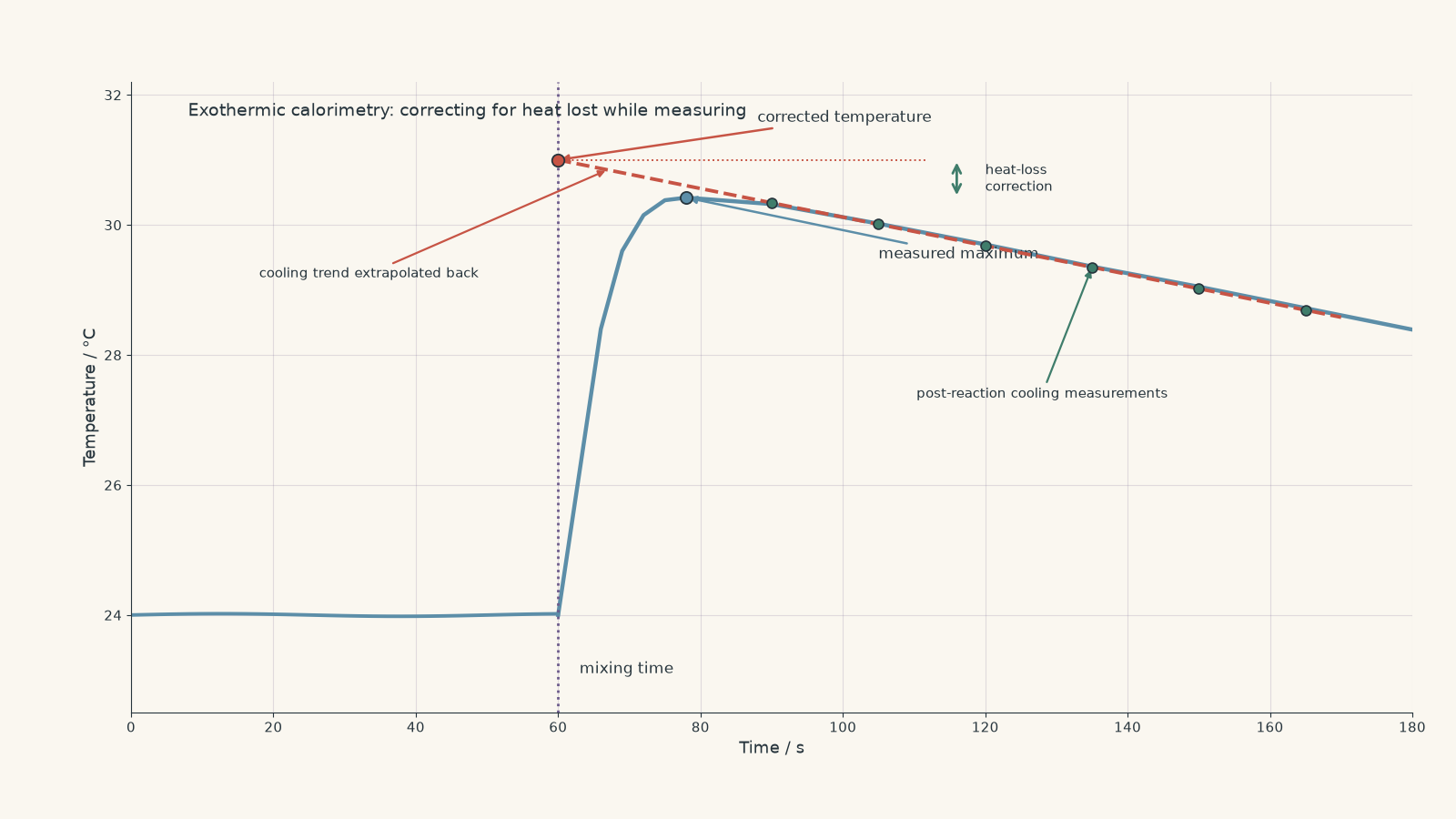
This correction rests on an assumption: the post-reaction cooling trend is a reasonable model of the heat-loss behaviour over the short interval being corrected.
That assumption is not exact. Heat loss does not have to remain perfectly linear over long periods. The method is useful because the extrapolation is kept over a short time interval.
06Why combustion needs a different design
Suppose you burn a fuel underneath a beaker of water and use \(q=mc\Delta T\) for the water.
What should happen? The water warms.
Does that prove all the combustion energy entered the water? No. A large amount can heat the surrounding air, the burner, the container, and the hot combustion gases. Some fuel may also burn incompletely.
The geometry is the problem. Much of the released energy has an easy escape route that never passes through the measured water.
A bomb calorimeter changes the design.
The fuel sits inside a strong sealed metal vessel, traditionally called the bomb, with oxygen. An electrical ignition system starts the reaction. The metal vessel is surrounded by a known quantity of water or another calibrated thermal assembly. The water is stirred, and its temperature change is measured.
Energy therefore travels from the combustion reaction into the bomb, then into the surrounding calorimeter and water.
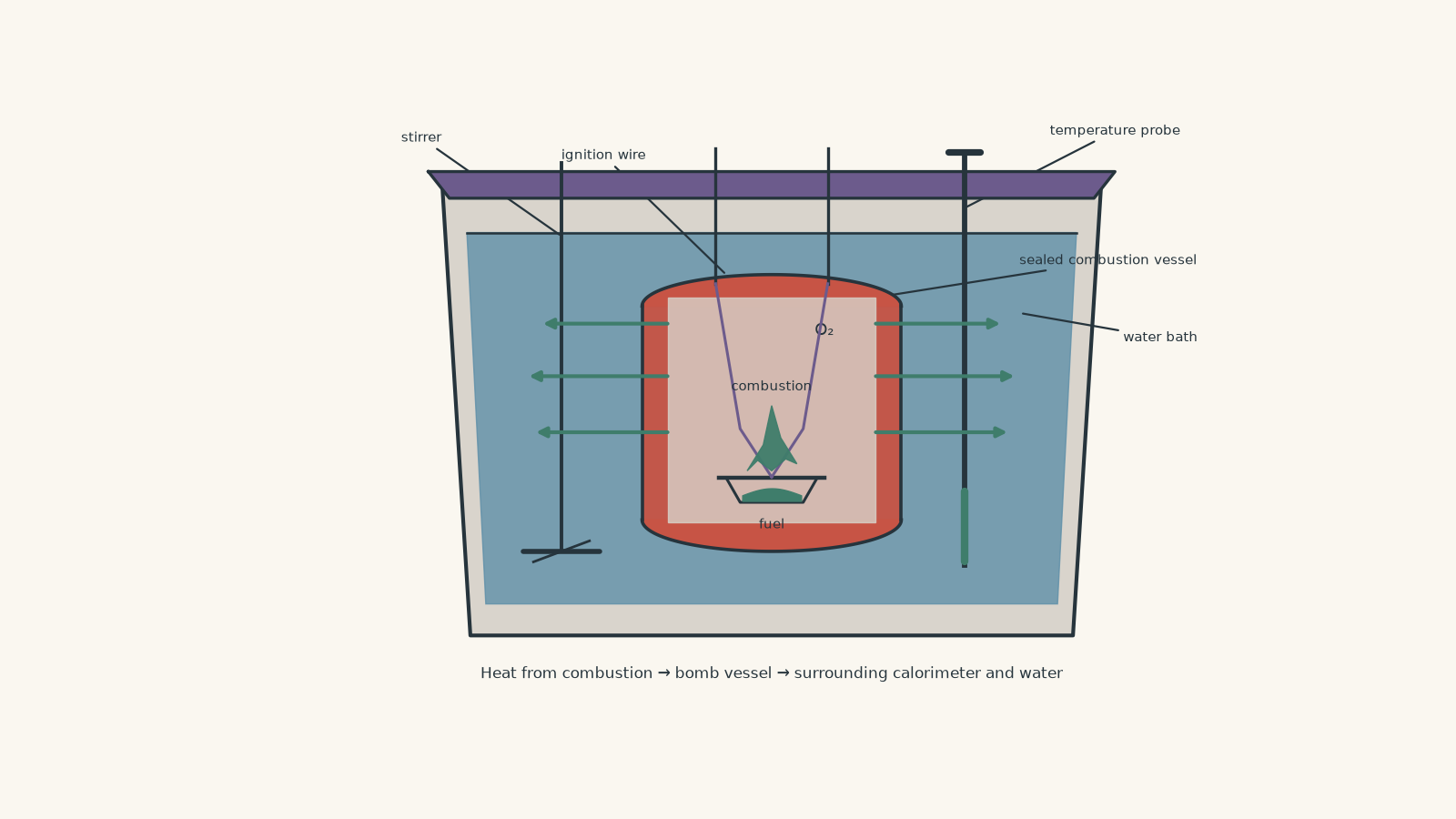
The prediction is again simple: an exothermic combustion should cause a temperature rise.
The improved design captures much more of the released energy and can be calibrated as a complete device.
There is one precision point worth knowing. A rigid bomb calorimeter operates at essentially constant volume, so its directly measured reaction heat corresponds to \(q_v\), which is related to the change in internal energy, \(\Delta U\). A coffee-cup calorimeter operates approximately at constant pressure, where \(q_p\) is associated with \(\Delta H\).
In many school calculations, the question supplies the model it wants you to use. Do not automatically label every calorimeter heat measurement as \(\Delta H\) without checking the experimental conditions and the assumptions given.
07Comparing experimental enthalpy changes properly
A bigger temperature rise does not automatically mean a reaction has a larger molar enthalpy change.
Suppose Reaction A raises \(50\text{ g}\) of solution by \(8^\circ\text{C}\), while Reaction B raises \(200\text{ g}\) by \(3^\circ\text{C}\). Reaction B produced the smaller \(\Delta T\), but it heated four times as much material.
Then there is the amount reacted. Releasing \(4\text{ kJ}\) from \(0.020\text{ mol}\) is not the same molar enthalpy as releasing \(4\text{ kJ}\) from \(0.100\text{ mol}\).
A sensible comparison therefore follows this order:
- account for all important heat capacities
- determine the reaction heat
- determine the amount that actually reacted
- convert to \(\text{kJ mol}^{-1}\)
- only then compare reactions or trials
What common experimental errors actually do
It is more useful to predict the direction of an error than merely write “heat loss”.
| Experimental problem | What changes | Likely effect on calculated \(|\Delta H|\) | Better design or analysis |
|---|---|---|---|
| Exothermic mixture loses heat to a cooler room | measured temperature rise is too small | too small | better insulation, lid, temperature-time correction |
| Endothermic mixture gains heat from a warmer room | measured temperature fall is too small | too small | better insulation, lid, temperature-time correction |
| Calorimeter heat capacity is ignored | part of the energy transfer is omitted | usually too small | determine and include \(C_{\text{cal}}\) |
| Reactants start at different temperatures | ordinary thermal mixing is confused with reaction heat | can be too high, too low, or even give the wrong interpretation | use a separate \(m c\Delta T\) term for each initial temperature |
| Reaction is incomplete | less reaction occurs than assumed | usually too small per nominal mole | ensure adequate mixing and identify how much actually reacted |
| Water values for \(c\) or density are poor approximations | calculated heat is systematically shifted | could be high or low | use supplied experimental values or calibration data |
| Temperature probe responds slowly | true maximum or minimum can be missed | usually too small | faster probe and temperature-time analysis |
| Solution is spilled or evaporates | both matter and energy leave the measured system | direction may be difficult to predict | lid, careful transfer, repeat trials |
A result can also be precise without being accurate. Five trials might give almost identical values because the procedure is very repeatable, while every trial underestimates \(|\Delta H|\) because the same amount of heat is consistently lost to the surroundings.
If an accepted value is supplied, percentage error is commonly calculated using
\[
\text{percentage error}
=
\frac{|\text{experimental value}-\text{accepted value}|}
{|\text{accepted value}|}
\times100\%
\]
The absolute values matter because an enthalpy might be negative. You are comparing the size of the discrepancy, not asking whether the experimental value is “more negative”.
08Questions and solutions
Question 1
A reaction occurs in \(75.0\text{ g}\) of aqueous solution. The temperature rises from \(22.4^\circ\text{C}\) to \(28.1^\circ\text{C}\). Assume \(c=4.18\text{ J g}^{-1}\text{K}^{-1}\), neglect the calorimeter’s heat capacity, and suppose \(0.0250\text{ mol}\) of limiting reactant reacts.
Calculate:
a. the heat gained by the solution
b. the heat released by the reaction
c. the molar enthalpy change per mole of limiting reactant
Solution 1
The reaction releases \(1.79\text{ kJ}\), giving a molar enthalpy change of \(-71.5\text{ kJ mol}^{-1}\).
The temperature change is
\[
\Delta T=28.1-22.4=5.7\text{ K}
\]
For the solution,
\[
\begin{aligned}
q_{\text{solution}}
&=mc\Delta T\\
&=(75.0)(4.18)(5.7)\\
&=1787\text{ J}\\
&=+1.79\text{ kJ}
\end{aligned}
\]
So the reaction has the opposite heat change:
\[
q_{\text{reaction}}=-1.79\text{ kJ}
\]
Then
\[
\Delta H
=\frac{-1.79}{0.0250}
=-71.5\text{ kJ mol}^{-1}
\]
The tempting mistake is to make both \(q_{\text{solution}}\) and \(q_{\text{reaction}}\) positive because the temperature increased. The temperature increase belongs to the solution. The reaction supplied that energy, so its \(q\) is negative.
Question 2
The same exothermic reaction is investigated twice in the same calorimeter. Assume both solutions have \(c=4.18\text{ J g}^{-1}\text{K}^{-1}\), and the calorimeter has \(C_{\text{cal}}=45.0\text{ J K}^{-1}\). Heat exchange with the external environment is negligible.
In Trial A, \(0.0500\text{ mol}\) reacts in \(100.0\text{ g}\) of solution and the temperature rises by \(6.20\text{ K}\).
In Trial B, \(0.0250\text{ mol}\) reacts in \(50.0\text{ g}\) of solution and the temperature rises by \(5.70\text{ K}\).
A student ignores the calorimeter heat capacity and concludes that the reaction has a different molar enthalpy in each trial.
Calculate the uncorrected and corrected molar enthalpy for both trials, and explain why the correction affects Trial B more strongly.
Solution 2
After including the calorimeter, the two trials give similar values: Trial A gives \(-57.4\text{ kJ mol}^{-1}\), and Trial B gives \(-57.9\text{ kJ mol}^{-1}\). Ignoring the calorimeter produces \(-51.8\text{ kJ mol}^{-1}\) and \(-47.7\text{ kJ mol}^{-1}\), respectively.
For Trial A, if the cup is ignored:
\[
\begin{aligned}
q_{\text{solution,A}}
&=(100.0)(4.18)(6.20)\\
&=2592\text{ J}
\end{aligned}
\]
so
\[
\Delta H_{\text{uncorrected,A}}
=
\frac{-2.592}{0.0500}
=-51.8\text{ kJ mol}^{-1}
\]
The calorimeter also absorbs
\[
q_{\text{cal,A}}=(45.0)(6.20)=279\text{ J}
\]
Therefore,
\[
\begin{aligned}
q_{\text{reaction,A}}
&=-(2592+279)\\
&=-2871\text{ J}
\end{aligned}
\]
and
\[
\Delta H_{\text{corrected,A}}
=
\frac{-2.871}{0.0500}
=-57.4\text{ kJ mol}^{-1}
\]
For Trial B,
\[
q_{\text{solution,B}}
=(50.0)(4.18)(5.70)
=1191\text{ J}
\]
so the uncorrected result is
\[
\Delta H_{\text{uncorrected,B}}
=
\frac{-1.191}{0.0250}
=-47.7\text{ kJ mol}^{-1}
\]
The calorimeter absorbs
\[
q_{\text{cal,B}}
=(45.0)(5.70)
=257\text{ J}
\]
giving
\[
q_{\text{reaction,B}}
=-(1191+257)
=-1448\text{ J}
\]
and
\[
\Delta H_{\text{corrected,B}}
=
\frac{-1.448}{0.0250}
=-57.9\text{ kJ mol}^{-1}
\]
The tempting argument is that halving the amount reacting should simply halve every energy term. It halves the reaction energy, but it does not halve the physical calorimeter.
The same cup, lid, and probe are still present. Their heat capacity is therefore a much larger fraction of the total thermal load in the smaller-scale trial. Ignoring the cup produces a larger percentage error in Trial B.
The small remaining difference between the corrected results would normally be treated as experimental variation or evidence that one of our assumptions is imperfect.
Question 3
A neutralisation experiment begins at \(23.0^\circ\text{C}\). The solutions are mixed at \(t=60\text{ s}\). After the reaction is complete, the following temperatures are recorded:
| Time / s | Temperature / \(^{\circ}\text{C}\) |
|---|---|
| 90 | 28.7 |
| 120 | 28.3 |
| 150 | 27.9 |
Assume the post-reaction cooling is linear over this interval and that extrapolating this trend back to the mixing time gives the corrected reaction temperature.
The total solution mass is \(100.0\text{ g}\), \(c=4.18\text{ J g}^{-1}\text{K}^{-1}\), the calorimeter heat capacity is \(50.0\text{ J K}^{-1}\), and \(0.0500\text{ mol}\) of water forms.
Determine the corrected molar enthalpy of neutralisation and explain why using \(28.7^\circ\text{C}\) as the maximum temperature gives a systematically different result.
Solution 3
The corrected temperature at the mixing time is \(29.1^\circ\text{C}\), giving \(\Delta H=-57.1\text{ kJ mol}^{-1}\).
The recorded temperature decreases by \(0.4^\circ\text{C}\) every \(30\text{ s}\):
\[
28.7\rightarrow28.3\rightarrow27.9
\]
Extrapolating one \(30\text{ s}\) interval backwards from \(t=90\text{ s}\) to \(t=60\text{ s}\),
\[
T_{\text{corrected}}
=28.7+0.4
=29.1^\circ\text{C}
\]
Therefore,
\[
\Delta T=29.1-23.0=6.1\text{ K}
\]
The solution heat capacity is
\[
mc=(100.0)(4.18)=418\text{ J K}^{-1}
\]
Including the calorimeter,
\[
C_{\text{total}}=418+50.0=468\text{ J K}^{-1}
\]
so the surroundings absorb
\[
\begin{aligned}
q_{\text{surroundings}}
&=(468)(6.1)\\
&=2855\text{ J}
\end{aligned}
\]
Hence,
\[
q_{\text{reaction}}=-2.855\text{ kJ}
\]
and
\[
\Delta H
=
\frac{-2.855}{0.0500}
=-57.1\text{ kJ mol}^{-1}
\]
The tempting route is to use \(28.7^\circ\text{C}\) because it is the highest temperature actually written in the table.
But the experiment is already cooling by \(t=90\text{ s}\). The measured maximum has been depressed by heat loss before that reading was taken. For an exothermic reaction, using it gives too small a \(\Delta T\), so the calculated \(|\Delta H|\) is too small.
The extrapolation does not magically eliminate all error. It relies on the stated model that the observed cooling trend can be extended backwards over this short time interval.
Question 4
A reaction is known to have the same molar enthalpy in two trials performed in the same calorimeter, but the calorimeter heat capacity is unknown.
Assume there is no heat exchange with the room and that every solution has \(c=4.18\text{ J g}^{-1}\text{K}^{-1}\).
Trial 1 uses \(80.0\text{ g}\) of solution. \(0.0200\text{ mol}\) reacts, producing a temperature rise of \(2.50\text{ K}\).
Trial 2 uses \(120.0\text{ g}\) of solution. \(0.0400\text{ mol}\) reacts, producing a temperature rise of \(4.00\text{ K}\).
Use the two experiments together to determine:
a. the heat capacity of the calorimeter
b. the molar enthalpy of the reaction
Solution 4
The calorimeter heat capacity is \(334.4\text{ J K}^{-1}\), and the reaction enthalpy is \(-83.6\text{ kJ mol}^{-1}\).
Let the magnitude of the molar energy released be \(H\), in \(\text{J mol}^{-1}\), and let the unknown calorimeter heat capacity be \(C_{\text{cal}}\).
Because the reaction is exothermic,
\[
q_{\text{reaction}}=-nH
\]
while the surroundings gain the same magnitude of energy.
For Trial 1,
\[
0.0200H
=
\left[(80.0)(4.18)+C_{\text{cal}}\right](2.50)
\]
so
\[
0.0200H=836+2.50C_{\text{cal}}
\]
For Trial 2,
\[
0.0400H
=
\left[(120.0)(4.18)+C_{\text{cal}}\right](4.00)
\]
so
\[
0.0400H=2006.4+4.00C_{\text{cal}}
\]
Double the first equation:
\[
0.0400H=1672+5.00C_{\text{cal}}
\]
Both right-hand sides now equal \(0.0400H\), so
\[
1672+5.00C_{\text{cal}}
=
2006.4+4.00C_{\text{cal}}
\]
Therefore,
\[
C_{\text{cal}}=334.4\text{ J K}^{-1}
\]
Substitute this into Trial 1:
\[
\begin{aligned}
0.0200H
&=\left[334.4+334.4\right](2.50)\\
&=1672\text{ J}
\end{aligned}
\]
Thus,
\[
H=\frac{1672}{0.0200}
=83\,600\text{ J mol}^{-1}
=83.6\text{ kJ mol}^{-1}
\]
Because the reaction releases this energy,
\[
\Delta H=-83.6\text{ kJ mol}^{-1}
\]
The tempting assumption is that doubling the moles reacted should double \(\Delta T\). It would only do that if the total heat capacity being heated also remained unchanged.
Here the amount of solution changes as well, while the calorimeter contributes the same fixed heat capacity to both trials. The two trials therefore contain enough information to separate the fixed calorimeter contribution from the reaction enthalpy.
Question 5
A student calibrates a calorimeter while it contains \(100.0\text{ g}\) of water. An electrical heater transfers exactly \(1.200\text{ kJ}\) to the calorimeter-and-water assembly, causing its temperature to rise by \(2.40\text{ K}\).
Later, the same calorimeter is used for an exothermic reaction, but this time it contains \(120.0\text{ g}\) of solution. Assume both water and the reaction solution have \(c=4.18\text{ J g}^{-1}\text{K}^{-1}\).
During the reaction, \(0.0200\text{ mol}\) reacts and the temperature rises by \(3.00\text{ K}\).
Student A says the calibration showed that \(C=500\text{ J K}^{-1}\), so they use \(q=(500)(3.00)\).
Student B says \(500\text{ J K}^{-1}\) is the calorimeter heat capacity, so they add it to the \(mc\) value for the \(120.0\text{ g}\) solution.
Determine the correct molar enthalpy and explain precisely why both students’ interpretations of the calibration are wrong.
Solution 5
The correct molar enthalpy is \(-87.5\text{ kJ mol}^{-1}\). The crucial point is that the measured \(500\text{ J K}^{-1}\) belongs to the original calorimeter-plus-\(100.0\text{ g water}\) assembly, not to the empty calorimeter by itself.
From the calibration,
\[
C_{\text{calibration assembly}}
=
\frac{q}{\Delta T}
=
\frac{1200}{2.40}
=
500\text{ J K}^{-1}
\]
But \(100.0\text{ g}\) of that assembly was water. The water contributes
\[
C_{\text{water}}
=mc
=(100.0)(4.18)
=418\text{ J K}^{-1}
\]
Therefore, the calorimeter itself contributes
\[
C_{\text{cal}}
=500-418
=82.0\text{ J K}^{-1}
\]
Now move to the reaction trial.
The \(120.0\text{ g}\) solution contributes
\[
C_{\text{solution}}
=(120.0)(4.18)
=501.6\text{ J K}^{-1}
\]
So the total relevant heat capacity is
\[
C_{\text{total}}
=501.6+82.0
=583.6\text{ J K}^{-1}
\]
The surroundings gain
\[
\begin{aligned}
q_{\text{surroundings}}
&=(583.6)(3.00)\\
&=1750.8\text{ J}\\
&=1.7508\text{ kJ}
\end{aligned}
\]
The reaction therefore releases
\[
q_{\text{reaction}}=-1.7508\text{ kJ}
\]
and
\[
\Delta H
=
\frac{-1.7508}{0.0200}
=-87.5\text{ kJ mol}^{-1}
\]
Student A’s calculation treats the \(500\text{ J K}^{-1}\) calibration constant as though nothing about the calibrated assembly changed. But the reaction trial contains \(120.0\text{ g}\) of solution instead of \(100.0\text{ g}\) of water. Its total heat capacity is different.
Student B makes the opposite mistake. The \(500\text{ J K}^{-1}\) value already includes the \(100.0\text{ g}\) of water used during calibration. Adding \(500\text{ J K}^{-1}\) to the full heat capacity of the reaction solution would count that original water contribution twice.
The subtle point is that a calibration constant only means something when you know exactly what was included during the calibration. A number labelled “calorimeter constant” in one experiment might describe the hardware alone, or it might describe an entire calorimeter-and-contents assembly. You have to read the experimental definition, not just the units.
09Where calorimetry leads next
Calorimetry gives you one experimental route to \(\Delta H\): measure an energy transfer, account for where that energy went, then express the result per mole of reaction.
The next useful step is Hess’s law. Because enthalpy is a state function, the overall \(\Delta H\) depends on the initial and final states, not on the particular reaction pathway. That means calorimetry can measure enthalpy changes for reactions you can perform safely and cleanly, while Hess’s law can combine those measurements to infer the enthalpy of a reaction that would be difficult to measure directly.
That is also why experimental evaluation matters. If one calorimetry value is systematically too small because energy was missed, that error does not disappear when the value is later used inside a Hess’s law calculation.