
Projectile Motion from a Launch Height: HSC Physics Guide
Learn how to model projectiles that land above or below their launch level. Use vertical displacement, flight time, and quadratic roots correctly in HSC Physics problems.
A ball is launched at \(20\text{ m s}^{-1}\) at the same angle in two trials. In the first trial, it lands at the same height it was launched from. In the second, it lands on ground \(15\text{ m}\) lower.
Would you expect the same horizontal range because the launch velocity is unchanged? Predict before reading on.
The second ball travels further. Its horizontal motion has not become faster. It simply has more time to travel horizontally because it must fall further before reaching its landing level.
Now reverse the situation. Suppose the landing platform is above the launch point. The projectile may reach that height twice, once while rising and once while falling. Or it may never reach it at all.
That height difference is the part of projectile motion we need to handle carefully.
01The equation cares about displacement, not “height”
The cleanest approach is usually to put the launch point at \(y=0\).
Then describe the landing point using its vertical displacement,
\[
\Delta y=y_f-y_i
\]
where \(y_i\) is the initial vertical position and \(y_f\) is the final vertical position.
If the launch point is our origin, \(y_i=0\), so \(\Delta y\) is just the landing position relative to the launch.
| Landing position | Vertical displacement |
|---|---|
| \(12\text{ m}\) below launch | \(\Delta y=-12\text{ m}\) |
| Same level as launch | \(\Delta y=0\) |
| \(6\text{ m}\) above launch | \(\Delta y=+6\text{ m}\) |
That minus sign in the first row is not optional. It records that the projectile finishes below where it started.
A common error is to see “a \(12\text{ m}\) cliff” and automatically substitute \(+12\text{ m}\). The number \(12\text{ m}\) is a distance. The vertical displacement is \(-12\text{ m}\) if upward has been chosen as positive.
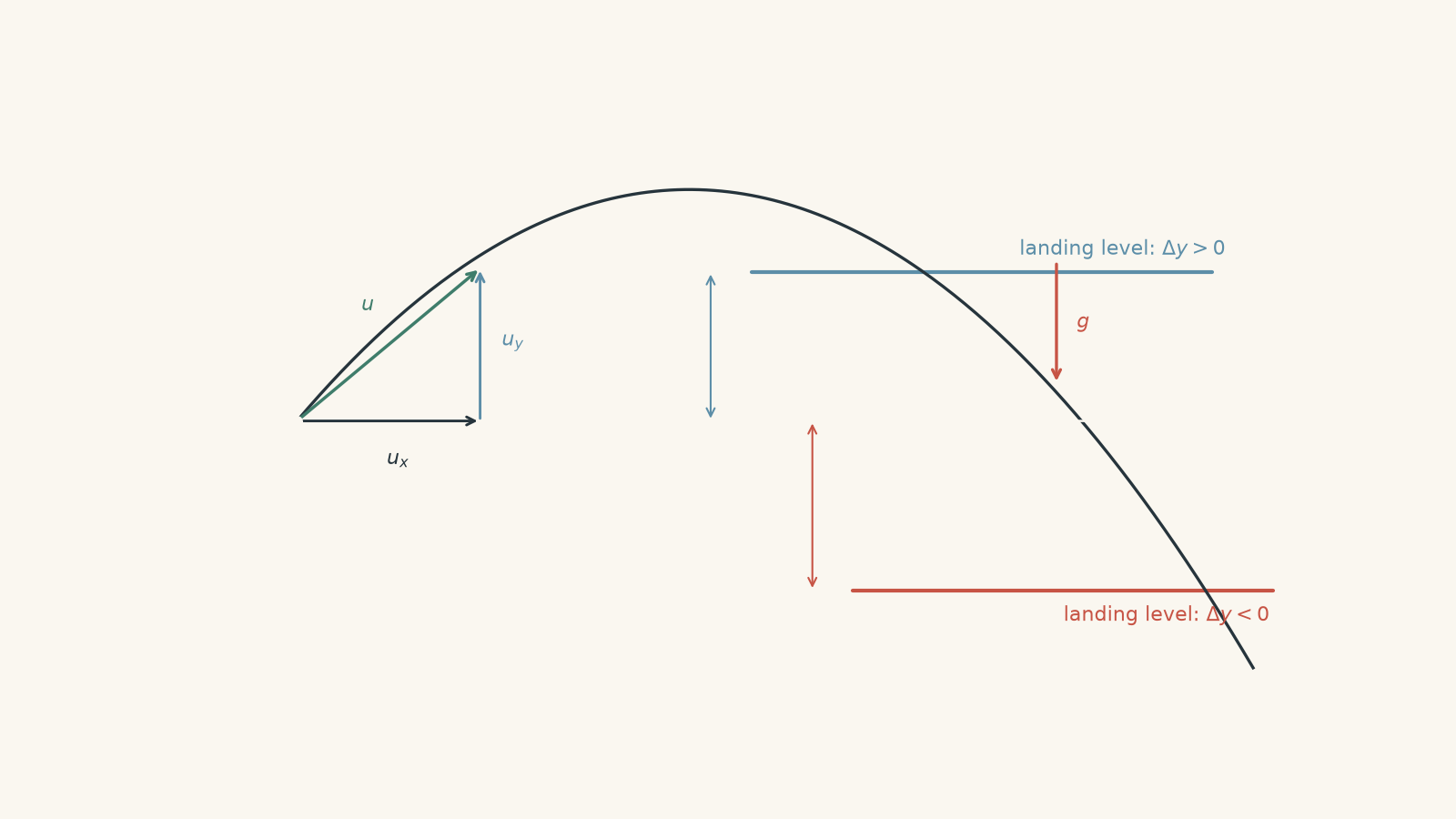
02Keep the horizontal and vertical motion separate
Picture projectile motion as two videos playing with the same timestamp.
One video shows horizontal motion. The other shows vertical motion. They do different things, but both must be at the same time \(t\).
It is a little like two people doing separate parts of a group assignment but sharing one deadline. Horizontal motion cannot quietly take \(2.0\text{ s}\) while vertical motion takes \(3.0\text{ s}\). There is only one projectile, so there is only one elapsed time.
Under the standard HSC projectile model:
\[
a_x=0
\]
and
\[
a_y=-g
\]
where \(a_x\) and \(a_y\) are the horizontal and vertical accelerations, and \(g=9.8\text{ m s}^{-2}\) is the magnitude of gravitational acceleration near Earth’s surface.
This model assumes air resistance is negligible. With significant air resistance, the horizontal and vertical motions are no longer this neatly independent because the drag force depends on the projectile’s velocity.
Refresh: resolving the launch velocity
If the projectile is launched with speed \(u\) at angle \(\theta\) above the horizontal,
\[
u_x=u\cos\theta
\]
and
\[
u_y=u\sin\theta
\]
where \(u_x\) is the initial horizontal velocity and \(u_y\) is the initial vertical velocity.
If this step is still taking too much brainpower, refresh projectile initial velocity components before pushing on. Everything here becomes easier once those components feel routine.
The horizontal position after time \(t\) is
\[
\Delta x=u_x t
\]
because the horizontal acceleration is zero.
Vertically,
\[
\Delta y=u_y t-\frac{1}{2}gt^2
\]
because the vertical acceleration is \(-g\).
The important point is that an uneven landing changes \(\Delta y\). That changes the time, and the changed time then changes the horizontal distance.
03Finding the flight time when the landing height is different
Start from
\[
\Delta y=u_y t-\frac{1}{2}gt^2
\]
and rearrange:
\[
\frac{1}{2}gt^2-u_y t+\Delta y=0
\]
This is a quadratic equation in \(t\). Using the quadratic formula gives
\[
t=\frac{u_y\pm\sqrt{u_y^2-2g\Delta y}}{g}
\]
This particular form assumes upward is positive and therefore \(a_y=-g\). It is safer to understand where the equation came from than to memorise the signs blindly.
The expression under the square root,
\[
u_y^2-2g\Delta y
\]
also tells us something physically useful.
Landing below the launch point
If \(\Delta y<0\), then
\[
-2g\Delta y>0
\]
so the square-root term is larger than \(|u_y|\).
That produces one positive time and one negative time when \(t=0\) is the launch instant. The positive value describes the future impact. The negative value belongs to the mathematical extension of the parabola before the projectile was launched, so we reject it.
A lower landing level therefore gives the projectile extra flight time.
Landing at the same level
If \(\Delta y=0\),
\[
t=\frac{u_y\pm u_y}{g}
\]
for an upward launch.
The two solutions are
\[
t=0
\]
and
\[
t=\frac{2u_y}{g}
\]
The first is the launch itself. The second is the return to the launch height.
Landing above the launch point
This case needs more thought.
Suppose \(\Delta y>0\). Before solving anything, ask: does the projectile rise high enough to reach that level?
At maximum height, the vertical velocity is zero. Using
\[
v_y^2=u_y^2+2a_y\Delta y
\]
with \(v_y=0\) and \(a_y=-g\),
\[
0=u_y^2-2g\Delta y_{\max}
\]
so
\[
\Delta y_{\max}=\frac{u_y^2}{2g}
\]
For an upward launch:
- if the required \(\Delta y\) is greater than \(\Delta y_{\max}\), the projectile never reaches the level;
- if it equals \(\Delta y_{\max}\), the projectile touches that level once, at the top;
- if it is smaller, the projectile normally passes through that height twice: once rising and once falling.
That last case is where blindly choosing one quadratic root causes trouble.
Worked example: Launching from a \(20\text{ m}\) cliff
A projectile is launched from the top of a \(20.0\text{ m}\) cliff at \(15.0\text{ m s}^{-1}\), \(30.0^\circ\) above the horizontal. Ignore air resistance. Find its time of flight and horizontal distance travelled before reaching the ground.
Step 1
\[
\begin{aligned}
u_x&=15.0\cos30.0^\circ\\
&=13.0\text{ m s}^{-1}
\\[4pt]
u_y&=15.0\sin30.0^\circ\\
&=7.50\text{ m s}^{-1}
\end{aligned}
\]
Step 2
Take the launch point as \(y=0\). The ground is \(20.0\text{ m}\) below it, so
\[
\Delta y=-20.0\text{ m}
\]
not \(+20.0\text{ m}\).
Step 3
\[
\begin{aligned}
\Delta y&=u_y t-\frac12gt^2\\
-20.0&=7.50t-4.90t^2\\
4.90t^2-7.50t-20.0&=0
\end{aligned}
\]
Using the quadratic formula,
\[
t=\frac{7.50\pm\sqrt{(-7.50)^2-4(4.90)(-20.0)}}{9.80}
\]
which gives approximately
\[
t=2.93\text{ s}
\]
or
\[
t=-1.40\text{ s}
\]
The negative value is rejected because the clock started when the projectile was launched.
Step 4
\[
\begin{aligned}
\Delta x&=u_x t\\
&=(13.0)(2.93)\\
&=38.0\text{ m}
\end{aligned}
\]
The projectile is therefore airborne for about \(2.93\text{ s}\) and travels \(38.0\text{ m}\) horizontally.
The important idea is not the arithmetic. The lower ground increased the flight time, and the extra flight time increased the range.
04Two positive times can both be mathematically correct
Suppose a projectile is launched from below a raised platform.
A student sees two positive answers for \(t\) and assumes the quadratic has somehow gone wrong.
It hasn’t.
A projectile can pass the same height twice.
Imagine throwing a ball past a second-storey window. It passes the window once on the way up, disappears above it, then passes the same window again on the way down. Same height, different times.
The equation knows when the projectile is at that height. It does not know where the actual platform begins, how wide it is, or whether there is any solid object there.
That geometry must come from the question.
Worked example: Reaching a raised platform level twice
A projectile is launched at \(20.0\text{ m s}^{-1}\), \(50.0^\circ\) above the horizontal. Find the horizontal positions where it is \(6.00\text{ m}\) above its launch point. A small platform is located at that height near \(x=34.3\text{ m}\). Is the projectile rising or falling when it reaches the platform?
Step 1
\[
\begin{aligned}
u_x&=20.0\cos50.0^\circ\\
&=12.86\text{ m s}^{-1}
\\[4pt]
u_y&=20.0\sin50.0^\circ\\
&=15.32\text{ m s}^{-1}
\end{aligned}
\]
Step 2
Its maximum rise is
\[
\begin{aligned}
\Delta y_{\max}
&=\frac{u_y^2}{2g}\\
&=\frac{(15.32)^2}{2(9.8)}\\
&=11.98\text{ m}
\end{aligned}
\]
So \(6.00\text{ m}\) is definitely reachable.
Step 3
\[
6.00=15.32t-4.90t^2
\]
so
\[
4.90t^2-15.32t+6.00=0
\]
and
\[
t=\frac{15.32\pm\sqrt{(15.32)^2-4(4.90)(6.00)}}{9.80}
\]
giving
\[
t_1=0.459\text{ s}
\]
and
\[
t_2=2.67\text{ s}
\]
Both are positive. Both are real events.
Step 4
\[
\begin{aligned}
x_1&=(12.86)(0.459)=5.90\text{ m}\\
x_2&=(12.86)(2.67)=34.3\text{ m}
\end{aligned}
\]
The projectile first crosses the \(6.00\text{ m}\) level at \(x=5.90\text{ m}\) while rising. It reaches the same height again at \(x=34.3\text{ m}\) while falling.
The platform is near the second position, so the relevant time is \(2.67\text{ s}\).
This is an important distinction: solving the vertical equation tells you where the trajectory crosses a height. The physical layout tells you which crossing corresponds to the collision or landing.
05The most tempting mistakes
| Tempting move | Why it fails | Better decision |
|---|---|---|
| Use the launch height as a positive number automatically | Kinematics requires displacement, including direction | Calculate \(\Delta y=y_f-y_i\) |
| Use \(t=\sqrt{2h/g}\) for every cliff problem | That formula assumes \(u_y=0\) | Use \(\Delta y=u_y t-\frac12gt^2\) when there is initial vertical velocity |
| Set \(v_y=0\) at landing | \(v_y=0\) at the highest point, not normally at impact | Use the landing displacement to find \(t\), then calculate \(v_y\) if needed |
| Choose the first positive root automatically | A higher level can be crossed twice | Convert each valid time into a position and check the geometry |
| Reject every negative time without thinking | Negative means “before the chosen \(t=0\)”, not automatically “physically impossible” | First ask what event the question defined as \(t=0\) |
| Use the full launch speed in \(\Delta x=ut\) | Only the horizontal component determines horizontal motion | Use \(\Delta x=u_x t\) |
The fifth row is subtle. In most HSC launch problems, \(t=0\) is explicitly the launch instant, so a negative time is outside the physical motion being modelled. But that rule depends on where the clock starts. Question 5 below pushes on exactly that point.
06A reliable method for uneven landing heights
For a projectile that lands above or below its launch level, work in this order:
- Choose an origin and sign convention. Upward positive is usually easiest.
- Resolve the launch velocity into \(u_x\) and \(u_y\).
- Calculate the actual vertical displacement, \(\Delta y=y_f-y_i\).
- If the landing level is above the launch, check whether that height is reachable.
- Solve the vertical equation for \(t\).
- Interpret every root using the physical situation rather than discarding roots mechanically.
- Use the appropriate time in \(\Delta x=u_x t\).
- If impact velocity is required, calculate \(v_y=u_y-gt\) and combine it with the unchanged \(v_x=u_x\).
This is also the core idea behind projectile time of flight for level and uneven landings: get the vertical motion right first, because the horizontal motion is waiting for the correct time.
07Questions and solutions
Question 1
A ball rolls horizontally from the edge of a \(12.0\text{ m}\) high cliff at \(8.00\text{ m s}^{-1}\). Ignore air resistance.
Find:
a. the time taken to reach the ground
b. the horizontal distance travelled.
Solution 1
The ball is airborne for \(1.56\text{ s}\) and travels \(12.5\text{ m}\) horizontally.
The tempting mistake is to use \(12.0\text{ m}\) as a positive vertical displacement. With upward positive, the ground is below the launch point, so
\[
\Delta y=-12.0\text{ m}
\]
The ball is launched horizontally, so
\[
u_y=0
\]
Use the vertical motion first:
\[
\begin{aligned}
\Delta y&=u_y t-\frac12gt^2\\
-12.0&=0-4.90t^2\\
t^2&=\frac{12.0}{4.90}\\
t&=1.56\text{ s}
\end{aligned}
\]
Only the positive time is relevant because \(t=0\) is the launch instant.
Horizontally,
\[
\begin{aligned}
\Delta x&=u_x t\\
&=(8.00)(1.56)\\
&=12.5\text{ m}
\end{aligned}
\]
So the \(12.0\text{ m}\) drop determines how long the projectile remains airborne, while the \(8.00\text{ m s}^{-1}\) horizontal velocity determines how far it travels during that time.
Question 2
A projectile is launched at \(18.0\text{ m s}^{-1}\), \(35.0^\circ\) above the horizontal, from a ledge \(8.00\text{ m}\) above level ground.
Find:
a. the time until impact
b. the horizontal distance travelled
c. the magnitude and direction of its velocity immediately before impact.
Solution 2
The projectile hits the ground after \(2.71\text{ s}\), \(40.0\text{ m}\) horizontally from the launch point, with speed \(21.9\text{ m s}^{-1}\) at \(47.7^\circ\) below the horizontal.
The tempting shortcut is to treat the motion as an \(8.00\text{ m}\) free fall. That would ignore the fact that the projectile initially travels upward before falling past the launch height.
First resolve the initial velocity:
\[
\begin{aligned}
u_x&=18.0\cos35.0^\circ\\
&=14.74\text{ m s}^{-1}
\\[4pt]
u_y&=18.0\sin35.0^\circ\\
&=10.32\text{ m s}^{-1}
\end{aligned}
\]
The ground is below the launch point, so
\[
\Delta y=-8.00\text{ m}
\]
Use vertical motion:
\[
\begin{aligned}
-8.00&=10.32t-4.90t^2\\
4.90t^2-10.32t-8.00&=0
\end{aligned}
\]
The quadratic formula gives one positive and one negative value. The future impact occurs at
\[
t=2.71\text{ s}
\]
The horizontal displacement is therefore
\[
\begin{aligned}
\Delta x&=u_xt\\
&=(14.74)(2.71)\\
&=40.0\text{ m}
\end{aligned}
\]
The horizontal velocity remains
\[
v_x=14.74\text{ m s}^{-1}
\]
The final vertical velocity is
\[
\begin{aligned}
v_y&=u_y-gt\\
&=10.32-(9.8)(2.71)\\
&=-16.23\text{ m s}^{-1}
\end{aligned}
\]
The negative sign means the projectile is moving downward.
Its final speed is
\[
\begin{aligned}
v&=\sqrt{v_x^2+v_y^2}\\
&=\sqrt{(14.74)^2+(16.23)^2}\\
&=21.9\text{ m s}^{-1}
\end{aligned}
\]
For the direction,
\[
\tan\phi=\frac{|v_y|}{v_x}
\]
so
\[
\phi=\tan^{-1}\left(\frac{16.23}{14.74}\right)=47.7^\circ
\]
Therefore the impact velocity is \(21.9\text{ m s}^{-1}\), \(47.7^\circ\) below the horizontal.
Question 3
A projectile is launched from \(y=0\) at \(16.0\text{ m s}^{-1}\), \(55.0^\circ\) above the horizontal.
A thin horizontal platform surface is at \(y=+5.00\text{ m}\) and extends from \(x=19.0\text{ m}\) to \(x=22.0\text{ m}\). Ignore the platform’s thickness and any vertical front face.
Does the projectile land on the platform? If it does, state where it lands and whether it is moving upward or downward.
Solution 3
Yes. The projectile lands on the platform at \(x=20.3\text{ m}\), about \(2.21\text{ s}\) after launch, while moving downward.
The tempting route is to find the first positive time at which the projectile reaches \(5.00\text{ m}\) and stop there. The constraint that changes the answer is the platform’s horizontal position.
Resolve the velocity:
\[
\begin{aligned}
u_x&=16.0\cos55.0^\circ\\
&=9.18\text{ m s}^{-1}
\\[4pt]
u_y&=16.0\sin55.0^\circ\\
&=13.11\text{ m s}^{-1}
\end{aligned}
\]
At platform height,
\[
\Delta y=+5.00\text{ m}
\]
so
\[
5.00=13.11t-4.90t^2
\]
or
\[
4.90t^2-13.11t+5.00=0
\]
Solving gives
\[
t_1=0.461\text{ s}
\]
and
\[
t_2=2.21\text{ s}
\]
Both times are physically possible crossings of the \(5.00\text{ m}\) level.
Now check where they occur.
For the first crossing,
\[
\begin{aligned}
x_1&=u_xt_1\\
&=(9.18)(0.461)\\
&=4.23\text{ m}
\end{aligned}
\]
There is no platform there.
For the second crossing,
\[
\begin{aligned}
x_2&=(9.18)(2.21)\\
&=20.3\text{ m}
\end{aligned}
\]
This lies inside the platform interval from \(19.0\text{ m}\) to \(22.0\text{ m}\).
To check the direction of motion,
\[
\begin{aligned}
v_y&=u_y-gt\\
&=13.11-(9.8)(2.21)\\
&=-8.59\text{ m s}^{-1}
\end{aligned}
\]
so the projectile is moving downward.
The first positive root was not “wrong”. It described a real event at the wrong horizontal location. The geometry selects the second crossing as the landing.
Question 4
A target is \(30.0\text{ m}\) horizontally from a launch point and \(5.00\text{ m}\) below it. A projectile must be launched at exactly \(20.0\text{ m s}^{-1}\).
Find every launch angle between \(0^\circ\) and \(90^\circ\) that hits the target.
Then determine the flight time and impact speed for each trajectory.
A student argues that the steeper trajectory must hit with a greater speed because gravity acts on it for longer. Assess that claim.
Solution 4
There are two launch angles, approximately \(12.3^\circ\) and \(68.2^\circ\). Their flight times are \(1.54\text{ s}\) and \(4.04\text{ s}\), respectively, but both hit the target at the same speed, \(22.3\text{ m s}^{-1}\).
The student’s argument is tempting because the steeper projectile spends much longer in the air. The missing constraint is that it also spends part of that extra time moving upward and losing speed. With no air resistance, both projectiles start with the same speed and finish \(5.00\text{ m}\) below the same launch level.
Let the launch angle be \(\theta\).
Horizontally,
\[
30.0=(20.0\cos\theta)t
\]
so
\[
t=\frac{30.0}{20.0\cos\theta}
\]
Vertically,
\[
-5.00=(20.0\sin\theta)t-4.90t^2
\]
Substitute the expression for \(t\):
\[
-5.00
=
30.0\tan\theta
–
11.025\sec^2\theta
\]
Using
\[
\sec^2\theta=1+\tan^2\theta
\]
and defining
\[
T=\tan\theta
\]
gives
\[
-5.00=30.0T-11.025(1+T^2)
\]
so
\[
11.025T^2-30.0T+6.025=0
\]
The quadratic formula gives
\[
T=0.2184
\]
or
\[
T=2.503
\]
Therefore,
\[
\theta_1=\tan^{-1}(0.2184)=12.3^\circ
\]
and
\[
\theta_2=\tan^{-1}(2.503)=68.2^\circ
\]
For the lower trajectory,
\[
\begin{aligned}
t_1
&=\frac{30.0}{20.0\cos12.3^\circ}\\
&=1.54\text{ s}
\end{aligned}
\]
For the higher trajectory,
\[
\begin{aligned}
t_2
&=\frac{30.0}{20.0\cos68.2^\circ}\\
&=4.04\text{ s}
\end{aligned}
\]
The flight times are very different.
Now compare the impact speeds without doing two long component calculations.
Vertically,
\[
v_y^2=u_y^2+2a_y\Delta y
\]
For either trajectory,
\[
a_y=-9.8\text{ m s}^{-2}
\]
and
\[
\Delta y=-5.00\text{ m}
\]
so
\[
v_y^2=u_y^2+98.0
\]
The total final speed satisfies
\[
v^2=v_x^2+v_y^2
\]
Therefore,
\[
\begin{aligned}
v^2
&=u_x^2+u_y^2+98.0\\
&=u^2+98.0\\
&=(20.0)^2+98.0\\
&=498
\end{aligned}
\]
so
\[
v=22.3\text{ m s}^{-1}
\]
for both trajectories.
The impact directions are different, but the impact speed is the same. In the ideal projectile model, the extra flight time of the high trajectory does not by itself create a larger final speed.
Question 5
A projectile is launched from level ground. Later, while it is rising through a sensor \(5.00\text{ m}\) above the ground, its velocity components are measured as
\[
v_x=12.0\text{ m s}^{-1}
\]
and
\[
v_y=+8.00\text{ m s}^{-1}
\]
The sensor sets its clock to \(t=0\) at that instant and its position to \(x=0,\ y=0\).
Ignore air resistance.
Find:
a. every time, relative to the sensor’s clock, at which the projectile is at ground level
b. the horizontal position of each ground crossing relative to the sensor
c. the projectile’s total horizontal range from launch to landing.
A student obtains one negative time and immediately rejects it. Is that reasoning valid here?
Solution 5
The ground crossings occur at \(t=-0.482\text{ s}\) and \(t=2.12\text{ s}\). The negative time must not be rejected: it represents the actual launch, which occurred before the sensor chose \(t=0\). The total ground-to-ground range is \(31.2\text{ m}\).
This is the important hinge: negative time does not mean “unphysical”. It means “before whatever event was labelled \(t=0\)”. In ordinary launch questions those are usually the same thing, because the clock starts at launch. Here they are deliberately different.
Relative to the sensor, the ground is
\[
\Delta y=-5.00\text{ m}
\]
At \(t=0\), the projectile’s vertical velocity is
\[
u_y=+8.00\text{ m s}^{-1}
\]
for this new time coordinate.
Use the vertical motion equation:
\[
\begin{aligned}
-5.00&=8.00t-4.90t^2\\
4.90t^2-8.00t-5.00&=0
\end{aligned}
\]
The quadratic formula gives
\[
t=\frac{8.00\pm\sqrt{(-8.00)^2-4(4.90)(-5.00)}}{9.80}
\]
so
\[
t=-0.482\text{ s}
\]
and
\[
t=2.12\text{ s}
\]
Both roots describe actual events in the stated motion.
The horizontal velocity is constant at
\[
v_x=12.0\text{ m s}^{-1}
\]
because there is no horizontal acceleration.
The earlier ground crossing is therefore at
\[
\begin{aligned}
x_{\text{launch}}
&=(12.0)(-0.482)\\
&=-5.79\text{ m}
\end{aligned}
\]
relative to the sensor.
The later crossing is at
\[
\begin{aligned}
x_{\text{landing}}
&=(12.0)(2.12)\\
&=25.4\text{ m}
\end{aligned}
\]
The total horizontal range is the difference between those positions:
\[
\begin{aligned}
R
&=25.4-(-5.79)\\
&=31.2\text{ m}
\end{aligned}
\]
The tempting rule was “discard negative time”. The correct rule is more precise: discard times that lie outside the physical interval being modelled.
Because the sensor reset the clock part-way through the flight, the launch itself legitimately has a negative timestamp.
08What this lets you do next
Once you can handle \(\Delta y\) correctly and interpret quadratic roots physically, projectiles launched from cliffs, pits, balconies, and raised platforms stop being separate problem types. They are the same model with different final coordinates.
The next useful step is to connect that flight time to range, impact direction, and final speed. The mathematics is usually straightforward after the harder decision has been made: identifying the correct vertical displacement and the correct time.