
Acceleration of a Charge in an Electric Field: HSC Physics
Learn how to combine F = qE with Newton's second law to calculate the acceleration of charged particles in electric fields. Includes worked examples, force-direction reasoning, and challenging HSC-style questions.
Put a proton and an electron at rest in the same uniform electric field. The field pushes on them with forces of the same magnitude because their charges have the same magnitude. So which one accelerates more?
It is tempting to say they should accelerate equally. They don’t. The electron accelerates far more because its mass is much smaller. It also accelerates in the opposite direction.
That result comes from joining two equations you already know:
\[
\vec F_E=q\vec E
\]
and
\[
\vec F_{\text{net}}=m\vec a
\]
The important part is knowing exactly when you can set those two forces equal.
01From electric field to acceleration
Picture a positive charge sitting in a uniform electric field. The field arrows point to the right.
The arrows tell you the direction in which a positive test charge would be pushed. A stronger field means a larger force on each coulomb of charge.
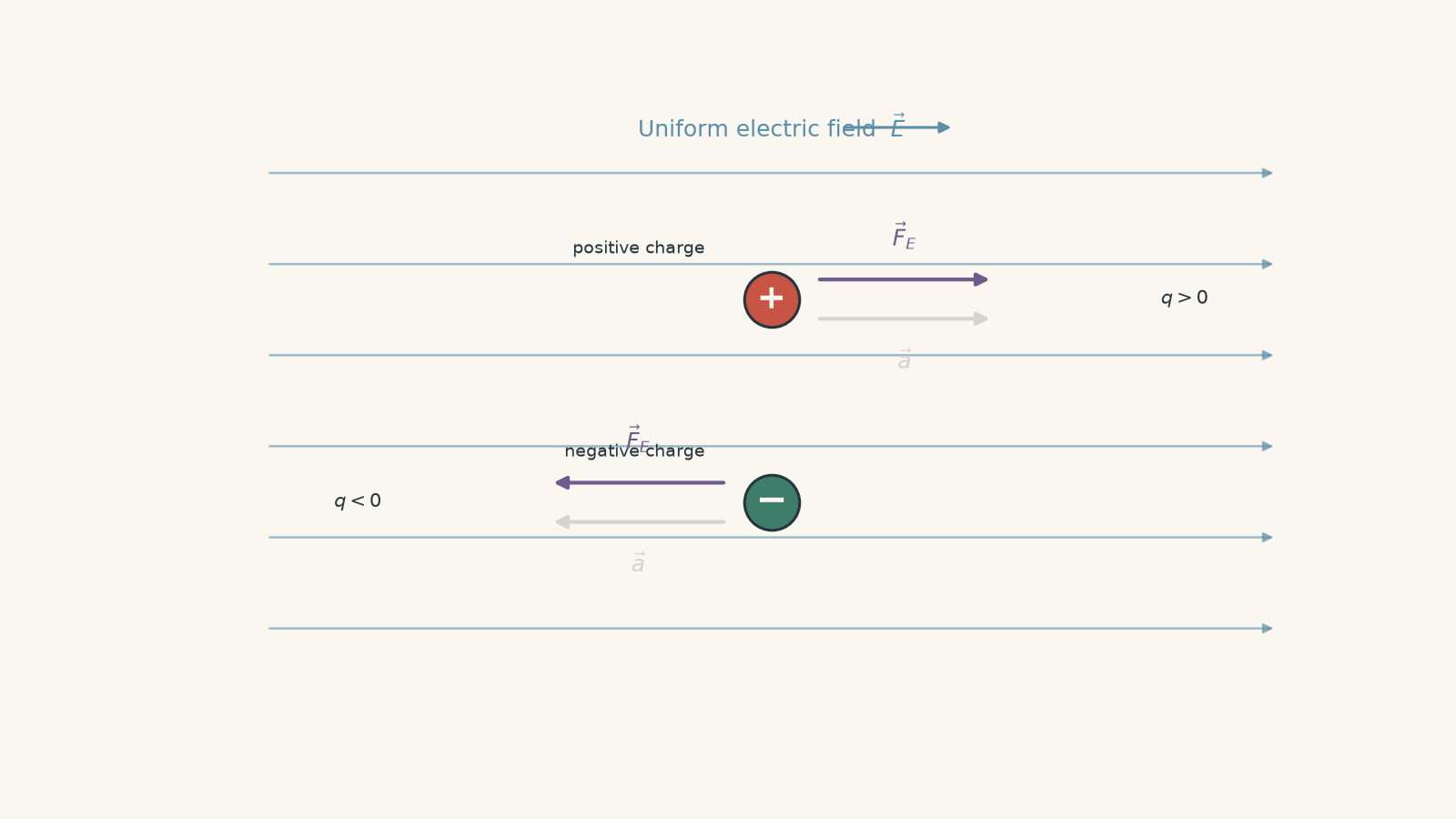
For a charge \(q\) in an electric field \(\vec E\),
\[
\vec F_E=q\vec E
\]
where:
- \(\vec F_E\) is the electric force in newtons, N
- \(q\) is the charge in coulombs, C
- \(\vec E\) is the electric field strength in newtons per coulomb, N C\(^{-1}\)
Now predict what happens if \(q\) is negative.
A negative charge accelerates opposite to the field direction. That is because multiplying \(\vec E\) by a negative \(q\) reverses the force vector.
A slightly silly way to picture it is that the electric field arrow is an invitation written specifically for positive charges. Positive charges follow the invitation. Negative charges read it and go the other way.
The analogy stops there. An electric field is not a stream pushing particles along, and it is not used up as charges move through it.
02Joining \(F=qE\) and \(F_{\text{net}}=ma\)
Newton’s second law says
\[
\vec F_{\text{net}}=m\vec a
\]
where \(m\) is the particle’s mass in kilograms, kg, and \(\vec a\) is its acceleration in metres per second squared, m s\(^{-2}\).
Suppose the electric force is the only significant force acting. Then
\[
\vec F_{\text{net}}=\vec F_E
\]
so
\[
m\vec a=q\vec E
\]
and therefore
\[
\vec a=\frac{q\vec E}{m}
\]
This is the main result.
For the magnitude of the acceleration,
\[
a=\frac{|q|E}{m}
\]
The absolute value \(|q|\) is used because a magnitude cannot be negative. The sign of the charge tells you the direction separately.
So there are two effects to keep track of:
| Property | Effect on acceleration |
|---|---|
| Larger \(E\) | Larger acceleration |
| Larger \(|q|\) | Larger acceleration |
| Larger \(m\) | Smaller acceleration |
| Positive \(q\) | Acceleration in the field direction |
| Negative \(q\) | Acceleration opposite the field direction |
A useful mental chain is
\[
\text{electric field} \rightarrow \text{electric force} \rightarrow \text{net force} \rightarrow \text{acceleration}
\]
Do not skip the net-force step when other forces are present.
Worked example: acceleration of a proton
A proton is released from rest in a uniform electric field of \(3.0\times10^4\) N C\(^{-1}\). The proton has charge \(+1.60\times10^{-19}\) C and mass \(1.67\times10^{-27}\) kg. Calculate its acceleration.
Step 1
The proton is positively charged, so the force acts in the same direction as the field.
\[
F_E=qE=(1.60\times10^{-19})(3.0\times10^4)
=4.8\times10^{-15}\text{ N}
\]
Step 2
The electric force is the only force we are considering, so \(F_{\text{net}}=F_E\).
\[
a=\frac{F_{\text{net}}}{m}
=\frac{4.8\times10^{-15}}{1.67\times10^{-27}}
=2.87\times10^{12}\text{ m s}^{-2}
\]
To two significant figures,
\[
a=2.9\times10^{12}\text{ m s}^{-2}
\]
The proton therefore accelerates at \(2.9\times10^{12}\) m s\(^{-2}\) in the direction of the electric field.
That acceleration looks enormous even though the force is tiny. There is no contradiction: a proton’s mass is extremely small.
03The most common mistake: \(qE\) is not always the net force
Students often write
\[
ma=qE
\]
the moment they see an electric field.
Sometimes that is correct. Sometimes it quietly ruins the whole question.
The exact statement is
\[
\vec F_{\text{net}}=\sum \vec F
\]
If electric force is the only important force, then \(m\vec a=q\vec E\). If gravity, tension, drag, or another electric force also matters, you must include it first.
For a microscopic particle such as an electron or proton, gravity is normally negligible compared with a typical electric force. For a charged oil drop or larger object, gravity can matter.
Worked example: electric force competing with gravity
A small droplet has mass \(2.0\times10^{-12}\) kg and charge \(-4.0\times10^{-15}\) C. It is placed in a uniform electric field of \(6.0\times10^3\) N C\(^{-1}\) directed vertically downward. Calculate the droplet’s acceleration. Use \(g=9.8\) m s\(^{-2}\).
Step 1
The field points downward, but the charge is negative. Therefore the electric force points upward.
Its magnitude is
\[
F_E=|q|E
=(4.0\times10^{-15})(6.0\times10^3)
=2.4\times10^{-11}\text{ N}
\]
Step 2
\[
F_g=mg
=(2.0\times10^{-12})(9.8)
=1.96\times10^{-11}\text{ N}
\]
Gravity acts downward.
Step 3
Taking upward as positive,
\[
F_{\text{net}}
=F_E-F_g
=2.4\times10^{-11}-1.96\times10^{-11}
=4.4\times10^{-12}\text{ N}
\]
The net force is upward.
Step 4
\[
a=\frac{F_{\text{net}}}{m}
=\frac{4.4\times10^{-12}}{2.0\times10^{-12}}
=2.2\text{ m s}^{-2}
\]
The droplet accelerates upward at \(2.2\) m s\(^{-2}\).
Notice what would have happened if we had automatically used \(a=|q|E/m\). We would have found \(12\) m s\(^{-2}\), which is the acceleration produced by the electric force alone. It is not the actual acceleration because gravity is also acting.
04Acceleration between parallel plates
A common HSC situation is a charge moving between parallel conducting plates.
For ideal parallel plates, away from the edges, the electric field is approximately uniform. If the potential difference between the plates is \(V\) and their separation is \(d\),
\[
E=\frac{V}{d}
\]
You can review why this works in Electric Fields Between Parallel Plates: Using \(E=V/d\).
If electric force is the only significant force, substitute \(E=V/d\) into \(a=|q|E/m\):
\[
a=\frac{|q|V}{md}
\]
This tells you something useful immediately. With the voltage fixed, moving the plates closer together increases the field and therefore increases the particle’s acceleration.
But be careful with the wording “constant acceleration”. A charge has constant acceleration only if the field and the other relevant forces are constant.
Between ideal parallel plates, that approximation is usually reasonable. Near the edges, the field is not perfectly uniform, so the acceleration will not remain exactly constant.
05Force direction is not the same as velocity direction
Suppose an electron enters a region travelling horizontally while the electric force points upward.
Does it immediately start travelling upward?
No. Its horizontal velocity does not suddenly disappear. The upward force produces an upward acceleration, so the electron gradually gains upward velocity while continuing to move horizontally.
This is the same basic idea as projectile motion. Gravity curves a thrown ball’s path because its acceleration is not necessarily in the same direction as its velocity. An electric field can curve a charged particle’s path for the same reason.
The analogy has a limit: gravitational acceleration near Earth’s surface is approximately the same for objects of different mass, whereas electric acceleration depends on the charge-to-mass ratio \(q/m\).
For a uniform electric field,
\[
a=\frac{|q|E}{m}
\]
so two particles in the same field can have very different accelerations.
06Questions and solutions
Question 1
A particle has charge \(+3.2\times10^{-19}\) C and mass \(6.4\times10^{-27}\) kg. It is released in a uniform electric field of \(2.5\times10^3\) N C\(^{-1}\).
Calculate:
a. the electric force on the particle
b. its acceleration
c. the direction of its acceleration relative to the electric field.
Assume no other significant forces act.
Solution 1
The particle experiences a force of \(8.0\times10^{-16}\) N and accelerates at \(1.25\times10^{11}\) m s\(^{-2}\) in the direction of the electric field.
The charge is positive, so its electric force points in the field direction.
For part a,
\[
F_E=qE
=(3.2\times10^{-19})(2.5\times10^3)
=8.0\times10^{-16}\text{ N}
\]
For part b, the electric force is the net force:
\[
a=\frac{F_{\text{net}}}{m}
=\frac{8.0\times10^{-16}}{6.4\times10^{-27}}
=1.25\times10^{11}\text{ m s}^{-2}
\]
For part c, both the force and acceleration point in the same direction as \(\vec E\).
A tempting mistake is to think the very small force must produce a very small acceleration. Acceleration depends on \(F/m\), and the particle’s mass is also extremely small.
Question 2
An electron enters a \(2.0\) cm long region of uniform electric field with an initial horizontal speed of \(8.0\times10^6\) m s\(^{-1}\). The field strength is \(5.0\times10^3\) N C\(^{-1}\) and points downward.
The electron has charge \(-1.60\times10^{-19}\) C and mass \(9.11\times10^{-31}\) kg.
Assume the field does not affect its horizontal velocity and ignore gravity.
Calculate:
a. the electron’s vertical acceleration
b. the time spent in the field
c. its vertical displacement while passing through the field.
Solution 2
The electron accelerates upward at \(8.8\times10^{14}\) m s\(^{-2}\), spends \(2.5\times10^{-9}\) s in the field, and moves about \(2.7\) mm upward.
Because the electron is negative, its electric force is opposite to the downward electric field. Its acceleration is therefore upward.
For part a,
\[
a_y=\frac{|q|E}{m}
=\frac{(1.60\times10^{-19})(5.0\times10^3)}
{9.11\times10^{-31}}
=8.78\times10^{14}\text{ m s}^{-2}
\]
For part b, there is no horizontal force, so the horizontal speed remains \(8.0\times10^6\) m s\(^{-1}\).
With a horizontal distance \(x=2.0\) cm \(=2.0\times10^{-2}\) m,
\[
t=\frac{x}{v_x}
=\frac{2.0\times10^{-2}}{8.0\times10^6}
=2.5\times10^{-9}\text{ s}
\]
For part c, the initial vertical velocity is zero, so
\[
\begin{aligned}
y&=u_yt+\frac12a_yt^2\\
&=0+\frac12(8.78\times10^{14})(2.5\times10^{-9})^2\\
&=2.74\times10^{-3}\text{ m}
\end{aligned}
\]
Therefore,
\[
y\approx2.7\text{ mm upward}
\]
The tempting route is to use the electron’s total speed in a single one-dimensional equation. The horizontal and vertical motions must instead be treated separately. The electric field changes the vertical velocity but, in this idealised case, does not change the horizontal velocity.
Question 3
A positively charged oil droplet of mass \(3.0\times10^{-15}\) kg is initially stationary in a vertical electric field of \(4.0\times10^4\) N C\(^{-1}\) directed upward.
a. Determine the magnitude of the droplet’s charge.
The field strength is then increased to \(5.0\times10^4\) N C\(^{-1}\) without changing direction.
b. Determine the droplet’s initial acceleration after the field changes.
Use \(g=9.8\) m s\(^{-2}\).
Solution 3
The charge is \(7.35\times10^{-19}\) C, and after the field increases the droplet accelerates upward at \(2.45\) m s\(^{-2}\).
Initially, the droplet is stationary. Stationary by itself does not prove the forces balance, but the wording implies it is being held stationary by the constant forces rather than merely passing through an instant of zero velocity. Therefore its initial net force is zero.
For part a, the upward electric force must balance the downward weight:
\[
F_E=F_g
\]
so
\[
qE=mg
\]
and
\[
\begin{aligned}
q&=\frac{mg}{E}\\
&=\frac{(3.0\times10^{-15})(9.8)}
{4.0\times10^4}\\
&=7.35\times10^{-19}\text{ C}
\end{aligned}
\]
For part b, the new electric force is
\[
F_E=qE
=(7.35\times10^{-19})(5.0\times10^4)
=3.675\times10^{-14}\text{ N}
\]
The weight has not changed:
\[
F_g=mg
=(3.0\times10^{-15})(9.8)
=2.94\times10^{-14}\text{ N}
\]
Therefore,
\[
F_{\text{net}}
=3.675\times10^{-14}-2.94\times10^{-14}
=7.35\times10^{-15}\text{ N upward}
\]
and
\[
a=\frac{F_{\text{net}}}{m}
=\frac{7.35\times10^{-15}}{3.0\times10^{-15}}
=2.45\text{ m s}^{-2}
\]
The tempting mistake is to use \(a=qE/m\) after the field increases. Gravity has not disappeared. The changed electric force must still be combined with the unchanged gravitational force to find the net force.
Question 4
Particles A and B are initially at rest and enter the same first region of uniform electric field \(E_1\). Each travels a distance \(L\) through this field.
Particle A has charge \(+q\) and mass \(m\). Particle B has charge \(+2q\) and mass \(4m\).
After leaving the first region, each particle enters a second region containing a uniform electric field \(E_2\) perpendicular to its velocity. The second region has horizontal length \(\ell\).
Ignore gravity, edge effects, and relativistic effects.
Which particle has the larger vertical deflection while crossing the second region, or are the deflections equal? Justify your answer.
Solution 4
The two particles have equal vertical deflections in the second field, despite having different accelerations and different entry speeds.
At first glance, particle A seems likely to deflect more because its charge-to-mass ratio is larger:
\[
\left(\frac{q}{m}\right)_A=\frac qm
\]
while
\[
\left(\frac{q}{m}\right)_B
=\frac{2q}{4m}
=\frac{q}{2m}
\]
So in either electric field,
\[
a_A=2a_B
\]
That conclusion is incomplete because the particles do not spend the same time in the second field.
In the first field, a particle starting from rest satisfies
\[
v^2=2aL
\]
For A,
\[
v_A^2=2\frac{qE_1}{m}L
\]
For B,
\[
v_B^2
=2\frac{2qE_1}{4m}L
=\frac{qE_1L}{m}
\]
Thus
\[
v_A^2=2v_B^2
\]
so
\[
v_A=\sqrt2\,v_B
\]
Particle A enters the second region faster and therefore spends less time there.
For either particle, the time in the second region is
\[
t=\frac{\ell}{v}
\]
and its vertical deflection, starting with zero vertical velocity, is
\[
y=\frac12a_yt^2
\]
For a general particle with charge \(Q\) and mass \(M\),
\[
a_y=\frac{QE_2}{M}
\]
while its speed after the first field satisfies
\[
v^2=2\frac{QE_1}{M}L
\]
Therefore,
\[
\begin{aligned}
y
&=\frac12\frac{QE_2}{M}
\left(\frac{\ell}{v}\right)^2\\
&=\frac12\frac{QE_2}{M}
\frac{\ell^2}{2(QE_1/M)L}\\
&=\frac{E_2\ell^2}{4E_1L}
\end{aligned}
\]
The charge-to-mass ratio cancels completely.
The tempting argument notices only that particle A has twice the transverse acceleration. The missing interaction is time: A also moves through the deflecting region faster. Its larger acceleration acts for a shorter time in exactly the way required to give the same displacement.
This equality depends on both particles starting from rest and being accelerated through the same first field over the same distance. Change those conditions, and the cancellation need not occur.
Question 5
Two particles are separated by a distance \(d\) in a uniform electric field directed to the right.
Particle P begins at the left and has charge \(+q\) and mass \(m\). Particle N begins at the right and has charge \(-q\) and mass \(4m\). Both are released from rest at the same instant.
Ignore the electric force the particles exert on each other, gravity, and relativistic effects.
a. Where do the particles collide, measured from P’s starting point?
b. Immediately before the collision, how do the magnitudes of their momenta compare?
c. Suppose they stick together in the collision, forming a small object with net charge zero. What happens to the object immediately after the collision?
Solution 5
They collide at \(4d/5\) from P’s starting point, their momenta have equal magnitudes and opposite directions immediately before collision, and the stuck, neutral object remains at rest immediately afterwards under the stated assumptions.
For part a, both particles experience electric forces of the same magnitude:
\[
F=|q|E
\]
But equal forces do not give equal accelerations because their masses differ.
For P,
\[
a_P=\frac{qE}{m}
\]
For N, the acceleration magnitude is
\[
a_N=\frac{qE}{4m}
\]
so
\[
a_P=4a_N
\]
Both begin from rest and accelerate for exactly the same time until they collide. Their displacements are therefore
\[
x_P=\frac12a_Pt^2
\]
and
\[
x_N=\frac12a_Nt^2
\]
Hence
\[
x_P=4x_N
\]
They must cover the full original separation:
\[
x_P+x_N=d
\]
so
\[
4x_N+x_N=d
\]
giving
\[
x_N=\frac d5
\]
and
\[
x_P=\frac{4d}{5}
\]
Therefore they collide \(4d/5\) from P’s starting position.
The tempting midpoint prediction comes from noticing that the electric forces have equal magnitudes. The lighter particle has four times the acceleration, so it covers four times the distance in the same time.
For part b, their momentum magnitudes are equal.
Each particle experiences a force of magnitude \(qE\) for the same time \(t\). The impulse magnitude on each is therefore
\[
J=Ft=qEt
\]
Since impulse equals change in momentum and each particle starts from rest,
\[
|p_P|=|p_N|=qEt
\]
Their directions are opposite, so the total momentum of the two-particle system is zero.
There is a useful subtlety here. P has four times N’s speed at the collision because P has one-quarter of the mass:
\[
mv_P=(4m)v_N
\]
so
\[
v_P=4v_N
\]
Equal momentum does not require equal speed.
For part c, if the collision is perfectly inelastic,
\[
p_{\text{before}}=p_{\text{after}}
\]
The total momentum immediately before collision is zero, so the combined object’s momentum immediately afterwards must also be zero. Its velocity is therefore zero.
Its net charge is also zero. In a uniform electric field, the net electric force on the combined idealised object is therefore zero.
So, in this model, it remains at rest.
The deepest trap is to reason about each particle separately all the way through. Before the collision, that is useful. At the collision, treating the two particles as one system reveals something simpler: the external electric forces are equal and opposite, so the system’s total momentum remains zero even though both particles are accelerating dramatically.
07What this lets you understand next
Once you are comfortable moving through
\[
\vec E\rightarrow\vec F_E\rightarrow\vec F_{\text{net}}\rightarrow\vec a
\]
you can analyse far more than a charge released from rest. The same chain explains charged-particle deflection, motion between parallel plates, equilibrium of charged particles, and why different particles follow different trajectories in the same field.
The next useful step is to connect this force description with electric potential energy. \(F=qE\) tells you how a particle accelerates at each instant; energy methods tell you how its speed changes after moving through a potential difference.