
Charged-Particle Trajectories in Electric Fields: HSC Physics
Learn how charged particles move through uniform electric fields, how to calculate their deflection, and why their paths resemble projectile motion. Includes worked examples and challenging HSC-style questions.
An electron enters the gap between two horizontal charged plates, moving straight to the right. The upper plate is positive, the lower plate is negative. What happens next: does the electron travel diagonally, bend in a circle, or follow the same sort of curve as a projectile?
Predict before reading on. The electric field points downward, from the positive plate towards the negative plate. But an electron is negatively charged, so its electric force points upward. It keeps moving to the right while accelerating upward. Inside a uniform field, that combination produces a parabola.
The important idea is not “charged particles curve in electric fields”. It is more precise than that: a constant electric force produces constant acceleration in one direction, while motion perpendicular to that force can continue unchanged. That is almost exactly the structure of projectile motion.
01Start with motion you already know
Picture a trolley rolling east on a nearly frictionless floor while someone pulls it north with a constant force.
The northward pull does not erase its eastward velocity. The trolley keeps moving east while gaining more and more northward velocity. Its path bends.
A charged particle in a uniform electric field behaves the same way. The “rope” is the electric force. Unlike a real rope, though, nothing physically touches the particle, and the force can act throughout the region containing the field.
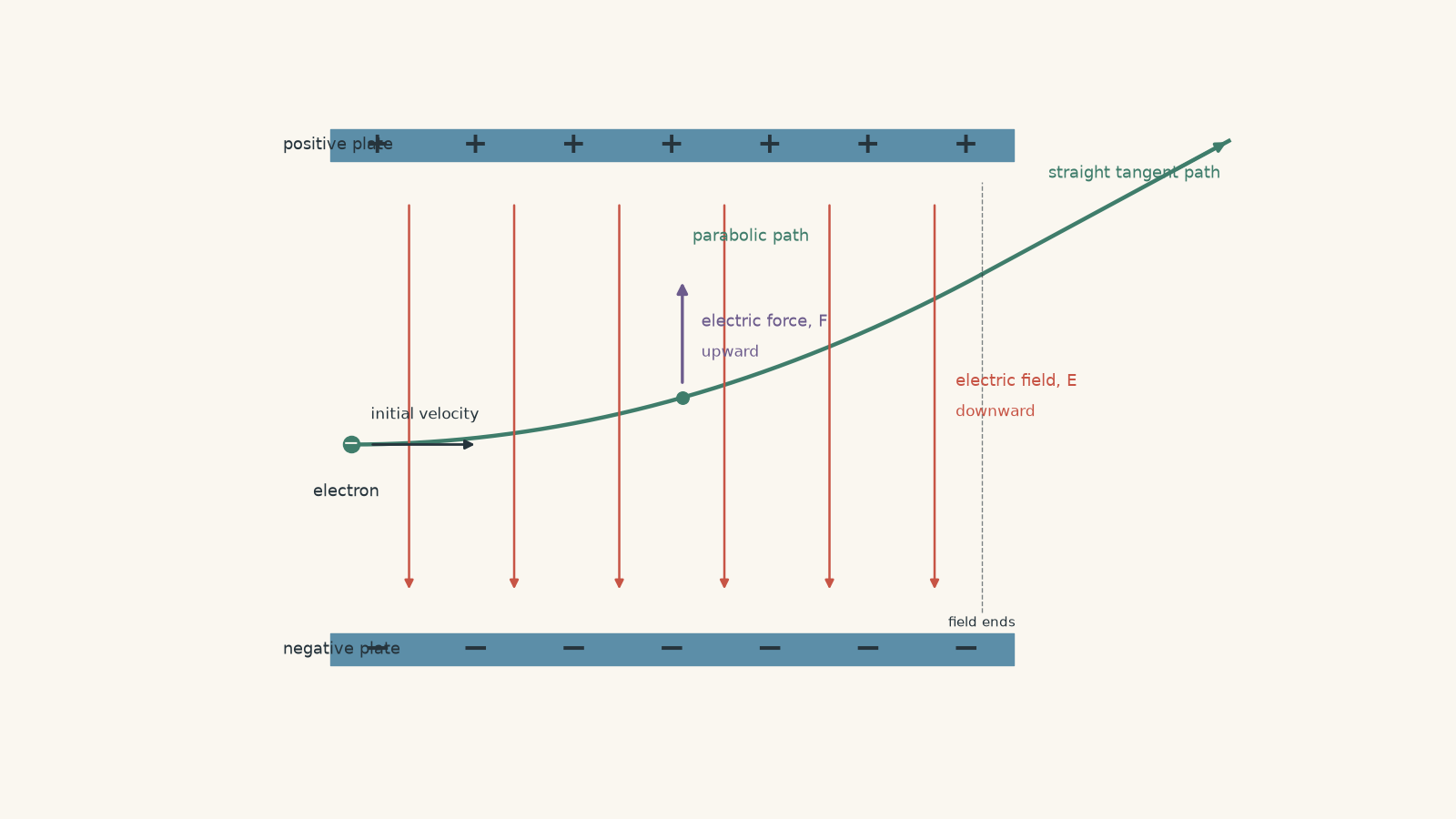
This immediately gives us two separate motion problems:
- perpendicular to the field: constant velocity, if there is no force in that direction
- parallel to the field: constant acceleration
That separation is the key to nearly every HSC question about charged-particle trajectories.
02Work out the direction before touching an equation
The electric field direction is defined as the direction a positive charge would be pushed.
So:
| Particle | Force relative to \(\vec E\) |
|---|---|
| Positive charge | Same direction as the field |
| Negative charge | Opposite direction to the field |
| Neutral particle | No electric force |
For a charge \(q\) in an electric field \(\vec E\),
\[
\vec F = q\vec E
\]
where \(F\) is electric force in newtons, \(q\) is charge in coulombs, and \(E\) is electric field strength in newtons per coulomb.
Newton’s second law gives
\[
\vec a=\frac{\vec F}{m}=\frac{q\vec E}{m}
\]
where \(m\) is the particle’s mass in kilograms and \(a\) is its acceleration in metres per second squared.
Notice that \(q\) is signed. If we choose upward as positive and the field points downward, then the field component \(E_y\) is negative. For an electron, \(q\) is also negative. The product \(qE_y\) is therefore positive, giving an upward acceleration.
This is safer than memorising “electrons go up”. They don’t. Electrons accelerate opposite to whatever direction the electric field happens to point.
03Why the trajectory becomes a parabola
Suppose a particle enters a uniform electric field horizontally.
Choose:
- the \(x\)-direction along its initial velocity
- the \(y\)-direction along the electric field axis
- initial horizontal speed \(u_x\)
- initial vertical speed \(u_y=0\)
Assume the field has no \(x\)-component. There is therefore no horizontal electric force, so
\[
a_x=0
\]
and the horizontal motion is
\[
x=u_xt
\]
The vertical acceleration is constant:
\[
a_y=\frac{qE_y}{m}
\]
so the vertical displacement is
\[
y=\frac{1}{2}a_yt^2
\]
Substituting \(t=x/u_x\),
\[
y=\frac{1}{2}\left(\frac{qE_y}{m}\right)\left(\frac{x}{u_x}\right)^2
\]
which becomes
\[
y=\frac{qE_y}{2mu_x^2}x^2
\]
That \(x^2\) is the giveaway. The trajectory is parabolic.
This result also tells us what controls the amount of bending. The deflection becomes larger when:
- the electric field is stronger,
- the charge magnitude is larger,
- the particle is lighter, or
- the horizontal speed is smaller.
That last one is especially important. A faster particle experiences the same acceleration, but spends less time inside a field of fixed length.
The more general trajectory
If the particle already has some vertical velocity \(u_y\), the same reasoning gives
\[
y=y_0+\frac{u_y}{u_x}x+\frac{qE_y}{2mu_x^2}x^2
\]
where \(y_0\) is its initial vertical position.
It is still a parabola as long as the field is uniform, \(u_x\neq0\), and there is no acceleration in the \(x\)-direction.
There is one useful boundary case. If the particle enters exactly parallel to the field, there is no sideways component to create a curved trajectory. It simply travels along a straight line while speeding up or slowing down.
04The quickest way to handle a finite plate length
Suppose the uniform field extends for a horizontal length \(L\), and the particle enters horizontally at speed \(u\).
Because its horizontal speed stays constant,
\[
t=\frac{L}{u}
\]
The vertical displacement while it is between the plates is therefore
\[
\Delta y
=\frac{1}{2}\left(\frac{qE_y}{m}\right)\left(\frac{L}{u}\right)^2
\]
or
\[
\Delta y=\frac{qE_yL^2}{2mu^2}
\]
For magnitude only,
\[
|\Delta y|=\frac{|q|EL^2}{2mu^2}
\]
The vertical velocity at the plate exit is
\[
v_y=a_yt=\frac{qE_yL}{mu}
\]
while the horizontal velocity remains \(u\).
The exit angle \(\theta\), measured from the horizontal, can therefore be found from
\[
\tan\theta=\frac{v_y}{u}
\]
The signs should come from your diagram rather than from blindly dropping negative numbers into every line.
05If the field comes from parallel plates
Questions do not always give \(E\) directly. Between ideal parallel plates,
\[
E=\frac{V}{d}
\]
where \(V\) is the potential difference between the plates in volts, and \(d\) is their separation in metres.
For a fuller refresher on that step, see Electric Fields Between Parallel Plates: Using \(E=V/d\).
The idealisation matters. \(E=V/d\) treats the field as uniform. Near the plate edges, real field lines spread out, producing fringing. HSC trajectory problems will normally give enough information for you to use the uniform-field model.
Worked example: Deflection of a proton
A proton enters horizontally into a uniform downward electric field of \(5.0\times10^3\ \mathrm{N\,C^{-1}}\). Its speed is \(3.0\times10^5\ \mathrm{m\,s^{-1}}\), and the field extends \(5.0\times10^{-2}\ \mathrm{m}\) horizontally. Calculate its vertical deflection before it leaves the field.
Use \(q_p=1.60\times10^{-19}\ \mathrm C\) and \(m_p=1.67\times10^{-27}\ \mathrm{kg}\).
Step 1
A proton is positively charged, so its force is in the same direction as the field. Its deflection will therefore be downward.
Step 2
\[
a=\frac{qE}{m}
=\frac{(1.60\times10^{-19})(5.0\times10^3)}
{1.67\times10^{-27}}
=4.79\times10^{11}\ \mathrm{m\,s^{-2}}
\]
That acceleration looks enormous, but atomic particles have extremely small masses.
Step 3
Its horizontal velocity is unchanged:
\[
t=\frac{L}{u}
=\frac{5.0\times10^{-2}}{3.0\times10^5}
=1.67\times10^{-7}\ \mathrm s
\]
Step 4
The initial vertical velocity is zero, so
\[
\Delta y
=\frac12at^2
=\frac12(4.79\times10^{11})(1.67\times10^{-7})^2
=6.65\times10^{-3}\ \mathrm m
\]
The proton is deflected about \(6.7\ \mathrm{mm}\) downward.
The important physical point is that the proton has not lost its horizontal motion. The field has added a growing downward velocity while the horizontal velocity continues.
Worked example: Electron deflection followed by a field-free region
An electron travels horizontally midway between two parallel plates. The plates have a potential difference of \(300\ \mathrm V\), are separated by \(1.5\times10^{-2}\ \mathrm m\), and are \(3.0\times10^{-2}\ \mathrm m\) long. The electron enters at \(3.0\times10^7\ \mathrm{m\,s^{-1}}\).
The upper plate is positive. A screen is \(0.15\ \mathrm m\) beyond the end of the plates.
Calculate:
- the electron’s deflection while between the plates,
- its direction on leaving the plates, and
- its total vertical displacement when it reaches the screen.
Use \(e=1.60\times10^{-19}\ \mathrm C\) and \(m_e=9.11\times10^{-31}\ \mathrm{kg}\).
Step 1
The field points from the positive upper plate to the negative lower plate, so it points downward.
Its magnitude is
\[
E=\frac{V}{d}
=\frac{300}{1.5\times10^{-2}}
=2.0\times10^4\ \mathrm{N\,C^{-1}}
\]
An electron is negative, so its electric force and acceleration are upward.
Step 2
Using the magnitude,
\[
a=\frac{eE}{m_e}
=\frac{(1.60\times10^{-19})(2.0\times10^4)}
{9.11\times10^{-31}}
=3.51\times10^{15}\ \mathrm{m\,s^{-2}}
\]
Step 3
\[
t_1=\frac{L}{u}
=\frac{3.0\times10^{-2}}{3.0\times10^7}
=1.0\times10^{-9}\ \mathrm s
\]
Step 4
\[
y_1
=\frac12at_1^2
=\frac12(3.51\times10^{15})(1.0\times10^{-9})^2
=1.76\times10^{-3}\ \mathrm m
\]
So the electron rises by about \(1.8\ \mathrm{mm}\) between the plates.
Step 5
\[
v_y=at_1
=(3.51\times10^{15})(1.0\times10^{-9})
=3.51\times10^6\ \mathrm{m\,s^{-1}}
\]
Its horizontal velocity is still \(3.0\times10^7\ \mathrm{m\,s^{-1}}\).
Therefore,
\[
\tan\theta
=\frac{3.51\times10^6}{3.0\times10^7}
\]
giving
\[
\theta\approx6.7^\circ
\]
above the horizontal.
Step 6
Once the electron leaves the electric field, the electric force disappears. Under the usual HSC model, we neglect gravity and any other forces.
The electron therefore continues in a straight line with its exit velocity.
Its travel time to the screen is
\[
t_2=\frac{0.15}{3.0\times10^7}
=5.0\times10^{-9}\ \mathrm s
\]
Its additional upward displacement is
\[
y_2=v_yt_2
=(3.51\times10^6)(5.0\times10^{-9})
=1.76\times10^{-2}\ \mathrm m
\]
The total displacement is
\[
y_{\text{total}}
=y_1+y_2
=1.76\times10^{-3}+1.76\times10^{-2}
=1.93\times10^{-2}\ \mathrm m
\]
So the electron reaches the screen about \(1.9\ \mathrm{cm}\) above its original line of motion.
Notice the change in model at the plate edge: parabola while the force acts, then straight-line motion after the force disappears.
06Electric deflection and projectile motion
The mathematical resemblance to projectile motion is strong because both involve constant acceleration in one direction and constant velocity in a perpendicular direction.
| Projectile near Earth’s surface | Charged particle in a uniform electric field |
|---|---|
| Force is approximately \(mg\) downward | Force is \(qE\) |
| Acceleration is \(g\) downward | Acceleration is \(qE/m\) |
| Horizontal velocity is constant if air resistance is neglected | Perpendicular velocity is constant if the field has no component in that direction |
| Trajectory is parabolic | Trajectory is parabolic |
| \(g\) is independent of projectile mass | Electric acceleration depends on \(q/m\) |
| Gravity acts over the whole usual flight | Plate field often ends sharply in the model |
There is one difference worth stopping over.
Drop a bowling ball and a small metal ball together, neglecting air resistance, and they have the same gravitational acceleration. Their masses cancel because \(F_g=mg\).
That does not happen automatically for electric motion:
\[
a=\frac{qE}{m}
\]
Two particles in the same electric field can therefore accelerate very differently because their charge-to-mass ratios \(q/m\) are different.
07The most tempting mistakes
“The particle bends towards the negative plate”
Only a positive particle does that.
The field points towards the negative plate. A negative particle experiences force in the opposite direction and bends towards the positive plate.
The safer sequence is always:
- draw the electric field,
- identify the sign of the charge,
- determine the force direction,
- determine the acceleration direction.
“A curved path must be part of a circle”
A circle requires an acceleration that continually turns so that it points towards the centre of the circle.
In a uniform electric field, the electric force points in one fixed direction. The acceleration therefore has a fixed direction rather than continually rotating.
The resulting trajectory is a parabola, not a circle.
“The horizontal speed gets used up as the particle turns”
It is easy to picture velocity as one fixed amount that must be shared between horizontal and vertical motion. That is not how vector components work.
If there is no horizontal force,
\[
a_x=0
\]
so \(v_x\) remains constant. The electric field creates a changing \(v_y\); it does not steal velocity from \(v_x\).
“Once the particle leaves the plates, it straightens back out”
It travels straight after leaving the field, but it does not return to its original direction.
At the instant it leaves the field, it already has both horizontal and vertical velocity components. With no further force, both components remain constant. The particle therefore follows the tangent to its parabolic path.
08Questions and solutions
Question 1
An electron enters horizontally at \(2.5\times10^7\ \mathrm{m\,s^{-1}}\) into a uniform electric field of \(1.5\times10^4\ \mathrm{N\,C^{-1}}\) directed downward. The field extends \(2.0\times10^{-2}\ \mathrm m\) horizontally.
Calculate the electron’s vertical deflection before it leaves the field, and state its direction.
Use \(e=1.60\times10^{-19}\ \mathrm C\) and \(m_e=9.11\times10^{-31}\ \mathrm{kg}\).
Solution 1
The electron is deflected \(8.4\times10^{-4}\ \mathrm m\), or \(0.84\ \mathrm{mm}\), upward.
The field points downward, but the electron is negatively charged, so its force is upward.
First calculate the acceleration magnitude:
\[
a=\frac{eE}{m_e}
=\frac{(1.60\times10^{-19})(1.5\times10^4)}
{9.11\times10^{-31}}
=2.63\times10^{15}\ \mathrm{m\,s^{-2}}
\]
The time spent in the field is
\[
t=\frac{L}{u}
=\frac{2.0\times10^{-2}}{2.5\times10^7}
=8.0\times10^{-10}\ \mathrm s
\]
The initial vertical velocity is zero, so
\[
\Delta y
=\frac12at^2
=\frac12(2.63\times10^{15})(8.0\times10^{-10})^2
=8.43\times10^{-4}\ \mathrm m
\]
Therefore,
\[
\boxed{\Delta y\approx0.84\ \mathrm{mm}\text{ upward}}
\]
A common wrong route is to send the electron downward because the field points downward. The field direction tells you the force direction for a positive charge; the electron’s force is opposite.
Question 2
A proton and an alpha particle enter the same uniform electric field horizontally and travel through the same horizontal distance.
Take the proton to have charge \(+e\) and mass \(m_p\). Approximate the alpha particle as having charge \(+2e\) and mass \(4m_p\).
Compare their deflections if:
a. they enter with the same speed,
b. they enter with the same kinetic energy.
No numerical values are required.
Solution 2
With the same speed, the proton is deflected twice as far as the alpha particle. With the same kinetic energy, the alpha particle is deflected twice as far as the proton.
For a particle entering horizontally,
\[
y=\frac{qEL^2}{2mu^2}
\]
For part a, \(E\), \(L\), and \(u\) are identical, so
\[
y\propto\frac qm
\]
For the proton,
\[
\frac qm=\frac{e}{m_p}
\]
For the alpha particle,
\[
\frac qm=\frac{2e}{4m_p}
=\frac12\frac{e}{m_p}
\]
Therefore,
\[
y_\alpha=\frac12y_p
\]
so the proton bends twice as much.
Part b changes something important: equal kinetic energy does not mean equal speed.
Using
\[
K=\frac12mu^2
\]
gives
\[
u^2=\frac{2K}{m}
\]
Substitute this into the deflection equation:
\[
y
=\frac{qEL^2}
{2m(2K/m)}
=\frac{qEL^2}{4K}
\]
The mass has now cancelled. For fixed \(K\),
\[
y\propto q
\]
The alpha particle has twice the proton’s charge, so
\[
y_\alpha=2y_p
\]
The tempting mistake is to use \(q/m\) for both parts. That works only while the speed is being held fixed. When kinetic energy is fixed instead, the particles enter at different speeds, which changes how long they spend in the field.
Question 3
An electron enters a uniform electric field horizontally. The field strength is \(1.2\times10^4\ \mathrm{N\,C^{-1}}\), and the field region is \(4.0\times10^{-2}\ \mathrm m\) long.
After leaving the field, the electron travels another \(0.20\ \mathrm m\) horizontally before striking a screen. Its total vertical displacement from its original line of motion is \(3.0\times10^{-2}\ \mathrm m\).
Determine its horizontal entry speed.
Use \(e=1.60\times10^{-19}\ \mathrm C\) and \(m_e=9.11\times10^{-31}\ \mathrm{kg}\).
Solution 3
The electron’s entry speed is approximately \(2.5\times10^7\ \mathrm{m\,s^{-1}}\).
The key is that the \(3.0\ \mathrm{cm}\) displacement is not produced entirely while the electron is between the plates. The electron continues moving vertically after leaving the field because it carries its exit vertical velocity with it.
Let the plate length be \(L\), the field-free distance be \(D\), and the horizontal speed be \(u\).
The acceleration magnitude is
\[
a=\frac{eE}{m_e}
\]
During the field region,
\[
t_1=\frac Lu
\]
so the first vertical displacement is
\[
y_1=\frac12a\left(\frac Lu\right)^2
=\frac{aL^2}{2u^2}
\]
The exit vertical speed is
\[
v_y=a\frac Lu
\]
The time travelling from the plate edge to the screen is
\[
t_2=\frac Du
\]
so the additional displacement is
\[
y_2=v_yt_2
=\left(\frac{aL}{u}\right)\left(\frac Du\right)
=\frac{aLD}{u^2}
\]
Therefore,
\[
Y
=\frac{a}{u^2}\left(\frac{L^2}{2}+LD\right)
\]
and hence
\[
u^2
=\frac{a}{Y}\left(\frac{L^2}{2}+LD\right)
\]
First,
\[
a
=\frac{(1.60\times10^{-19})(1.2\times10^4)}
{9.11\times10^{-31}}
=2.11\times10^{15}\ \mathrm{m\,s^{-2}}
\]
Then
\[
u^2
=
\frac{2.11\times10^{15}}{3.0\times10^{-2}}
\left[
\frac{(4.0\times10^{-2})^2}{2}
+(4.0\times10^{-2})(0.20)
\right]
\]
\[
u^2\approx6.18\times10^{14}\ \mathrm{m^2\,s^{-2}}
\]
so
\[
u\approx2.49\times10^7\ \mathrm{m\,s^{-1}}
\]
Therefore,
\[
\boxed{u\approx2.5\times10^7\ \mathrm{m\,s^{-1}}}
\]
The tempting shortcut is to put the full \(3.0\ \mathrm{cm}\) into \(y=\frac12at^2\) using only the plate length. That ignores most of the geometry: after leaving the plates, the acceleration becomes zero, but the vertical velocity does not.
Question 4
A proton travels horizontally at \(4.0\times10^5\ \mathrm{m\,s^{-1}}\) through two adjacent electric-field regions.
Each region is \(2.0\times10^{-2}\ \mathrm m\) long.
- In the first region, the uniform electric field is \(3.0\times10^3\ \mathrm{N\,C^{-1}}\) upward.
- In the second region, the field has the same magnitude but points downward.
The proton enters with no vertical velocity.
Determine:
a. its vertical velocity when it leaves the second region,
b. its total vertical displacement,
c. whether reversing the field in the second half completely undoes the motion caused by the first half.
Use \(q_p=1.60\times10^{-19}\ \mathrm C\) and \(m_p=1.67\times10^{-27}\ \mathrm{kg}\).
Solution 4
The proton leaves with zero vertical velocity, but it remains displaced upward by about \(7.2\times10^{-4}\ \mathrm m\). Reversing the field cancels the vertical velocity, not the displacement already accumulated.
The acceleration magnitude is
\[
a=\frac{qE}{m}
=\frac{(1.60\times10^{-19})(3.0\times10^3)}
{1.67\times10^{-27}}
=2.87\times10^{11}\ \mathrm{m\,s^{-2}}
\]
Each region takes
\[
\tau
=\frac{2.0\times10^{-2}}{4.0\times10^5}
=5.0\times10^{-8}\ \mathrm s
\]
to cross.
In the first region, the proton accelerates upward.
Its displacement is
\[
y_1
=\frac12a\tau^2
=\frac12(2.87\times10^{11})(5.0\times10^{-8})^2
=3.59\times10^{-4}\ \mathrm m
\]
Its vertical velocity at the midpoint is
\[
v_{y,1}
=a\tau
=(2.87\times10^{11})(5.0\times10^{-8})
=1.44\times10^4\ \mathrm{m\,s^{-1}}
\]
upward.
In the second region, the acceleration reverses. After another time \(\tau\),
\[
v_{y,2}=v_{y,1}-a\tau=0
\]
so the proton does indeed finish with zero vertical velocity.
But during that second interval it begins with an upward velocity. Its displacement is
\[
y_2
=v_{y,1}\tau-\frac12a\tau^2
\]
\[
y_2
=(1.44\times10^4)(5.0\times10^{-8})
-\frac12(2.87\times10^{11})(5.0\times10^{-8})^2
\]
\[
y_2=3.59\times10^{-4}\ \mathrm m
\]
Therefore,
\[
y_{\text{total}}
=y_1+y_2
=7.19\times10^{-4}\ \mathrm m
\]
or about
\[
\boxed{0.72\ \mathrm{mm}\text{ upward}}
\]
The proton exits parallel to its original direction but shifted upward.
The tempting argument is that equal and opposite fields acting for equal times must undo one another. They do undo the change in velocity. They cannot undo the first upward displacement because, during the second region, the proton is still moving upward while it is being slowed vertically.
This is the same reason that throwing a ball upward and waiting until its vertical velocity returns to zero does not put the ball back where it started.
Question 5
A proton and an alpha particle both start from rest.
Each is accelerated through the same potential difference of \(800\ \mathrm V\). They then enter the same uniform deflecting electric field horizontally.
The deflecting field has magnitude \(4.0\times10^3\ \mathrm{N\,C^{-1}}\) and extends \(5.0\times10^{-2}\ \mathrm m\) horizontally.
Take the proton to have charge \(+e\) and mass \(m_p\), and the alpha particle to have charge \(+2e\) and mass \(4m_p\).
A student argues:
“The proton has the larger \(q/m\), so it must follow the more strongly curved path.”
Determine whether the proton and alpha particle actually follow different trajectories inside the deflecting field. Calculate their exit deflection and exit angle.
Assume non-relativistic motion and neglect gravity.
Solution 5
The proton and alpha particle follow the same geometrical trajectory inside the deflecting field. Each is deflected \(3.13\ \mathrm{mm}\), and each leaves at about \(7.1^\circ\) to the horizontal.
The student’s argument correctly notices that their accelerations in the deflecting field are different. The missing constraint is that the particles were first accelerated from rest through the same potential difference. They therefore do not enter the deflecting region at the same speed.
A particle of positive charge \(q\) accelerated from rest through potential difference \(V_a\) gains kinetic energy
\[
qV_a=\frac12mu^2
\]
so
\[
u^2=\frac{2qV_a}{m}
\]
Inside the perpendicular deflecting field,
\[
y=\frac{qEx^2}{2mu^2}
\]
Substituting the expression for \(u^2\),
\[
y
=
\frac{qEx^2}
{2m(2qV_a/m)}
\]
The charge and mass both cancel:
\[
y=\frac{Ex^2}{4V_a}
\]
That equation contains neither \(q\) nor \(m\).
So, under these assumptions, any positive non-relativistic particle accelerated from rest through the same potential difference and then entering this same deflecting field follows the same \(y(x)\) trajectory.
At the plate exit, \(x=L\):
\[
y
=\frac{EL^2}{4V_a}
\]
\[
y
=
\frac{(4.0\times10^3)(5.0\times10^{-2})^2}
{4(800)}
\]
\[
y
=\frac{10}{3200}
=3.125\times10^{-3}\ \mathrm m
\]
Therefore,
\[
\boxed{y\approx3.13\ \mathrm{mm}}
\]
for both particles.
For the exit angle,
\[
\tan\theta=\frac{v_y}{u}
\]
Since
\[
v_y=\frac{qEL}{mu},
\]
we obtain
\[
\tan\theta
=\frac{qEL}{mu^2}
\]
and using
\[
mu^2=2qV_a,
\]
\[
\tan\theta=\frac{EL}{2V_a}
\]
Therefore,
\[
\tan\theta
=\frac{(4.0\times10^3)(5.0\times10^{-2})}
{2(800)}
=0.125
\]
so
\[
\boxed{\theta\approx7.1^\circ}
\]
for both particles.
The proton really does have twice the alpha particle’s charge-to-mass ratio, so its acceleration in the deflecting field is twice as large. But the proton also leaves the accelerating voltage with a larger speed. It crosses the deflecting field more quickly. The increased acceleration and decreased interaction time compensate exactly.
That is the hinge in the problem: \(q/m\) alone tells you the acceleration, but a trajectory depends on both acceleration and how long that acceleration acts.
09What this lets you understand next
Once you can separate charged-particle motion into perpendicular constant-velocity motion and parallel accelerated motion, several harder electric-field problems become much more manageable.
The next useful step is to connect the trajectory model to electric potential energy. A potential difference can determine the particle’s entry speed through \(qV=\Delta K\), while the deflecting field determines how that speed changes direction. Question 5 showed why combining those two ideas can produce results that are not obvious from \(F=qE\) alone.