
Force on a Moving Charge in a Magnetic Field: HSC Physics
Learn how to calculate magnetic force using F = qvB sin θ and determine its direction correctly. Includes worked examples and challenging HSC-style questions.
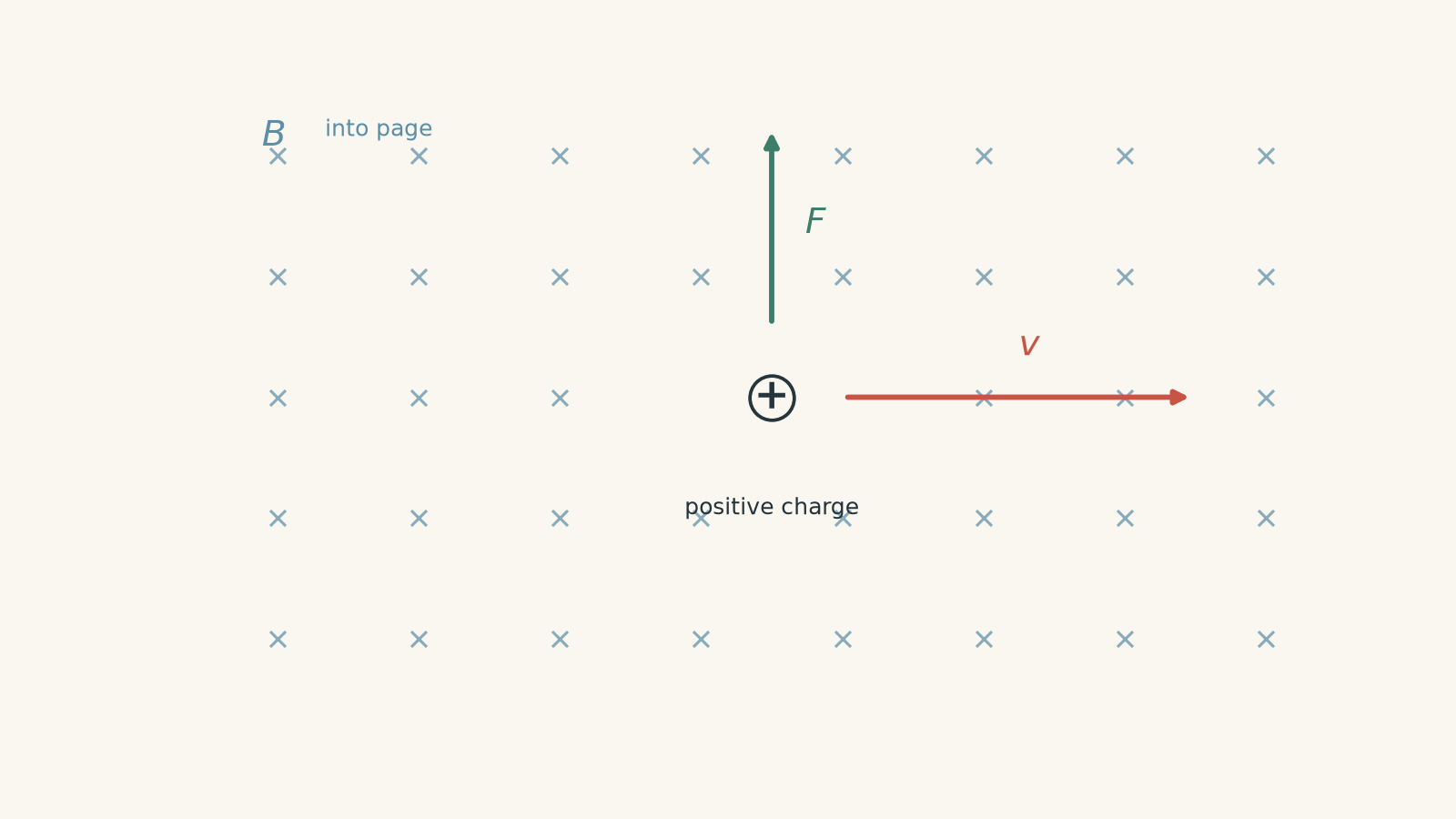
A positive charge flies to the right through a magnetic field directed into the page. The field exerts a force on it. What should happen: does the charge speed up, slow down, or turn?
Predict before reading on.
It turns upwards. The surprising part is that the magnetic force is sideways to the motion. A magnetic field can continuously bend a charged particle’s path without making it faster.
That one idea explains most HSC questions about magnetic force. The calculation tells you how strong the sideways force is. The direction rule tells you which way the particle turns.
01Start with the sideways-force model
Imagine a particle moving through space while something keeps nudging it exactly sideways. Each nudge changes where the particle is heading, but not how fast it is moving.
A magnetic field behaves like that for a moving electric charge. The analogy is useful, but incomplete. The magnetic force isn’t just “some sideways force”. Its size depends on the charge, speed, magnetic field strength, and the angle between the velocity and field.
Its direction is also tightly constrained: the force is perpendicular to both the particle’s velocity and the magnetic field.
There is one immediate consequence worth noticing. If the particle moves directly along the magnetic field, there is no sideways direction picked out by the velocity and field together. The magnetic force is zero.
02Calculating the magnitude of the magnetic force
For a charge moving through a magnetic field, the magnitude of the magnetic force is
\[
F=|q|vB\sin\theta
\]
where:
- \(F\) is the magnetic force in newtons, \(\text{N}\),
- \(q\) is the charge in coulombs, \(\text{C}\),
- \(v\) is the particle’s speed in metres per second, \(\text{m s}^{-1}\),
- \(B\) is the magnetic field strength in tesla, \(\text{T}\), and
- \(\theta\) is the angle between the particle’s velocity and the magnetic field.
You will also often see this written as
\[
F=qvB\sin\theta.
\]
When you are calculating the magnitude of the force, use the magnitude of the charge. In other words, an electron’s charge contributes \(1.60\times10^{-19}\text{ C}\), not a “negative force”. The negative sign matters when you determine the direction.
Why is there a \(\sin\theta\)?
Suppose the particle travels partly along the magnetic field and partly across it. Which part of its motion should produce the magnetic force?
Only the component perpendicular to the field.
That perpendicular speed is
\[
v_\perp=v\sin\theta.
\]
So the force can also be written as
\[
F=|q|v_\perp B.
\]
The component of velocity parallel to the magnetic field contributes no magnetic force.
This gives a useful set of boundary cases:
| Motion relative to the magnetic field | \(\theta\) | Magnetic force |
|---|---|---|
| Parallel to the field | \(0^\circ\) | \(0\) |
| At \(30^\circ\) | \(30^\circ\) | Half the maximum force |
| Perpendicular to the field | \(90^\circ\) | Maximum force |
| Opposite to the field | \(180^\circ\) | \(0\) |
That last row catches people. Moving against the magnetic field is still moving parallel to its line of action, so there is no magnetic force.
03Finding the direction
The equation gives the magnitude. It does not, by itself, tell you the spatial direction.
The full relationship is
\[
\vec F=q\vec v\times\vec B.
\]
You don’t need to turn every HSC problem into vector algebra. A right-hand rule does the same job.
For a positive charge:
- Point your right index finger in the direction of the velocity \(\vec v\).
- Point your middle finger in the direction of the magnetic field \(\vec B\), keeping it perpendicular to the index finger.
- Your thumb gives the direction of the magnetic force \(\vec F\).
For a negative charge, find the positive-charge direction first, then reverse it.
That last step is safer than trying to perform a special left-hand rule under exam pressure.
The sign of the charge changes direction, not magnitude
Suppose a proton and an electron have the same speed and move in the same direction through the same magnetic field.
Their charges have equal magnitude:
\[
|q_p|=|q_e|=1.60\times10^{-19}\text{ C}.
\]
So the two magnetic forces have the same magnitude.
But because their charge signs are opposite, the forces point in opposite directions.
This is why writing a negative electron charge directly into a scalar force calculation can be misleading. A force magnitude cannot be \(-3.0\times10^{-13}\text{ N}\). Calculate the positive magnitude, then handle the direction separately.
Worked example: Proton moving perpendicular to a field
A proton travels east at \(3.2\times10^6\text{ m s}^{-1}\) through a \(0.18\text{ T}\) magnetic field directed north. Calculate the magnitude and direction of the magnetic force.
Step 1
East and north are perpendicular, so
\[
\theta=90^\circ,\qquad \sin90^\circ=1.
\]
Step 2
The magnitude of the proton’s charge is \(1.60\times10^{-19}\text{ C}\).
\[
\begin{aligned}
F&=|q|vB\sin\theta\\
&=(1.60\times10^{-19})(3.2\times10^6)(0.18)(1)\\
&=9.2\times10^{-14}\text{ N}.
\end{aligned}
\]
Step 3
For a positive charge, point your right-hand rule from east, \(\vec v\), towards north, \(\vec B\). The force points out of the page.
So the proton experiences a magnetic force of
\[
9.2\times10^{-14}\text{ N}
\]
out of the page.
The number is tiny because an individual proton has an extremely small charge. That does not mean magnetic effects are unimportant: for microscopic particles with tiny masses, a small force can still produce a large acceleration.
04What if the particle isn’t moving at \(90^\circ\)?
This is where blindly using \(F=qvB\) causes trouble.
Suppose the particle travels at \(35^\circ\) to the magnetic field. Only the velocity perpendicular to the field produces force, so the force is smaller than its maximum possible value.
You can either calculate \(v_\perp\) first or use \(\sin35^\circ\) directly. They are exactly the same method.
Worked example: Electron travelling at an angle
An electron travels at \(4.5\times10^6\text{ m s}^{-1}\), \(35^\circ\) north of east. A uniform \(0.30\text{ T}\) magnetic field points east. Calculate the magnitude and direction of the magnetic force.
Step 1
The magnetic field points east. The electron’s eastward velocity component is parallel to the field, so it produces no magnetic force.
The perpendicular component is the northward component:
\[
v_\perp=v\sin35^\circ.
\]
Step 2
\[
\begin{aligned}
F&=|q|vB\sin\theta\\
&=(1.60\times10^{-19})(4.5\times10^6)(0.30)\sin35^\circ\\
&=1.24\times10^{-13}\text{ N}.
\end{aligned}
\]
So
\[
F\approx1.2\times10^{-13}\text{ N}.
\]
Step 3
Only the northward component of velocity matters for the direction. For a positive charge, north crossed with east gives a force into the page.
Step 4
The electron is negatively charged, so its force points out of the page.
Therefore, the magnetic force is approximately
\[
1.2\times10^{-13}\text{ N}
\]
out of the page.
Notice what the eastward velocity component did: nothing to the magnetic force. The electron can be moving very quickly along the field without that component contributing any force at all.
05Why a magnetic field bends a path without changing the speed
Here is a tempting prediction. If a force acts on a particle, surely it must speed the particle up or slow it down.
That is true only when the force has a component along or against the motion.
A magnetic force is perpendicular to the instantaneous velocity:
\[
\vec F\perp\vec v.
\]
So the field changes the direction of the velocity, not its magnitude.
Think of swinging an object in a horizontal circle on a string. The tension continually changes the object’s direction even though it does not have to increase the object’s speed. The analogy breaks because magnetic force is not a string tension, and its direction comes from \(q\vec v\times\vec B\), but the sideways-steering idea is the same.
This also means a magnetic field does no work on a charged particle by itself.
If the particle initially moves perpendicular to a uniform magnetic field, the magnetic force behaves as a centripetal force. The particle can follow a circular path.
If the particle also has some velocity parallel to the field, that parallel component continues unchanged while the perpendicular component turns. The resulting motion can become a helix.
The important cause is still the same:
\[
F=|q|v_\perp B.
\]
06Don’t confuse magnetic and electric forces
Electric and magnetic fields affect charges differently.
An electric field can exert a force on a stationary charge. Its force is
\[
\vec F=q\vec E.
\]
A magnetic field needs the charge to be moving. Its force also depends on the direction of that motion.
Electric fields can therefore change a particle’s kinetic energy much more directly. You can see that contrast in Charged-Particle Trajectories in Electric Fields: HSC Physics. If the electric field is produced between plates, the relationship \(E=V/d\) is developed in Electric Fields Between Parallel Plates: Using E = V/d.
A useful exam decision is:
| Question | Magnetic field | Electric field |
|---|---|---|
| Can it force a stationary charge to accelerate? | No | Yes |
| Does the force depend on speed? | Yes | No |
| Does the force depend on direction of motion? | Yes | No |
| Can the field alone change the particle’s speed? | No | Yes |
| Does charge sign reverse the force direction? | Yes | Yes |
07The most useful problem-solving routine
When you see a moving charge in a magnetic field, don’t start calculating immediately.
First ask:
- What direction is the particle moving?
- What direction is the magnetic field?
- What is the angle between them?
- Is the charge positive or negative?
- Do I need the whole velocity, or only \(v_\perp\)?
- What direction would the force have for a positive charge?
- If the particle is negative, have I reversed that direction?
Then calculate the magnitude.
This order prevents two common errors: using \(F=qvB\) when the motion is not perpendicular, and getting a perfectly calculated force pointing the wrong way.
08Questions and solutions
Question 1
A proton moves to the right at \(2.0\times10^6\text{ m s}^{-1}\) through a uniform \(0.30\text{ T}\) magnetic field directed into the page.
Calculate the magnitude and direction of the magnetic force on the proton.
Solution 1
The force is \(9.6\times10^{-14}\text{ N}\) upwards.
The velocity is perpendicular to the magnetic field, so
\[
\theta=90^\circ.
\]
Using the proton charge \(q=1.60\times10^{-19}\text{ C}\),
\[
\begin{aligned}
F&=|q|vB\sin\theta\\
&=(1.60\times10^{-19})(2.0\times10^6)(0.30)\sin90^\circ\\
&=9.6\times10^{-14}\text{ N}.
\end{aligned}
\]
For a positive charge, right crossed with into the page gives an upward force.
A tempting mistake is to imagine that the field pushes the proton into or out of the page because that is the field direction. It does not. The magnetic force is perpendicular to both \(\vec v\) and \(\vec B\).
Question 2
An electron travels at \(6.0\times10^6\text{ m s}^{-1}\), \(50^\circ\) north of east. A uniform magnetic field of \(0.25\text{ T}\) points east.
Another electron has the same speed in the same field but travels \(50^\circ\) south of east.
For each electron:
- calculate the magnitude of the magnetic force, and
- determine the force direction.
Explain why the force magnitudes are the same even though the velocity directions are different.
Solution 2
Both electrons experience a force of approximately \(1.8\times10^{-13}\text{ N}\), but the first force is out of the page and the second is into the page.
For either electron, the angle between the velocity and magnetic field has magnitude \(50^\circ\). Therefore,
\[
\begin{aligned}
F&=|q|vB\sin\theta\\
&=(1.60\times10^{-19})(6.0\times10^6)(0.25)\sin50^\circ\\
&=1.84\times10^{-13}\text{ N}.
\end{aligned}
\]
So
\[
F\approx1.8\times10^{-13}\text{ N}.
\]
For the first electron, the relevant perpendicular velocity component points north. North crossed with east gives an into-the-page force for a positive charge. An electron is negative, so its force is out of the page.
For the second electron, the perpendicular component points south. South crossed with east gives an out-of-the-page force for a positive charge, so the electron’s force is into the page.
The tempting route is to think that changing the velocity direction must change the force magnitude. What matters is the magnitude of the perpendicular velocity component. Both particles have
\[
v_\perp=v\sin50^\circ,
\]
so their force magnitudes are identical. Reversing that perpendicular component reverses the force direction.
Question 3
A singly charged positive ion moves through a uniform \(0.80\text{ T}\) magnetic field. Its velocity consists of:
- \(3.0\times10^5\text{ m s}^{-1}\) parallel to the magnetic field, and
- \(4.0\times10^5\text{ m s}^{-1}\) perpendicular to the magnetic field.
The ion’s charge is \(+1.60\times10^{-19}\text{ C}\).
Calculate the magnetic force magnitude. Then explain whether the magnetic field changes:
- the parallel component of velocity,
- the perpendicular component’s magnitude, and
- the ion’s total speed.
Solution 3
The force is \(5.1\times10^{-14}\text{ N}\). The parallel velocity remains unchanged, the perpendicular velocity changes direction but not magnitude, and the total speed remains constant.
Only the perpendicular component produces magnetic force, so
\[
\begin{aligned}
F&=|q|v_\perp B\\
&=(1.60\times10^{-19})(4.0\times10^5)(0.80)\\
&=5.12\times10^{-14}\text{ N}.
\end{aligned}
\]
Therefore,
\[
F\approx5.1\times10^{-14}\text{ N}.
\]
The \(3.0\times10^5\text{ m s}^{-1}\) parallel component produces no magnetic force, so it remains unchanged.
The perpendicular component is continuously turned by the magnetic force. Its direction changes, but its magnitude stays \(4.0\times10^5\text{ m s}^{-1}\).
The total initial speed is
\[
\begin{aligned}
v&=\sqrt{(3.0\times10^5)^2+(4.0\times10^5)^2}\\
&=5.0\times10^5\text{ m s}^{-1}.
\end{aligned}
\]
That total speed also remains constant because the magnetic force is always perpendicular to the instantaneous velocity and therefore does no work.
The tempting mistake is to say that the perpendicular component “decreases because the magnetic force opposes it”. It does not. The force continually rotates that component rather than opposing it along its own direction. Combining the unchanged parallel motion with the rotating perpendicular motion produces a helical trajectory.
Question 4
Use an \(x\)-\(y\) coordinate system in the plane of the page.
A positive particle enters a uniform magnetic field at the origin, travelling in the \(+x\) direction. The magnetic field points into the page. Its path has radius \(R\).
After completing exactly one-quarter of a circle, it reaches \((R,R)\), travelling in the \(+y\) direction. At that point it crosses sharply into a second region where the magnetic field has the same magnitude but points out of the page.
Assume there are no fringe-field effects.
A student argues:
Reversing the magnetic field reverses the force, so the particle must retrace the circular path it just followed.
Determine whether that claim is correct. Find the centre of the particle’s new circular path, its position after another quarter-circle, and its direction of motion at that point.
Solution 4
The claim is incorrect. The new circle has centre \((2R,R)\). After another quarter-circle, the particle is at \((2R,2R)\), moving in the \(+x\) direction.
In the first region, the particle initially moves in \(+x\) while the magnetic field points into the page. For a positive charge, the magnetic force points in \(+y\), so the path curves upwards.
At \((R,R)\), the particle’s velocity is \(+y\).
Crossing the boundary does not instantaneously reverse that velocity. This is the key constraint the student’s argument misses. The field changes the acceleration, not the particle’s existing velocity.
Immediately inside the second region:
- \(\vec v\) points in \(+y\),
- \(\vec B\) points out of the page.
For a positive charge, \(+y\) crossed with out of the page gives a force in \(+x\).
The force is centripetal, so the centre of the new circular path must lie one radius \(R\) to the right of the particle:
\[
(R,R)+(R,0)=(2R,R).
\]
The magnetic-field magnitude, charge, and speed have not changed, so the radius of curvature remains \(R\).
Starting at the leftmost point of this new circle, \((R,R)\), with velocity upwards, the particle travels clockwise. After one-quarter of that circle it reaches
\[
(2R,2R)
\]
and its tangent velocity points in \(+x\).
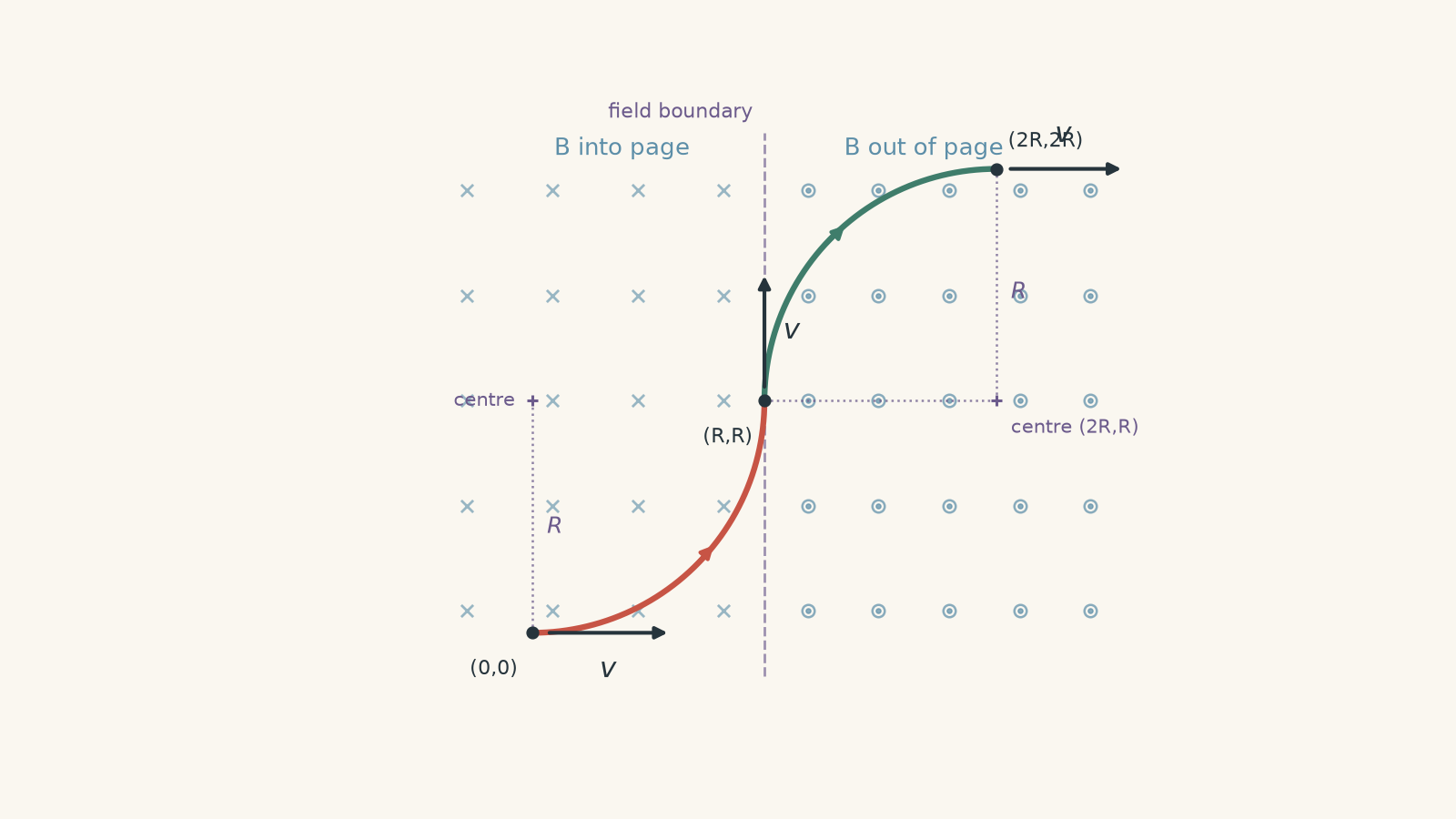
Why doesn’t it retrace its old path? Retracing would require the velocity at \((R,R)\) to point downwards along the old circle. Reversing \(\vec B\) reverses the magnetic acceleration, but it does not reverse \(\vec v\). The particle therefore begins a new tangent arc on the opposite side.
Question 5
Particles of unknown charge sign enter a region travelling to the right. A uniform magnetic field points into the page, and a uniform electric field points downwards.
At speed \(v_0\), the particles pass straight through without deflection.
The source is then adjusted so particles enter at \(1.20v_0\), still travelling to the right. These faster particles initially deflect downwards.
After one particle has begun to curve, its velocity points mostly rightwards but has acquired a small downward component.
Answer all of the following:
- Derive the relationship between \(v_0\), the electric field strength \(E\), and magnetic field strength \(B\).
- Can the undeflected motion at \(v_0\) alone tell you whether the particles are positive or negative?
- Use the observed downward deflection at \(1.20v_0\) to determine the charge sign.
- Suppose the electric field is suddenly switched off after the particle has acquired its small downward velocity component. The magnetic force now has a leftward component. Does that leftward component reduce the particle’s speed?
- If the electric field is instead left switched on, determine whether it initially increases or decreases the particle’s kinetic energy once the downward velocity component has developed.
Solution 5
The particles are negatively charged, \(v_0=E/B\), the magnetic field alone cannot change their speed, and the electric field initially decreases their kinetic energy once they are moving partly downwards.
For the original undeflected beam, the electric and magnetic forces must have equal magnitudes:
\[
F_E=F_B.
\]
Because the particles enter perpendicular to the magnetic field,
\[
|q|E=|q|v_0B.
\]
Cancelling \(|q|\) gives
\[
v_0=\frac{E}{B}.
\]
The straight path does not reveal the charge sign.
To see why, first imagine a positive charge. It moves right while \(\vec B\) points into the page, so its magnetic force points upwards. Its electric force points downwards. The two can cancel.
Now reverse the charge sign. Both forces reverse: the magnetic force points downwards and the electric force points upwards. They still cancel.
So an undeflected particle at the selector speed tells you the speed, but not whether the charge is positive or negative. The tempting conclusion that “the forces have these directions, therefore the particle must be positive” forgets that changing \(q\) reverses both forces simultaneously.
Now increase the speed to \(1.20v_0\).
The electric force magnitude remains
\[
F_E=|q|E.
\]
The magnetic force becomes
\[
F_B=|q|(1.20v_0)B.
\]
Since \(v_0B=E\),
\[
F_B=1.20|q|E.
\]
The magnetic force is now larger than the electric force.
For a positive particle, the stronger magnetic force would point upwards, producing a net upward deflection. The observed deflection is downward, so the particle must be negatively charged.
Now consider the later instant when the negative particle is moving both rightwards and slightly downwards.
If the electric field is switched off, only the magnetic force remains. Because the velocity is no longer exactly horizontal, the magnetic-force direction is also no longer exactly vertical. For this negative particle, it has both leftward and downward components.
It is tempting to see the leftward force component and conclude, “The particle is moving right, so that component must slow it down.”
That considers only one component of the motion.
The particle also has a downward velocity component, and the magnetic force has a corresponding downward component. The two contributions fit together so that the complete magnetic force remains exactly perpendicular to the complete velocity.
Therefore, the magnetic field does no work and cannot change the particle’s total speed. It redistributes the velocity between horizontal and vertical directions as the trajectory bends, but
\[
|\vec v|
\]
remains constant.
Finally, leave the electric field switched on.
The electric field points downwards, but the particle is negative, so its electric force points upwards. The particle now has a downward component of velocity. The electric force therefore has a component opposite the particle’s motion and initially does negative work.
Its kinetic energy begins to decrease.
This is the conceptual hinge: magnetic force can have a component opposite one coordinate component of velocity without reducing the total speed, because the full magnetic force remains perpendicular to the full velocity. An electric force has no such restriction and can change the particle’s kinetic energy.
That distinction is what lets you move from isolated \(F=qvB\sin\theta\) calculations to predicting complete charged-particle trajectories in combined electric and magnetic fields.