
Circular Motion of a Charge in a Magnetic Field: HSC Physics
Learn how magnetic force produces circular motion, then derive the radius and period of a charged particle in a uniform magnetic field.
A proton shoots into a uniform magnetic field at right angles to the field. The magnetic force is sideways, not forwards or backwards. So what should happen next: does the proton speed up, slow down, spiral away, or settle into a circle?
The key is that a sideways force can change the direction of a velocity without changing its size. If the magnetic field is uniform, that sideways force keeps turning with the particle and always points towards the same moving centre. The result is circular motion.
That gives us two useful questions straight away: how large is the circle, and how long does one orbit take?
01Why a magnetic field can produce a circle
Start with a particle of mass \(m\), charge \(q\), and speed \(v\), moving perpendicular to a uniform magnetic field of magnitude \(B\).
For a moving charge, the magnetic force has magnitude
\[
F_B = |q|vB
\]
when the velocity is perpendicular to the field. The absolute value \( |q| \) matters here because the magnitude of the force is positive. The sign of the charge controls the direction of the force, which we will deal with shortly.
If you need to refresh how this force is found and directed, see Force on a Moving Charge in a Magnetic Field.
Now picture driving around a roundabout at constant speed. Your speedometer can stay fixed even though your velocity is changing, because velocity includes direction. Something must continuously pull or push you towards the centre of the circle.
A charged particle in a magnetic field behaves in a similar way. The analogy is useful because the magnetic force acts like the inward turning force. It breaks down because a car needs contact forces from the road and loses energy through friction, while an ideal magnetic force acts directly on the moving charge and does no work.
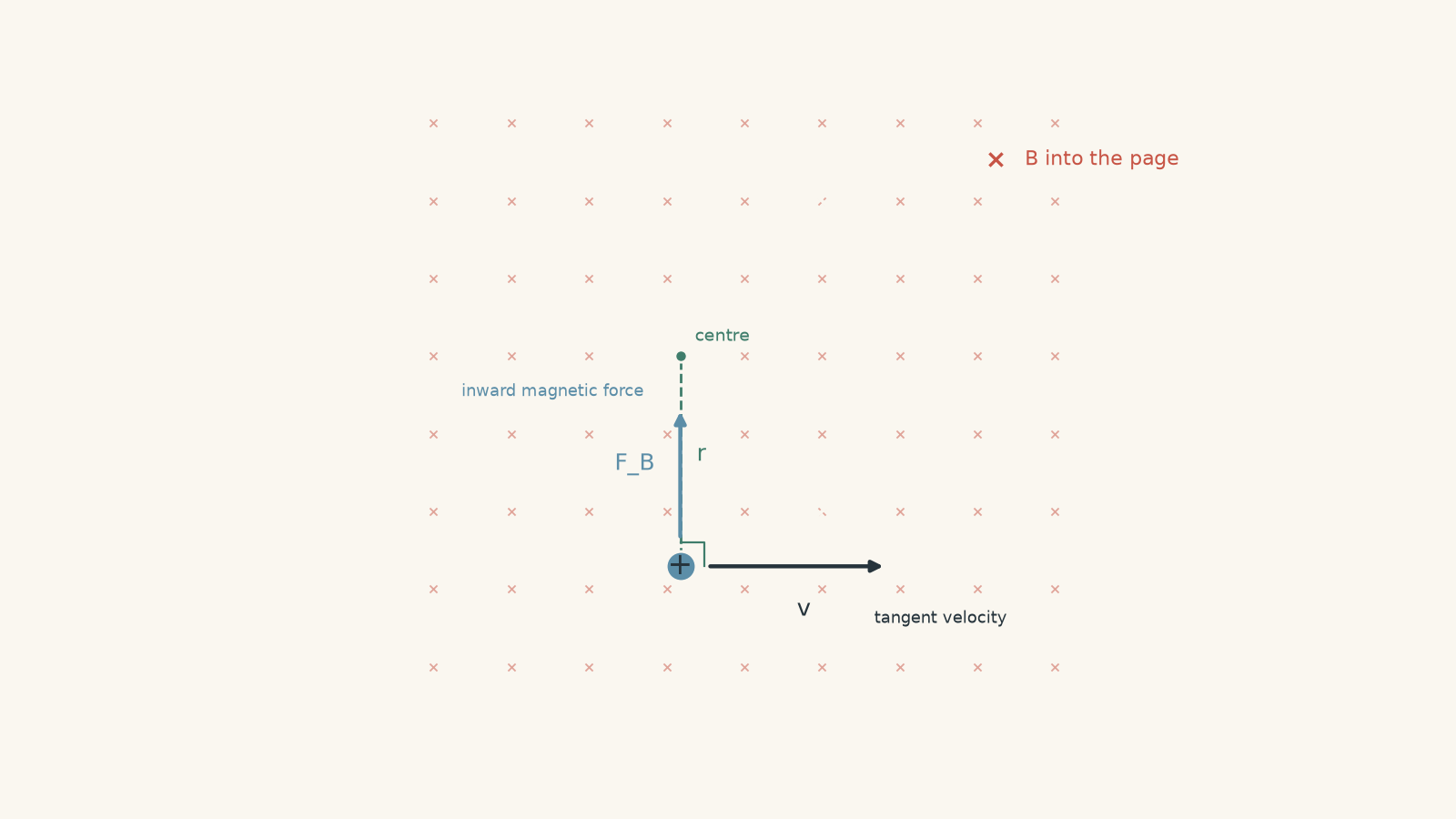
For circular motion, the required inward net force is
\[
F_c = \frac{mv^2}{r}
\]
where \(r\) is the radius of the circle.
There is an important wording point here. The “centripetal force” is not an extra force that appears alongside the magnetic force. It is the name we give to the net force pointing towards the centre.
In this situation, the magnetic force is the centripetal force.
02Deriving the radius
Because the magnetic force supplies the required inward force,
\[
F_B = F_c
\]
so
\[
|q|vB = \frac{mv^2}{r}.
\]
For a moving particle, divide both sides by \(v\):
\[
|q|B = \frac{mv}{r}.
\]
Rearranging gives
\[
r = \frac{mv}{|q|B}.
\]
This equation is worth understanding rather than memorising.
The radius becomes larger if the particle has:
- greater mass \(m\),
- greater speed \(v\), or
- a weaker magnetic field \(B\).
The radius becomes smaller if the magnitude of the charge \( |q| \) is larger.
You can also write the numerator as momentum, because in the non-relativistic HSC model \(p=mv\):
\[
r = \frac{p}{|q|B}.
\]
So a magnetic field is effectively measuring how difficult the particle’s momentum is to bend.
A fast, massive particle is stubborn. A strongly charged particle in a strong magnetic field is much easier to turn.
03Why the particle’s speed stays constant
A common first prediction is that the magnetic force must eventually slow the particle down. After all, it is constantly forcing the particle away from the direction it “wants” to travel.
But look at the angle between the force and the instantaneous motion. It is always \(90^\circ\).
Work done by a constant force over a small displacement is related to
\[
W = Fs\cos\theta.
\]
For the magnetic force,
\[
\theta = 90^\circ
\]
so the magnetic force does no work on the particle.
No work means no change in kinetic energy. Therefore, if the magnetic force is the only force doing anything significant,
\[
K = \frac{1}{2}mv^2
\]
remains constant, and so does the speed.
The velocity still changes because its direction changes continuously.
That distinction is the heart of the circular-motion model: constant speed does not mean constant velocity.
04Deriving the period
The period \(T\) is the time required for one complete orbit.
For one circle, the particle travels a distance equal to the circumference,
\[
2\pi r.
\]
Time is distance divided by speed, so
\[
T = \frac{2\pi r}{v}.
\]
Now substitute
\[
r = \frac{mv}{|q|B}.
\]
Then
\[
T
= \frac{2\pi}{v}\left(\frac{mv}{|q|B}\right)
= \frac{2\pi m}{|q|B}.
\]
Therefore,
\[
\boxed{T = \frac{2\pi m}{|q|B}}.
\]
Notice what vanished: \(v\).
Within this non-relativistic model, the period does not depend on the particle’s speed.
That feels odd at first. If the particle moves faster, shouldn’t it finish the orbit sooner?
It would, if the size of the orbit stayed fixed. But it does not. From
\[
r=\frac{mv}{|q|B},
\]
doubling \(v\) doubles \(r\). The circumference therefore doubles as well. The particle travels twice as fast around a path that is twice as long, so the time for one orbit stays unchanged.
That cancellation is one of the most useful results in this topic.
05What controls radius and period?
For the same particle unless stated otherwise:
| Change | Effect on radius \(r\) | Effect on period \(T\) |
|---|---|---|
| Increase \(v\) | Increases | No change |
| Increase \(B\) | Decreases | Decreases |
| Increase \(m\) | Increases | Increases |
| Increase \( |q| \) | Decreases | Decreases |
| Reverse the sign of \(q\) | No change | No change |
| Reverse \(B\) | No change | No change |
Reversing the charge or magnetic field changes which way the path curves. It does not change the size of the circle.
06What determines the direction?
The equations for radius and period use \( |q| \), so they do not tell you whether the path bends clockwise or anticlockwise.
Direction comes from the magnetic force.
For a positive charge, use the direction of
\[
\vec F_B = q\vec v\times\vec B.
\]
For a negative charge, reverse the force direction you would obtain for a positive charge moving in the same way.
Suppose a particle initially moves to the right while the magnetic field points into the page. A positive charge experiences an upward magnetic force. A negative charge experiences a downward force.
The force then keeps changing direction as the particle moves, remaining perpendicular to its velocity and pointing towards the centre of its circular path.
07The condition students often skip: \(v\) must be perpendicular to \(B\)
The simple equation
\[
F_B=|q|vB
\]
assumes that the particle moves at \(90^\circ\) to the magnetic field.
More generally,
\[
F_B=|q|vB\sin\theta,
\]
where \(\theta\) is the angle between the velocity and the magnetic field.
Only the component of velocity perpendicular to the field is bent.
If we call that component \(v_\perp\), then the circular radius is
\[
r=\frac{mv_\perp}{|q|B}.
\]
Any velocity component parallel to the field, \(v_\parallel\), is unaffected by the magnetic force. The particle therefore moves forwards along the field while circling around it, producing a helix.
There are two useful boundary cases:
- If \(\theta=90^\circ\), all of the velocity is perpendicular, so the path is a circle.
- If \(\theta=0^\circ\), then \(\sin\theta=0\), so there is no magnetic force and the particle continues in a straight line.
So “a charged particle in a magnetic field moves in a circle” is not quite the exact statement.
A charged particle moving perpendicular to a uniform magnetic field, with the magnetic force providing the net force, moves in a circle.
08Worked example: Find a proton’s radius and period
A proton moves at \(2.50\times10^6\text{ m s}^{-1}\) perpendicular to a uniform magnetic field of strength \(0.300\text{ T}\). Calculate the radius of its path and its period. Use \(m_p=1.67\times10^{-27}\text{ kg}\) and \(e=1.60\times10^{-19}\text{ C}\).
Step 1
The proton’s velocity is perpendicular to the magnetic field, so
\[
F_B=qvB.
\]
The magnetic force provides the centripetal force, giving
\[
r=\frac{mv}{qB}.
\]
Step 2
\[
\begin{aligned}
r
&=\frac{(1.67\times10^{-27})(2.50\times10^6)}
{(1.60\times10^{-19})(0.300)}\\
&=8.70\times10^{-2}\text{ m}.
\end{aligned}
\]
So
\[
r=0.0870\text{ m}.
\]
The proton travels in a circle with a radius of about \(8.7\text{ cm}\).
Step 3
\[
\begin{aligned}
T
&=\frac{2\pi m}{qB}\\
&=\frac{2\pi(1.67\times10^{-27})}
{(1.60\times10^{-19})(0.300)}\\
&=2.19\times10^{-7}\text{ s}.
\end{aligned}
\]
So the proton takes
\[
T=2.19\times10^{-7}\text{ s}
\]
to complete one orbit.
Step 4
The speed appeared in the radius calculation but not the final period calculation. If this proton entered the same field at twice the speed, its circular radius would double, but its period would remain \(2.19\times10^{-7}\text{ s}\).
09Worked example: A particle accelerated before entering the field
An alpha particle starts from rest and is accelerated through a potential difference of \(2.00\text{ kV}\). It then enters a \(0.500\text{ T}\) magnetic field perpendicular to the field lines. Calculate its speed, circular radius, and period.
Use \(m_\alpha=6.64\times10^{-27}\text{ kg}\) and \(q_\alpha=+3.20\times10^{-19}\text{ C}\).
Step 1
An electric field can do work on a charge. If the alpha particle starts from rest,
\[
qV=\frac12mv^2.
\]
Here,
\[
V=2.00\times10^3\text{ V}.
\]
Rearranging,
\[
v=\sqrt{\frac{2qV}{m}}.
\]
Substitute:
\[
\begin{aligned}
v
&=\sqrt{
\frac{2(3.20\times10^{-19})(2.00\times10^3)}
{6.64\times10^{-27}}
}\\
&=4.39\times10^5\text{ m s}^{-1}.
\end{aligned}
\]
Step 2
\[
\begin{aligned}
r
&=\frac{mv}{qB}\\
&=\frac{(6.64\times10^{-27})(4.39\times10^5)}
{(3.20\times10^{-19})(0.500)}\\
&=1.82\times10^{-2}\text{ m}.
\end{aligned}
\]
So
\[
r=1.82\text{ cm}.
\]
Step 3
\[
\begin{aligned}
T
&=\frac{2\pi m}{qB}\\
&=\frac{2\pi(6.64\times10^{-27})}
{(3.20\times10^{-19})(0.500)}\\
&=2.61\times10^{-7}\text{ s}.
\end{aligned}
\]
Step 4
The electric field increased the alpha particle’s kinetic energy and established its speed. The magnetic field then changed the direction of that velocity without changing its magnitude.
That difference is useful when comparing magnetic motion with charged-particle trajectories in electric fields.
10Three tempting mistakes
Treating centripetal force as an additional force
A student might write
\[
F_{\text{net}}=F_B+F_c.
\]
That double-counts the same physical job.
“Centripetal force” means the net inward force required for circular motion. Here,
\[
F_B=F_c.
\]
Assuming a faster particle has a shorter period
A faster particle does cover distance more quickly, but its orbit also becomes larger.
Because
\[
r\propto v,
\]
the increase in orbital distance exactly matches the increase in speed. Therefore,
\[
T=\frac{2\pi m}{|q|B}
\]
is independent of \(v\) in the non-relativistic model.
Assuming the magnetic field gives the particle its kinetic energy
A magnetic field bends the trajectory, but it does not increase the particle’s kinetic energy because its force is perpendicular to the motion.
If the speed changes, some other interaction must be involved, such as an electric field.
11Questions and solutions
Question 1
An electron moves to the right at \(4.00\times10^6\text{ m s}^{-1}\) through a uniform magnetic field of \(0.250\text{ T}\) directed into the page.
Calculate the radius of its circular path and state whether it initially curves upwards or downwards.
Use \(m_e=9.11\times10^{-31}\text{ kg}\) and \(e=1.60\times10^{-19}\text{ C}\).
Solution 1
The electron follows a path of radius \(9.11\times10^{-5}\text{ m}\) and initially curves downwards.
For the radius, use the magnitude of the electron charge:
\[
\begin{aligned}
r
&=\frac{mv}{|q|B}\\
&=\frac{(9.11\times10^{-31})(4.00\times10^6)}
{(1.60\times10^{-19})(0.250)}\\
&=9.11\times10^{-5}\text{ m}.
\end{aligned}
\]
For a positive charge moving to the right with \(B\) into the page, the magnetic force would point upwards. An electron has negative charge, so its force is in the opposite direction: downwards.
The tempting mistake is to put the negative electron charge directly into the radius equation and obtain a “negative radius”. Radius is a magnitude. The charge sign controls curvature direction, not the size of the orbit.
Question 2
A charged particle moves perpendicular to a uniform \(0.300\text{ T}\) magnetic field. It travels through exactly half of a circular path of radius \(0.0800\text{ m}\) in \(3.30\times10^{-7}\text{ s}\).
Determine:
- the particle’s speed, and
- its mass-to-charge-magnitude ratio \(m/|q|\).
Solution 2
The particle’s speed is \(7.62\times10^5\text{ m s}^{-1}\), and its mass-to-charge ratio is \(3.15\times10^{-8}\text{ kg C}^{-1}\).
For a semicircle, the distance travelled is not \(2\pi r\). It is
\[
s=\pi r.
\]
Therefore,
\[
\begin{aligned}
v
&=\frac{\pi r}{t}\\
&=\frac{\pi(0.0800)}
{3.30\times10^{-7}}\\
&=7.62\times10^5\text{ m s}^{-1}.
\end{aligned}
\]
The given time is half a period, so
\[
T=2(3.30\times10^{-7})
=6.60\times10^{-7}\text{ s}.
\]
Using
\[
T=\frac{2\pi m}{|q|B},
\]
rearrange:
\[
\frac{m}{|q|}
=\frac{TB}{2\pi}.
\]
Then
\[
\begin{aligned}
\frac{m}{|q|}
&=\frac{(6.60\times10^{-7})(0.300)}
{2\pi}\\
&=3.15\times10^{-8}\text{ kg C}^{-1}.
\end{aligned}
\]
A tempting route is to use the semicircle time directly as \(T\). That would halve the calculated \(m/|q|\). The geometry determines how much of a complete period has actually elapsed.
Question 3
A proton and an alpha particle enter the same uniform magnetic field perpendicular to the field lines. They have the same kinetic energy.
For this question, take
\[
m_\alpha=4m_p
\]
and
\[
q_\alpha=2q_p.
\]
Compare:
- their orbital radii, and
- their periods.
Solution 3
The proton and alpha particle have the same orbital radius, while the alpha particle’s period is twice the proton’s period.
The surprising part is the radius. It is tempting to reason from
\[
r=\frac{mv}{qB}
\]
and say that the alpha particle’s larger mass must produce a larger circle. But the particles do not have the same speed.
For a fixed kinetic energy \(K\),
\[
K=\frac12mv^2.
\]
Therefore,
\[
v=\sqrt{\frac{2K}{m}}.
\]
Substitute this into the radius equation:
\[
\begin{aligned}
r
&=\frac{m}{|q|B}\sqrt{\frac{2K}{m}}\\
&=\frac{\sqrt{2mK}}{|q|B}.
\end{aligned}
\]
For the alpha particle relative to the proton,
\[
\frac{r_\alpha}{r_p}
=
\frac{\sqrt{m_\alpha}/q_\alpha}
{\sqrt{m_p}/q_p}.
\]
Using \(m_\alpha=4m_p\) and \(q_\alpha=2q_p\),
\[
\frac{r_\alpha}{r_p}
=
\frac{\sqrt4}{2}
=1.
\]
So their radii are equal.
For the period,
\[
T=\frac{2\pi m}{|q|B},
\]
so
\[
\frac{T_\alpha}{T_p}
=
\frac{m_\alpha/q_\alpha}
{m_p/q_p}
=
\frac{4}{2}
=2.
\]
The alpha particle therefore takes twice as long to complete the same-sized circle.
The key constraint is equal kinetic energy, not equal speed. The alpha particle’s greater mass means it moves more slowly, and that reduced speed exactly offsets the mass and charge factors in the radius.
Question 4
An unknown positive particle starts from rest and is accelerated through a potential difference of \(30.0\text{ kV}\). It then enters a \(0.200\text{ T}\) uniform magnetic field at right angles.
Its circular path has radius \(0.150\text{ m}\), and its measured period is \(4.71\times10^{-7}\text{ s}\).
A student argues:
“We know the accelerating voltage, magnetic field, radius, and period, so there is enough information to calculate the particle’s mass and charge separately.”
Test the student’s claim. Determine the particle’s speed and \(m/q\), check whether the accelerating voltage is consistent with the magnetic measurements, and decide whether \(m\) and \(q\) can actually be found separately.
Solution 4
The particle’s speed is approximately \(2.00\times10^6\text{ m s}^{-1}\), its mass-to-charge ratio is \(1.50\times10^{-8}\text{ kg C}^{-1}\), and the \(30.0\text{ kV}\) accelerating voltage is consistent with those measurements. However, the mass and charge still cannot be determined separately from the information given.
First, combine the radius and period relations.
Since
\[
T=\frac{2\pi r}{v},
\]
the speed is
\[
\begin{aligned}
v
&=\frac{2\pi r}{T}\\
&=\frac{2\pi(0.150)}
{4.71\times10^{-7}}\\
&=2.00\times10^6\text{ m s}^{-1}.
\end{aligned}
\]
Next, use the period equation:
\[
T=\frac{2\pi m}{qB}.
\]
Because the particle is positive, \(q=|q|\). Rearranging,
\[
\frac{m}{q}
=\frac{TB}{2\pi}.
\]
So
\[
\begin{aligned}
\frac{m}{q}
&=\frac{(4.71\times10^{-7})(0.200)}
{2\pi}\\
&=1.50\times10^{-8}\text{ kg C}^{-1}.
\end{aligned}
\]
Now check the accelerating voltage.
Starting from rest,
\[
qV=\frac12mv^2.
\]
Divide by \(q\):
\[
V=\frac12\left(\frac{m}{q}\right)v^2.
\]
Substituting the magnetic measurements,
\[
\begin{aligned}
V
&=\frac12(1.50\times10^{-8})(2.00\times10^6)^2\\
&=3.00\times10^4\text{ V}\\
&=30.0\text{ kV}.
\end{aligned}
\]
So the measurements agree.
The student’s tempting argument is that there seem to be several equations for several unknowns. The catch is that the equations are not giving independent information about \(m\) and \(q\).
The magnetic period determines the ratio
\[
\frac{m}{q},
\]
not \(m\) or \(q\) individually. The accelerating-voltage equation also reduces to a condition involving that same ratio:
\[
\frac{m}{q}=\frac{2V}{v^2}.
\]
If both \(m\) and \(q\) were doubled, for example, all of these measurements would remain unchanged.
An additional independent measurement or assumption about the charge state would be needed to determine the actual mass and charge separately.
Question 5
A positive ion moves in a uniform magnetic field \(B\). A narrow accelerating gap lies along a diameter of its orbit. Each time the ion crosses the gap, an electric field increases its kinetic energy by the same amount \(\Delta K\). Outside the gap, only the uniform magnetic field acts.
Immediately after one particular crossing, the ion has kinetic energy \(K_0\).
Assume the motion remains non-relativistic.
Determine:
- the time between successive crossings of the gap,
- the radius after \(n\) further energy increases,
- whether the difference between successive orbital radii stays constant, increases, or decreases, and
- why an alternating electric field with one fixed frequency can continue accelerating the ion even though each semicircular path becomes larger.
Solution 5
The ion crosses the gap every \(\pi m/(qB)\), its radius after \(n\) further energy increases is
\[
r_n=\frac{\sqrt{2m(K_0+n\Delta K)}}{qB},
\]
the spacing between successive radii decreases, and a fixed alternating field can remain synchronised because the increase in path length is exactly matched by the increase in speed.
Start with the time for a complete magnetic orbit:
\[
T=\frac{2\pi m}{qB}.
\]
The gap lies on a diameter, so the ion reaches it after each semicircle. Therefore,
\[
t_{\text{gap}}
=\frac{T}{2}
=\frac{\pi m}{qB}.
\]
This time contains no \(v\) and no kinetic energy.
Now consider the orbit size.
After \(n\) additional crossings that each add \(\Delta K\),
\[
K_n=K_0+n\Delta K.
\]
Using
\[
K_n=\frac12mv_n^2,
\]
the speed is
\[
v_n=\sqrt{\frac{2K_n}{m}}.
\]
The magnetic radius is
\[
r_n=\frac{mv_n}{qB}.
\]
Substituting,
\[
\begin{aligned}
r_n
&=\frac{m}{qB}
\sqrt{\frac{2(K_0+n\Delta K)}{m}}\\
&=\frac{\sqrt{2m(K_0+n\Delta K)}}{qB}.
\end{aligned}
\]
Therefore,
\[
r_n\propto\sqrt{K_0+n\Delta K}.
\]
The radius increases after every acceleration, but equal increases in kinetic energy do not produce equal increases in radius.
The spacing between successive radii is
\[
r_{n+1}-r_n
=
\frac{\sqrt{2m}}{qB}
\left[
\sqrt{K_0+(n+1)\Delta K}
–
\sqrt{K_0+n\Delta K}
\right].
\]
As \(n\) becomes larger, the difference between the two square roots becomes smaller. The orbital radii therefore become progressively closer together.
The main conceptual trap is to look only at the growing radius. A larger semicircle has a greater path length, so it is tempting to conclude that the ion must arrive at the gap later each time.
But its speed has increased as well.
For a semicircle,
\[
t=\frac{\pi r}{v}.
\]
Substituting
\[
r=\frac{mv}{qB}
\]
gives
\[
t
=
\frac{\pi}{v}\frac{mv}{qB}
=
\frac{\pi m}{qB}.
\]
The speed cancels exactly.
So even though the ion moves through larger and larger semicircles, it returns to the gap after the same time on every pass.
The electric field must reverse direction between crossings so that it pushes the positive ion forwards rather than slowing it down. Since crossings occur every \(T/2\), an alternating field with full period
\[
T=\frac{2\pi m}{qB}
\]
can stay synchronised. Its frequency is therefore
\[
f=\frac{1}{T}
=\frac{qB}{2\pi m}.
\]
This is the central idea behind a cyclotron.
The fixed-period result depends on the assumptions used to derive it. At speeds where relativistic effects become significant, the simple non-relativistic relationship no longer remains exact.
12What this result lets you do next
The two equations
\[
r=\frac{mv_\perp}{|q|B}
\]
and
\[
T=\frac{2\pi m}{|q|B}
\]
tell you different things about a charged particle.
The radius contains information about its perpendicular momentum. The period contains information about its mass-to-charge ratio. Together, they let you reason backwards from an observed trajectory rather than merely predicting one.
The next useful comparison is with electric fields. Electric fields can change a particle’s kinetic energy, while magnetic fields can bend its velocity without changing its speed. Once those two roles are kept separate, devices that combine electric and magnetic fields become much easier to analyse.