
Electric Fields vs Magnetic Fields: HSC Physics Explained
Learn how electric and magnetic fields act differently on charged particles, including force direction, motion, and energy transfer. Includes worked examples and challenging HSC-style questions.
Put a proton at rest inside both an electric field and a magnetic field. Which field pushes it?
The electric field does. The magnetic field does nothing to the stationary proton.
Now launch the proton across the same region. The magnetic field can suddenly exert a force as well. Here is the more important prediction: if that magnetic force bends the proton through a large angle, has the magnetic field transferred energy to it?
No. A magnetic field can strongly change a charged particle’s direction while leaving its speed, and therefore its kinetic energy, unchanged. That difference between changing motion and changing energy is the key to separating electric and magnetic fields in HSC Physics.
01The first mental model: push versus steering
An electric field can push a charge whether the charge is moving or stationary.
A magnetic field needs the charge to be moving. Even then, it does not push forwards or backwards along the particle’s motion. Its force is sideways.
A useful first picture is this:
- an electric field can act like an accelerator, because its force can have a component along the motion;
- a magnetic field acts more like steering, because its force is perpendicular to the motion.
That model is useful, but incomplete. An electric field can also steer a particle if its force is not parallel to the velocity, and a magnetic field does not act on every moving charge: a charge travelling exactly parallel to the magnetic field experiences no magnetic force.
The steering analogy also has a limit. A real car’s steering involves forces from tyres and the road. For an ideal charged particle in the HSC model, the magnetic force is precisely perpendicular to its instantaneous velocity, which is why it does no work.
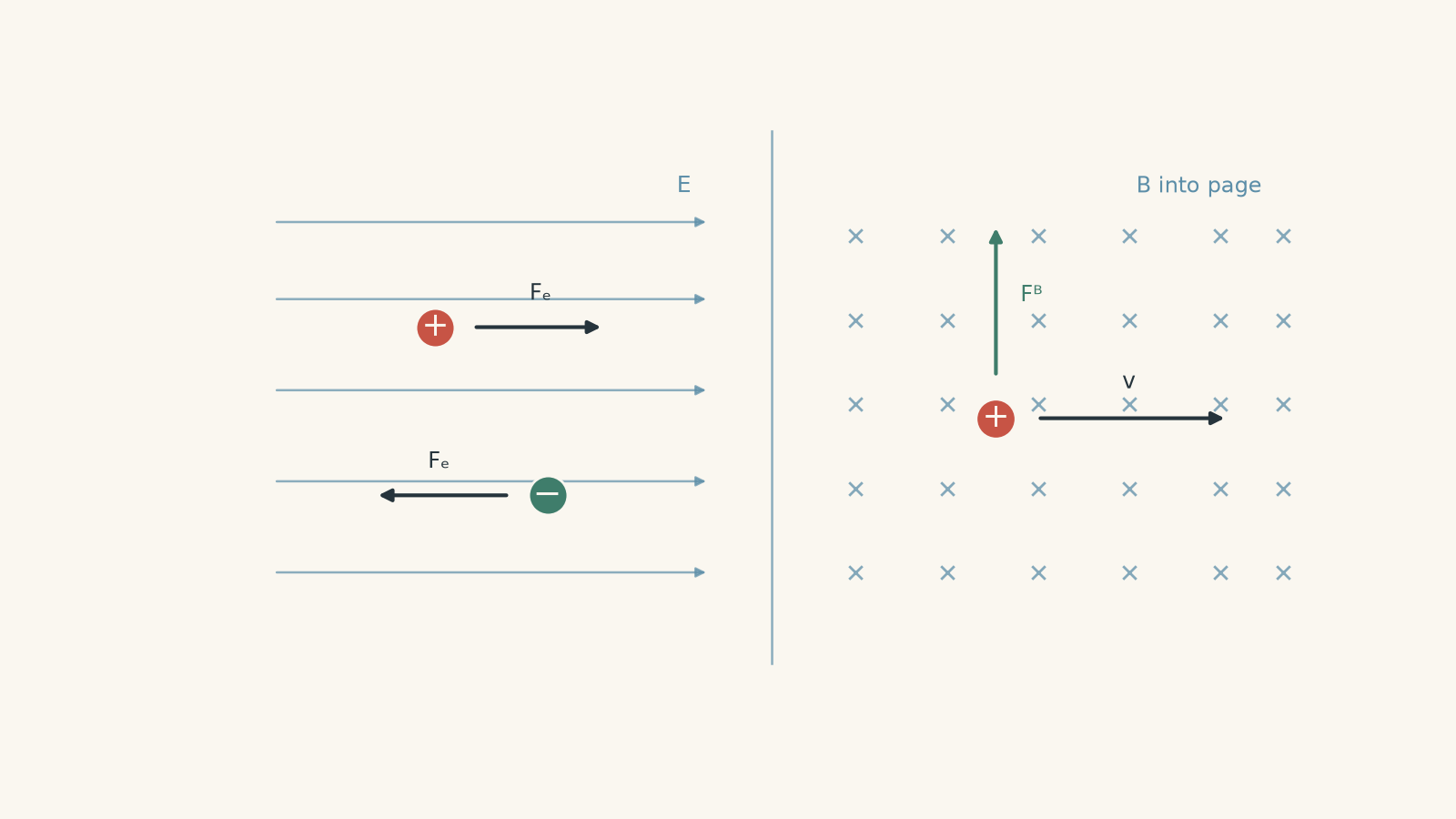
02Electric force: motion is not required
For a charge \(q\) in an electric field \(\mathbf E\),
\[
\mathbf F_E=q\mathbf E
\]
where:
- \(\mathbf F_E\) is the electric force in newtons, N,
- \(q\) is the charge in coulombs, C, and
- \(\mathbf E\) is the electric field strength in newtons per coulomb, N C\(^{-1}\), which is equivalent to volts per metre, V m\(^{-1}\).
For magnitudes,
\[
F_E=|q|E
\]
A positive charge feels a force in the direction of the electric field. A negative charge feels a force in the opposite direction.
Notice what is missing from the equation: velocity. The charge does not need to be moving.
A stationary proton in a rightward electric field immediately has a rightward force. A stationary electron in the same field immediately has a leftward force.
03Magnetic force: velocity matters
For a moving charge in a magnetic field,
\[
\mathbf F_B=q\mathbf v\times\mathbf B
\]
For HSC calculations, its magnitude is usually written as
\[
F_B=|q|vB\sin\theta
\]
where:
- \(F_B\) is the magnetic force in newtons, N,
- \(v\) is the particle’s speed in metres per second, m s\(^{-1}\),
- \(B\) is magnetic field strength in tesla, T, and
- \(\theta\) is the angle between the velocity and the magnetic field.
This immediately gives three useful cases.
| Motion relative to \(\mathbf B\) | Magnetic force |
|---|---|
| Particle stationary | \(0\) |
| Moving parallel or antiparallel to \(\mathbf B\) | \(0\) |
| Moving at some other angle | \(|q|vB\sin\theta\) |
| Moving perpendicular to \(\mathbf B\) | Maximum: \(|q|vB\) |
For a positive charge, use the right-hand rule for \(\mathbf v\times\mathbf B\). Reverse that direction for a negative charge.
The important geometric fact is that whenever the magnetic force is non-zero, it is perpendicular to the particle’s velocity.
That is why a magnetic field can produce acceleration without increasing speed. Acceleration means a change in the velocity vector. Changing direction counts.
04What if both fields are present?
The electric and magnetic forces simply add as vectors:
\[
\mathbf F=q(\mathbf E+\mathbf v\times\mathbf B)
\]
This is the Lorentz force.
Do not automatically compare \(E\) and \(B\) as raw numbers. They have different units. Compare the actual forces:
\[
F_E=|q|E
\]
and, for perpendicular motion,
\[
F_B=|q|vB
\]
Because the same \(|q|\) appears in each expression, a common special case occurs when the two forces point in opposite directions and have equal magnitudes:
\[
|q|E=|q|vB
\]
so
\[
v=\frac{E}{B}
\]
A particle travelling at this speed can pass straight through crossed electric and magnetic fields without being deflected.
That does not mean neither field is acting. Two non-zero forces can cancel.
05Force and energy are not the same question
This is where many otherwise solid answers go wrong.
A force tells you how momentum changes. Work tells you whether energy is transferred.
An electric field can do work on a charge. A magnetic field, by itself, cannot.
Electric fields can change kinetic energy
The electric potential energy of a charge is
\[
U=qV
\]
where \(V\) is electric potential in volts.
If a charge moves from initial potential \(V_i\) to final potential \(V_f\),
\[
\Delta U=q(V_f-V_i)
\]
The work done by the electric field is the negative change in electric potential energy:
\[
W_E=-\Delta U=q(V_i-V_f)
\]
If no other force transfers energy,
\[
\Delta K=W_E
\]
so
\[
\Delta K=q(V_i-V_f)
\]
This is often more useful than trying to track every part of the trajectory.
For a uniform electric field, the same idea can be written as
\[
W_E=qEs\cos\phi
\]
where \(s\) is the displacement and \(\phi\) is the angle between the electric field and the displacement.
So an electric field does not always transfer energy. If a charge moves exactly perpendicular to \(\mathbf E\), then \(\cos90^\circ=0\), and the electric field does no work during that displacement.
Magnetic fields do no work
Work depends on the component of force along the displacement.
A magnetic force is always perpendicular to the instantaneous velocity and therefore perpendicular to the particle’s instantaneous displacement.
So
\[
W_B=0
\]
The magnetic field can change the particle’s momentum direction, but not the magnitude of its momentum in the non-relativistic HSC model.
Equivalently, it can change direction without changing kinetic energy.
This is the same reason uniform circular motion can involve a continuous acceleration while the speed stays constant.
One tempting argument is: “There is a magnetic force, so the particle accelerates, so it must speed up.”
The first two statements are correct. The last one is not. Acceleration can change direction rather than speed.
Within the HSC treatment, we also neglect effects such as radiation from accelerating charges and collisions with matter.
A useful energy test
When both electric and magnetic fields are present, ask two separate questions:
- What is the net force, and therefore how does the trajectory change?
- What work is done, and therefore how does the kinetic energy change?
The magnetic field belongs in the first calculation. It does not contribute directly to the second.
For static electric fields,
\[
\Delta K=q(V_i-V_f)
\]
regardless of how complicated the magnetic field makes the path between those two points.
That fact becomes important later.
Worked example: an electron released in an electric field
An electron starts from rest in a uniform electric field of \(2.5\times10^4\) N C\(^{-1}\). It moves \(4.0\) mm directly opposite to the electric field. Calculate the magnitude of the electric force, the work done by the field, and the electron’s final speed.
Use \(|q_e|=1.60\times10^{-19}\) C and \(m_e=9.11\times10^{-31}\) kg.
Step 1
An electron has negative charge, so its electric force is opposite to \(\mathbf E\). Its displacement is also opposite to \(\mathbf E\), so the force and displacement point in the same direction.
The electric field therefore does positive work on the electron.
Step 2
\[
F_E=|q|E
=(1.60\times10^{-19})(2.5\times10^4)
=4.0\times10^{-15}\text{ N}
\]
Step 3
The displacement is
\[
d=4.0\times10^{-3}\text{ m}
\]
so
\[
W_E=|q|Ed
=(1.60\times10^{-19})(2.5\times10^4)(4.0\times10^{-3})
=1.60\times10^{-17}\text{ J}
\]
Because the electron starts from rest,
\[
K_f=1.60\times10^{-17}\text{ J}
\]
Step 4
Using
\[
K=\frac12mv^2
\]
gives
\[
v=\sqrt{\frac{2K}{m}}
=\sqrt{\frac{2(1.60\times10^{-17})}{9.11\times10^{-31}}}
=5.9\times10^6\text{ m s}^{-1}
\]
Step 5
The electron gains kinetic energy because the electric field does positive work on it.
There is a useful sign detail here. Moving opposite to \(\mathbf E\) means moving towards higher electric potential. The potential difference is
\[
\Delta V=Ed=(2.5\times10^4)(4.0\times10^{-3})=100\text{ V}
\]
Yet the electron’s electric potential energy decreases, because \(q\) is negative:
\[
\Delta U=q\Delta V=(-e)(100\text{ V})=-100\text{ eV}
\]
So “higher electric potential” does not automatically mean “higher electric potential energy”. The charge sign matters.
Worked example: a proton passing straight through crossed fields
A proton moves horizontally to the right through a uniform electric field of \(3.6\times10^4\) N C\(^{-1}\) directed upward. A uniform magnetic field of \(1.5\times10^{-2}\) T points out of the page.
Find the proton speed for which it passes through undeflected. Then calculate the magnitude of each force and determine the change in kinetic energy while it travels \(0.20\) m horizontally through the fields.
Use \(q_p=1.60\times10^{-19}\) C.
Step 1
The proton is positive, so the electric force points upward.
For a positive charge moving right while \(\mathbf B\) points out of the page, \(\mathbf v\times\mathbf B\) points downward.
The two forces can therefore cancel.
Step 2
For no deflection,
\[
qE=qvB
\]
The charge cancels:
\[
v=\frac{E}{B}
=\frac{3.6\times10^4}{1.5\times10^{-2}}
=2.4\times10^6\text{ m s}^{-1}
\]
Step 3
\[
F_E=qE
=(1.60\times10^{-19})(3.6\times10^4)
=5.8\times10^{-15}\text{ N}
\]
At the selected speed,
\[
F_B=qvB
=(1.60\times10^{-19})(2.4\times10^6)(1.5\times10^{-2})
=5.8\times10^{-15}\text{ N}
\]
The forces are equal and opposite, so the net force is zero.
Step 4
The proton moves horizontally while the electric field points vertically.
Therefore,
\[
W_E=qEs\cos90^\circ=0
\]
The magnetic field also does no work:
\[
W_B=0
\]
Hence,
\[
\Delta K=0
\]
Step 5
Both fields exert non-zero forces, but neither transfers energy during this straight horizontal motion.
The magnetic force never does work. The electric force happens to do no work here because it remains perpendicular to the displacement.
06A compact comparison
| Feature | Electric field | Magnetic field |
|---|---|---|
| Acts on a stationary charge? | Yes | No |
| Depends on particle speed? | No | Yes |
| Force magnitude | \(F_E=|q|E\) | \(F_B=|q|vB\sin\theta\) |
| Force direction for positive charge | Along \(\mathbf E\) | Along \(\mathbf v\times\mathbf B\) |
| Negative charge | Force reverses | Force reverses |
| Can change direction? | Yes | Yes |
| Can directly change speed? | Yes | No |
| Can directly change kinetic energy? | Yes, if it does work | No |
| Force when velocity is parallel to field | Electric force still acts | Magnetic force is zero |
A useful exam decision rule is simple: if the question asks about trajectory, consider both fields. If it asks about kinetic energy, look for electric work or a change in electric potential. Do not assign energy transfer to the magnetic force.
07Questions and solutions
Question 1
A proton and an electron are initially at rest in a region containing a uniform electric field of \(4.0\times10^3\) N C\(^{-1}\) directed east and a uniform magnetic field of \(0.20\) T directed north.
For each particle:
(a) determine the magnitude and direction of its initial electric force,
(b) determine its initial magnetic force, and
(c) identify which field can change its kinetic energy after it is released.
Use \(e=1.60\times10^{-19}\) C.
Solution 1
The proton initially experiences a \(6.4\times10^{-16}\) N electric force east, while the electron experiences the same magnitude west. Both initially experience zero magnetic force, and only the electric field can directly change their kinetic energy.
For either particle,
\[
F_E=|q|E
=(1.60\times10^{-19})(4.0\times10^3)
=6.4\times10^{-16}\text{ N}
\]
The proton is positive, so its force is in the direction of \(\mathbf E\): east.
The electron is negative, so its force is opposite to \(\mathbf E\): west.
For the magnetic force,
\[
F_B=|q|vB\sin\theta
\]
Initially \(v=0\), so
\[
F_B=0
\]
for both particles.
A tempting mistake is to use \(F_B=qvB\) with the magnetic field value but forget that the particles are stationary. A magnetic field may be present without exerting any force on a stationary point charge.
Once the particles begin moving, magnetic forces may appear depending on their velocity directions. Those magnetic forces can alter their paths, but they still do no work. The electric field supplies the kinetic-energy change.
Question 2
An electron enters a region moving horizontally to the right at \(3.0\times10^6\) m s\(^{-1}\).
The electric field is \(1.0\times10^5\) N C\(^{-1}\) upward, and the magnetic field is \(5.0\times10^{-2}\) T into the page.
Use \(|q_e|=1.60\times10^{-19}\) C.
(a) Find the magnitude and direction of the initial electric force.
(b) Find the magnitude and direction of the initial magnetic force.
(c) Find the initial net force.
(d) At the exact instant the electron enters the region, is its speed increasing, decreasing, or momentarily unchanged? Explain what happens immediately afterwards.
Solution 2
Both initial forces point downward, giving a net force of \(4.0\times10^{-14}\) N downward. Despite that non-zero net force, the electron’s speed is momentarily unchanged at the exact instant of entry because the force is perpendicular to its initial velocity; immediately afterwards, the electric field begins increasing its kinetic energy.
For the electric force,
\[
F_E=|q|E
=(1.60\times10^{-19})(1.0\times10^5)
=1.60\times10^{-14}\text{ N}
\]
The electric field points upward, but the electron is negative, so its electric force points downward.
For the magnetic force,
\[
F_B=|q|vB
\]
because the velocity is perpendicular to the magnetic field.
Therefore,
\[
F_B=(1.60\times10^{-19})(3.0\times10^6)(5.0\times10^{-2})
=2.40\times10^{-14}\text{ N}
\]
For a positive charge moving right through a magnetic field into the page, \(\mathbf v\times\mathbf B\) would point upward. The electron is negative, so its magnetic force is downward.
The forces therefore add:
\[
F_{\text{net}}
=1.60\times10^{-14}+2.40\times10^{-14}
=4.00\times10^{-14}\text{ N downward}
\]
It is tempting to conclude that a non-zero net force must mean the speed is immediately increasing. That is not necessarily true.
At the instant of entry, the electron’s velocity points right while the net force points down. The force is perpendicular to the velocity, so the instantaneous rate of work is zero.
The electron therefore begins by changing direction.
A moment later it has developed some downward velocity. The downward electric force then has a component along its motion and does positive work. Its kinetic energy starts increasing.
The magnetic force continues to remain perpendicular to the instantaneous velocity and contributes no work.
Question 3
A singly charged positive ion moves to the right through crossed fields. The electric field is \(2.4\times10^4\) N C\(^{-1}\) upward, and the magnetic field is \(1.2\times10^{-2}\) T out of the page.
(a) Find the speed at which the ion would pass through undeflected.
The ion actually enters at \(2.5\times10^6\) m s\(^{-1}\).
(b) State its initial direction of deflection.
Later, the ion is \(5.0\) mm below its initial horizontal line.
(c) Calculate its change in kinetic energy between entry and that point.
(d) Explain why the curved path produced by the magnetic field does not need to be known to calculate this energy change.
Use \(e=1.60\times10^{-19}\) C.
Solution 3
The undeflected speed is \(2.0\times10^6\) m s\(^{-1}\). At \(2.5\times10^6\) m s\(^{-1}\) the ion initially deflects downward, and after reaching a point \(5.0\) mm lower its kinetic energy has decreased by \(120\) eV, or \(1.92\times10^{-17}\) J.
For undeflected motion,
\[
qE=qvB
\]
so
\[
v=\frac{E}{B}
=\frac{2.4\times10^4}{1.2\times10^{-2}}
=2.0\times10^6\text{ m s}^{-1}
\]
The actual ion is faster than this.
At \(2.5\times10^6\) m s\(^{-1}\),
\[
vB=(2.5\times10^6)(1.2\times10^{-2})
=3.0\times10^4\text{ N C}^{-1}
\]
This is larger than the electric field strength of \(2.4\times10^4\) N C\(^{-1}\), so the magnetic force has the larger magnitude initially.
For a positive charge moving right with \(\mathbf B\) out of the page, the magnetic force is downward. The electric force is upward. The net force is therefore initially downward.
For the energy change, moving \(5.0\) mm downward means moving opposite to the upward electric field. The electric potential therefore rises by
\[
\Delta V=Ed
=(2.4\times10^4)(5.0\times10^{-3})
=120\text{ V}
\]
For a positive ion,
\[
\Delta K=q(V_i-V_f)=-q\Delta V
\]
so
\[
\Delta K=-(1.60\times10^{-19})(120)
=-1.92\times10^{-17}\text{ J}
\]
Equivalently,
\[
\Delta K=-120\text{ eV}
\]
The tempting mistake is to use the fact that the magnetic force was initially larger and attribute the energy decrease to the magnetic field.
The magnetic field determines much of the shape of the path, but it contributes zero work. The kinetic-energy change is determined by the electric potential difference between the starting and finishing points.
For a static electric field, the detailed route between those points is irrelevant to the electric work.
Question 4
The same singly charged positive ion is used in two experiments. Assume non-relativistic motion and perpendicular entry into each magnetic field.
In Run A, the ion starts from rest, gains \(800\) eV of kinetic energy while passing through an accelerating potential difference, and then enters a \(0.20\) T magnetic field. Its circular path has radius \(r\).
In Run B, the ion enters an accelerating region with some unknown initial kinetic energy \(K_0\). The electric field then adds \(400\) eV to its kinetic energy. It enters a \(0.10\) T magnetic field, and the measured radius is again \(r\).
Can any physically possible value of \(K_0\) make these observations consistent? Justify your answer.
Solution 4
No. The observations would require \(K_0=-200\) eV, which is impossible because kinetic energy cannot be negative. At least one of the stated assumptions or measurements must therefore be wrong.
For perpendicular motion in a uniform magnetic field,
\[
r=\frac{mv}{|q|B}
\]
or, using momentum \(p=mv\),
\[
p=|q|Br
\]
The same ion is used in both runs, and the measured radius is the same.
Therefore,
\[
\frac{p_B}{p_A}
=\frac{B_B}{B_A}
=\frac{0.10}{0.20}
=\frac12
\]
For the same non-relativistic particle,
\[
K=\frac{p^2}{2m}
\]
so halving the momentum makes the kinetic energy one quarter as large:
\[
K_B=\frac14K_A
\]
Run A has
\[
K_A=800\text{ eV}
\]
so the magnetic-radius measurement implies
\[
K_B=\frac14(800)=200\text{ eV}
\]
But in Run B,
\[
K_B=K_0+400\text{ eV}
\]
Therefore,
\[
K_0+400=200
\]
which gives
\[
K_0=-200\text{ eV}
\]
That result is not a strange but acceptable property of charged particles. It is a contradiction.
A common trap is to keep manipulating the equations after obtaining \(-200\) eV and report it as the answer. The physical constraint \(K\geq0\) must also be satisfied.
Since the electric field alone adds \(400\) eV in Run B, the ion must have at least \(400\) eV when it reaches the magnetic field. It cannot simultaneously have the \(200\) eV required by the stated magnetic radius.
Possible failed assumptions include the claimed field strengths, the measured radius, perpendicular entry, the identity of the particle, or the stated energy gain.
Question 5
A singly charged positive ion enters an apparatus at point A, where the electric potential is \(100\) V. Its initial kinetic energy is \(500\) eV.
The apparatus contains a static electric field and an adjustable magnetic field. There are two exit slits:
- slit C is on the \(100\) V equipotential;
- slit D is on the \(40\) V equipotential.
There are no collisions or other energy transfers.
With one magnetic-field setting, the ion follows a long curved path from A to C.
Changing only the magnetic field sends the same ion along a different curved path from A to D.
(a) Find the final kinetic energy at C.
(b) Find the final kinetic energy at D.
(c) A student argues, “Only the magnetic field was changed, so the extra kinetic energy at D proves the magnetic field did work.” Another argues, “A magnetic field does no work, so changing it can never change a particle’s final kinetic energy.”
Explain why both statements are wrong.
(d) Suppose the magnetic field is changed again so that the path to C becomes twice as long but still starts at A and finishes at C. Determine the final kinetic energy.
Solution 5
The ion leaves C with \(500\) eV and D with \(560\) eV. Changing the magnetic field can therefore change the final kinetic energy of a particle in a combined-field apparatus, but only indirectly by changing which electric potential the particle reaches; the magnetic force itself still does zero work.
For motion from A to C,
\[
\Delta K=q(V_A-V_C)
\]
Both points are at \(100\) V, so
\[
\Delta K=e(100-100)=0
\]
Hence,
\[
K_C=500\text{ eV}
\]
For motion from A to D,
\[
\Delta K=e(100-40)
=60\text{ eV}
\]
so
\[
K_D=500+60
=560\text{ eV}
\]
The first student notices a real correlation but gives the wrong mechanism. Changing the magnetic field altered the trajectory, causing the ion to leave through a slit at a different electric potential. The \(60\) eV energy gain came from work done by the electric field.
The magnetic force itself remained perpendicular to the particle’s instantaneous velocity and did no work.
The second student makes the opposite mistake. “A magnetic field does no work” does not mean that changing a magnetic field can never alter the final energy observed in an apparatus containing other fields.
By redirecting the particle, the magnetic field can determine which location the particle reaches. If those possible endpoints have different electric potentials, the electric field can do different amounts of work.
That gives the useful distinction:
- for fixed starting and finishing electric potentials, changing the magnetic path does not change the electric work;
- if changing the magnetic field changes the finishing potential, the final kinetic energy can change even though the magnetic field still transfers no energy directly.
Finally, making the route from A to C twice as long changes nothing about the energy result. The start and end potentials are still both \(100\) V:
\[
\Delta K=e(100-100)=0
\]
so the ion still leaves with
\[
K_C=500\text{ eV}
\]
The longer route may change travel time and the details of the trajectory, but electrostatic work depends on the potential difference, not the distance travelled.
Once force and energy are kept separate, charged-particle motion becomes much easier to organise. A uniform electric field can change both speed and direction, leading into charged-particle trajectories in electric fields. A uniform magnetic field acting perpendicular to the velocity keeps the speed fixed while continuously turning the particle, which leads directly to circular motion of a charge in a magnetic field.