
Particle-Antiparticle Annihilation: HSC Physics Explained
Learn how electron-positron annihilation converts rest mass into gamma-ray energy, and why conservation of momentum requires the familiar two-photon outcome.
An electron and a positron can disappear as particles, but the energy they carried cannot disappear. Suppose both are essentially at rest. Would you expect the annihilation to produce 511 keV, 1.022 MeV, or almost no energy? And why can’t that energy simply leave as one photon? Those two questions are the key to most electron-positron annihilation problems.

01Start with the energy balance
An electron \(e^-\) and a positron \(e^+\) have the same mass but opposite electric charge. The positron is the electron’s antiparticle.
When they annihilate, the electron and positron no longer exist as those particles. Their energy and momentum are transferred to other particles. In the standard low-energy HSC model, the products are two gamma-ray photons.
A useful first model is to think of each particle as carrying an energy balance even when it is not moving. This is only an analogy: rest mass is not literally a tiny battery inside the particle. The precise statement comes from mass-energy equivalence:
\[
E = mc^2
\]
Here, \(E\) is the rest energy associated with mass \(m\), and \(c\) is the speed of light in vacuum.
For an electron or positron, the rest mass is approximately
\[
m_e = 9.11\times10^{-31}\text{ kg}
\]
so its rest energy is
\[
E_{\text{rest}} = m_ec^2
\]
\[
E_{\text{rest}}
\approx
(9.11\times10^{-31})(3.00\times10^8)^2
\approx
8.19\times10^{-14}\text{ J}
\]
That is about \(511\text{ keV}\), where eV means electronvolt and \(1\text{ keV}=10^3\text{ eV}\).
The important point is that there are two particles. The electron contributes one rest mass and the positron contributes another.
Therefore, if both are at rest,
\[
E_{\text{pair}} = 2m_ec^2
\]
\[
E_{\text{pair}}
\approx
1.64\times10^{-13}\text{ J}
\approx
1.022\text{ MeV}
\]
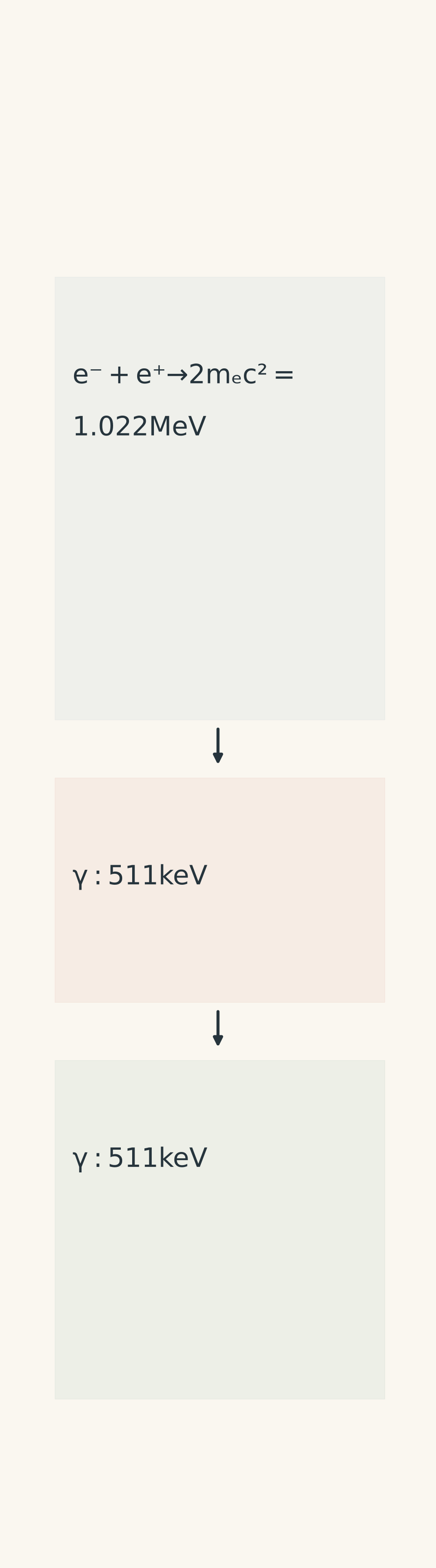
So the answer to the first prediction is \(1.022\text{ MeV}\) of total energy from the pair’s rest mass.

If \(E=mc^2\) feels like a formula that has appeared out of nowhere, the broader relativity picture is explained in Einstein’s Two Postulates of Special Relativity Explained.
02Why do two photons appear?
Now make a prediction.
If the electron and positron start at rest, could they produce one photon with an energy of \(1.022\text{ MeV}\)?
Energy conservation seems to say yes. One photon could carry exactly \(1.022\text{ MeV}\).
But energy is only half the bookkeeping.
The initial electron-positron pair has zero total momentum because both particles are at rest. A photon, however, always carries momentum. Its momentum \(p\) is related to its energy \(E\) by
\[
p=\frac{E}{c}
\]
So a single photon would leave the system with non-zero momentum. Nothing would be left to balance it.
That violates conservation of momentum.
Two photons solve the problem. If they travel in opposite directions with equal momentum, their momenta cancel:
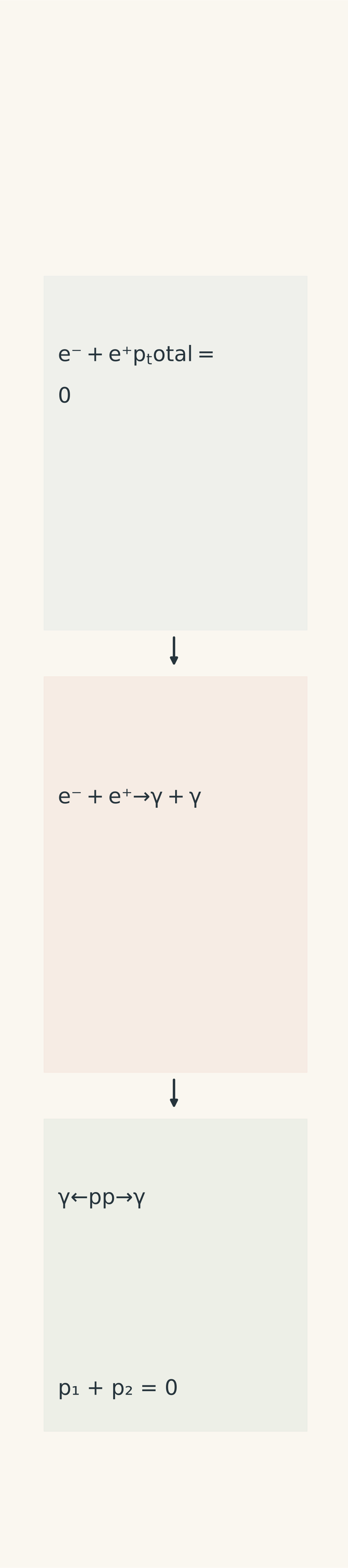
Because photon momentum is \(p=E/c\), equal photon momenta also mean equal photon energies.
Therefore, for an electron and positron annihilating at rest,
\[
E_\gamma
=
\frac{2m_ec^2}{2}
=
m_ec^2
\]
so each photon has
\[
E_\gamma\approx511\text{ keV}
\]
or approximately
\[
E_\gamma\approx8.19\times10^{-14}\text{ J}
\]
The two photons therefore carry \(511\text{ keV}+511\text{ keV}=1.022\text{ MeV}\) in total.
The key idea is this:
Energy conservation tells you how much energy must come out. Momentum conservation constrains how that energy can come out.
A single photon could only work if something else, such as a recoiling nucleus, also carried momentum. That is a different physical situation. For an isolated electron-positron pair at rest, two back-to-back photons are required.
03Worked example: an electron and positron annihilate at rest
An electron and positron are both initially at rest and annihilate. Calculate the total energy available from their rest masses and the energy of each of the two photons produced.
Step 1
Each particle has rest energy \(m_ec^2\), so the pair has
\[
E_{\text{total}}=2m_ec^2
\]
Step 2
\[
E_{\text{total}}
=
2(9.11\times10^{-31})
(3.00\times10^8)^2
\]
\[
E_{\text{total}}
\approx
1.64\times10^{-13}\text{ J}
\]
Step 3
The initial total momentum is zero, so the photons must travel in opposite directions with equal energies.
\[
E_\gamma
=
\frac{1.64\times10^{-13}}{2}
\approx
8.19\times10^{-14}\text{ J}
\]
Step 4
Using \(1\text{ eV}=1.60\times10^{-19}\text{ J}\),
\[
E_\gamma
\approx
5.11\times10^5\text{ eV}
=
511\text{ keV}
\]
So the pair provides approximately \(1.64\times10^{-13}\text{ J}\) in total, and each photon carries approximately \(8.19\times10^{-14}\text{ J}\), or \(511\text{ keV}\).
The \(511\text{ keV}\) value is the rest energy of one electron or positron. The \(1.022\text{ MeV}\) value belongs to the pair.
04What changes if the particles are moving?
The \(511\text{ keV}\) result is not the total energy of every electron-positron annihilation.
It is the rest-energy contribution of one particle.
If either particle has kinetic energy, that energy is also part of the total energy available to the final particles. Let \(K\) represent the kinetic energy of each particle.
For two particles with equal kinetic energies and equal-and-opposite momenta,
\[
E_{\text{total}}
=
2(m_ec^2+K)
\]
If the final state is still two photons, their total momentum is zero, so they can be equal in energy. Each photon then has
\[
E_\gamma=m_ec^2+K
\]
This is a useful extension of the basic result.

Worked example: annihilation with kinetic energy
An electron and positron have equal and opposite momenta. Each has \(200\text{ keV}\) of kinetic energy. They annihilate into two photons. Calculate the energy of each photon.
Step 1
Each particle has \(511\text{ keV}\) of rest energy and \(200\text{ keV}\) of kinetic energy.
\[
E_{\text{one}}
=
511+200
=
711\text{ keV}
\]
Step 2
\[
E_{\text{total}}
=
2(711)
=
1422\text{ keV}
=
1.422\text{ MeV}
\]
Step 3
The incoming momenta are equal and opposite, so the initial total momentum is zero. The two photons must therefore have equal and opposite momenta.
Equal photon momentum means equal photon energy.
\[
E_\gamma
=
\frac{1422}{2}
=
711\text{ keV}
\]
In joules,
\[
E_\gamma
=
711\times10^3
(1.60\times10^{-19})
\approx
1.14\times10^{-13}\text{ J}
\]
Each photon therefore carries \(711\text{ keV}\), not \(511\text{ keV}\).
The tempting route is to memorise “electron-positron annihilation gives two \(511\text{ keV}\) photons”. That is only the at-rest result. Here, the additional \(200\text{ keV}\) of kinetic energy from each incoming particle also has to go somewhere.
There is one more layer of precision. If the electron-positron pair has a net momentum, the two photons do not have to have equal energies in the laboratory frame. The equal-energy result depends on analysing the pair in a frame where its total momentum is zero.
For another example of relativity being tested through high-energy particles, see How Particle Accelerators Test Relativity.
05Where this appears in the real world: PET
The \(511\text{ keV}\) photons are not just a textbook number.
In positron emission tomography, or PET, a radioactive tracer emits a positron. The positron travels through the surrounding matter and loses most of its kinetic energy. It can then encounter an electron and annihilate.
In the idealised HSC picture, the annihilation produces two \(511\text{ keV}\) gamma photons travelling in opposite directions.
A PET scanner has detectors arranged around the patient. When two detectors register the photons at nearly the same time, the scanner can infer that the annihilation occurred somewhere along the line joining those detectors.

Notice how the same two ideas are doing the work again:
- \(E=mc^2\) gives the energy associated with the electron and positron rest masses.
- Momentum conservation explains why the photons are emitted in opposite directions in the idealised at-rest case.
06The HSC decision rule
When you see an electron-positron annihilation question, don’t immediately write \(511\text{ keV}\). First identify the physical situation.
| Situation | Energy to account for | What to do with the photons |
|---|---|---|
| Electron and positron at rest | \(2m_ec^2\) | Two photons of \(511\text{ keV}\) each, travelling in opposite directions |
| Each particle has kinetic energy \(K\), with equal and opposite momenta | \(2(m_ec^2+K)\) | Two equal-energy photons if total momentum is zero |
| Pair has net momentum | Rest energy plus kinetic energy | Don’t automatically assume equal photon energies in the laboratory frame |
| Another object can recoil | Total energy and momentum include that object | A different final state may be possible |
The most common traps are therefore:
“The positron has positive mass.”
No. The positron has the same positive mass as the electron. Its charge is opposite.
“The mass of the two particles is destroyed.”
The particle identities disappear, but total energy and momentum are conserved. The rest mass contributes to the energy carried by the final particles.
“Each photon gets \(1.022\text{ MeV}\).”
No. \(1.022\text{ MeV}\) is the total rest-energy contribution from both particles. For an at-rest pair producing two photons, each gets \(511\text{ keV}\).
“Energy conservation is enough.”
No. The final particles must also satisfy momentum conservation. This is why two opposite photons are required for an isolated pair initially at rest.
“The \(511\text{ keV}\) result always applies.”
Only when the relevant electron-positron system has zero total momentum and negligible kinetic energy in the frame being considered.
07Questions and solutions
Question 1
An electron and positron are initially at rest and annihilate into two gamma-ray photons.
Use \(m_e=9.11\times10^{-31}\text{ kg}\) and \(c=3.00\times10^8\text{ m s}^{-1}\).
(a) Calculate the total energy available from the rest masses of the electron and positron.
(b) Calculate the energy of each photon in joules and keV.
Solution 1
The total energy is approximately \(1.64\times10^{-13}\text{ J}\), and each photon carries approximately \(8.19\times10^{-14}\text{ J}=511\text{ keV}\).
Step 1: Include both rest masses.
\[
E_{\text{total}}=2m_ec^2
\]
\[
E_{\text{total}}
=
2(9.11\times10^{-31})
(3.00\times10^8)^2
\]
\[
E_{\text{total}}
\approx1.64\times10^{-13}\text{ J}
\]
Step 2: Divide the total energy between the two photons.
Because the initial momentum is zero, the photons must have equal and opposite momenta. Therefore, they have equal energies.
\[
E_\gamma
=
\frac{1.64\times10^{-13}}{2}
\approx8.19\times10^{-14}\text{ J}
\]
Step 3: Convert to keV.
\[
E_\gamma
=
\frac{8.19\times10^{-14}}
{1.60\times10^{-19}}
\approx5.11\times10^5\text{ eV}
\]
\[
E_\gamma\approx511\text{ keV}
\]
The tempting mistake is to use \(m_ec^2\) for the whole event. That only accounts for one particle. Annihilation involves both the electron and the positron, so there are two rest-energy contributions.
Question 2
An electron and positron have equal and opposite momenta. Each has \(200\text{ keV}\) of kinetic energy before annihilation.
Assume the annihilation produces exactly two photons.
Calculate the energy of each photon.
Solution 2
Each photon has an energy of \(711\text{ keV}\), or approximately \(1.14\times10^{-13}\text{ J}\).
Step 1: Add rest energy and kinetic energy for one incoming particle.
\[
E_{\text{one}}
=
511\text{ keV}+200\text{ keV}
=
711\text{ keV}
\]
Step 2: Find the total energy of both particles.
\[
E_{\text{total}}
=
2(711)
=
1422\text{ keV}
\]
Step 3: Apply momentum conservation.
The incoming momenta are equal and opposite, so the initial total momentum is zero. The two photons must therefore have equal and opposite momenta, which means equal energies.
\[
E_\gamma
=
\frac{1422}{2}
=
711\text{ keV}
\]
Converting to joules,
\[
E_\gamma
=
711\times10^3
(1.60\times10^{-19})
\]
\[
E_\gamma
\approx1.14\times10^{-13}\text{ J}
\]
The tempting route is to quote the familiar \(511\text{ keV}\) result. The constraint that changes the answer is the extra kinetic energy: energy conservation requires that \(200\text{ keV}\) from each incoming particle also appears in the final state.
Question 3
An isolated electron-positron pair is initially at rest. A student proposes the reaction
\[
e^-+e^+\rightarrow\gamma
\]
with the single photon carrying \(1.022\text{ MeV}\).
Explain why this cannot be the complete final state. State the simplest allowed two-photon outcome.
Solution 3
The one-photon final state is impossible because it violates conservation of momentum. The allowed two-photon outcome has two \(511\text{ keV}\) photons travelling in opposite directions.
The student’s energy calculation is correct:
\[
E_{\text{initial}}
=
2m_ec^2
\approx1.022\text{ MeV}
\]
So energy conservation alone does not expose the problem.
The problem is momentum.
The initial pair is at rest, so
\[
p_{\text{initial}}=0
\]
A photon cannot have zero momentum if it has non-zero energy. Its momentum is
\[
p_\gamma=\frac{E_\gamma}{c}
\]
Therefore, one \(1.022\text{ MeV}\) photon would leave the final system with non-zero momentum.
There is no second object to provide an equal and opposite momentum, so momentum would not be conserved.
With two photons, the momenta can cancel:
\[
\vec p_1+\vec p_2=0
\]
This requires the photons to travel in opposite directions with equal momentum. Since \(p=E/c\), they must also have equal energy:
\[
E_1=E_2=511\text{ keV}
\]
The tempting route is to check only \(E=mc^2\). The exact constraint that changes the result is conservation of momentum.
Question 4
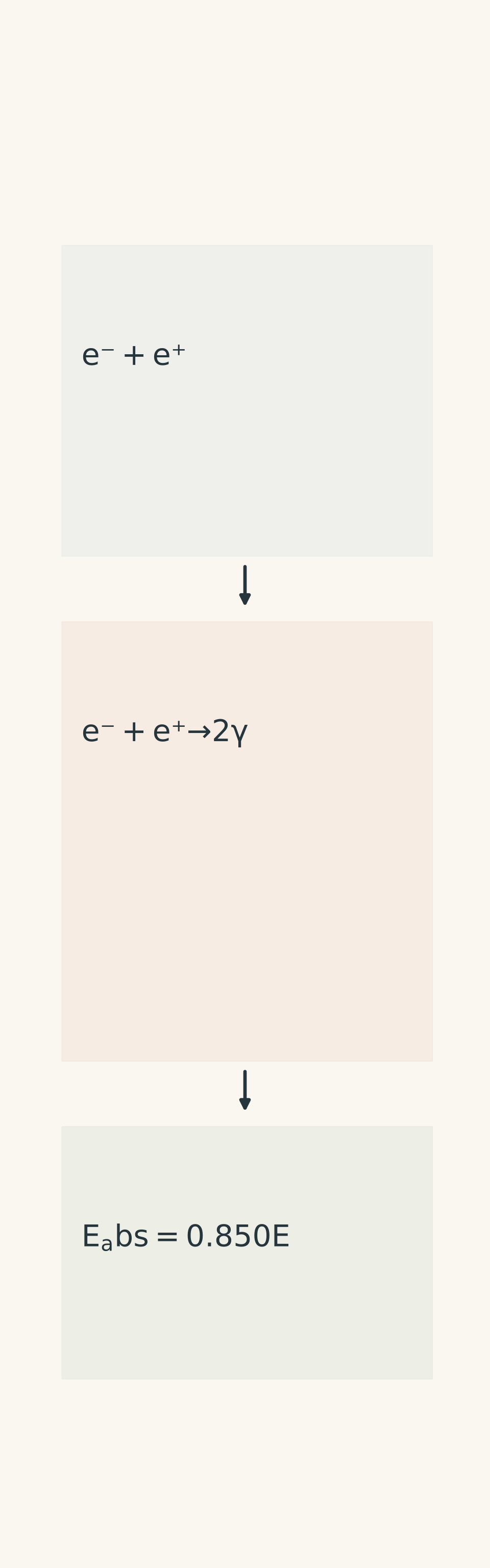
A source contains \(3.00\times10^8\) electron-positron pairs. Assume every pair annihilates at rest, producing two photons.
A detector absorbs \(85.0\%\) of the total annihilation energy.
Calculate the energy absorbed by the detector in joules.
Solution 4
The detector absorbs approximately \(4.17\times10^{-5}\text{ J}\).
Step 1: Find the energy released by one pair.
Each pair contributes approximately \(1.022\text{ MeV}\).
Convert to joules:
\[
E_{\text{pair}}
=
1.022\times10^6
(1.60\times10^{-19})
\]
\[
E_{\text{pair}}
\approx1.64\times10^{-13}\text{ J}
\]
Step 2: Multiply by the number of pairs.
\[
E_{\text{total}}
=
(3.00\times10^8)
(1.64\times10^{-13})
\]
\[
E_{\text{total}}
\approx4.92\times10^{-5}\text{ J}
\]
Step 3: Apply the detector efficiency.
An absorption of \(85.0\%\) means a factor of \(0.850\):
\[
E_{\text{absorbed}}
=
0.850(4.92\times10^{-5})
\]
\[
E_{\text{absorbed}}
\approx4.17\times10^{-5}\text{ J}
\]
The tempting mistake is to use \(85.0\%\) as though it were the amount lost. It is the fraction absorbed, so the correct multiplier is \(0.850\).
The physics is unchanged by the large number of pairs: calculate the energy per annihilation, multiply by the number of annihilations, then account for what the detector actually absorbs.
Question 5
Two gamma-ray photons are detected from an isolated electron-positron annihilation in free space.
One photon has an energy of \(700\text{ keV}\), the other has an energy of \(322\text{ keV}\), and the photons travel at an angle of \(120^\circ\) to each other.
A student argues:
“This must be possible. \(700+322=1022\text{ keV}\), which is exactly the rest energy of the electron and positron.”
Is the student correct? Explain using both energy and momentum conservation.
Assume the initial electron-positron pair is at rest and no other object is available to take momentum.
Solution 5
The student is not correct. The photon energies add to the correct total energy, but the photon momenta cannot satisfy the zero-momentum condition of an electron-positron pair initially at rest.
The first calculation is tempting because it looks perfect:
\[
700+322=1022\text{ keV}
\]
The photons therefore have exactly the total rest energy of the pair.
But this creates an even stronger constraint. If the initial pair is at rest, its total energy is already at the minimum possible value:
\[
E_{\text{initial}}=2m_ec^2\approx1.022\text{ MeV}
\]
There is no extra kinetic energy available.
So the initial total momentum must be zero.
Now consider the photons. Each photon has momentum
\[
p=\frac{E}{c}
\]
For their momenta to cancel, the two momentum vectors must point in opposite directions and have equal magnitudes.
Neither condition is satisfied here.
First, the photons travel at \(120^\circ\), not \(180^\circ\), so their momentum vectors cannot cancel.
Second, their energies are different:
\[
700\text{ keV}\neq322\text{ keV}
\]
so their momentum magnitudes are also different.
The non-zero resultant momentum can even be calculated. If \(p_{\text{net}}\) is the magnitude of the combined photon momentum,
\[
p_{\text{net}}c
=
\sqrt{
E_1^2+E_2^2
+
2E_1E_2\cos120^\circ
}
\]
Using \(E_1=700\text{ keV}\) and \(E_2=322\text{ keV}\),
\[
p_{\text{net}}c\approx607\text{ keV}
\]
so the photons definitely carry a non-zero net momentum.
That cannot match an initially stationary electron-positron pair.
The hinge in this problem is that getting the total energy right does not guarantee a physically possible final state. Because the photon energies already use up the entire \(1.022\text{ MeV}\) rest-energy budget, the pair cannot secretly have kinetic energy that supplies the required initial momentum.
For an isolated pair at rest, the two-photon result is much more restrictive: the photons must each have \(511\text{ keV}\) and travel in opposite directions.
This is the useful pattern to carry into harder HSC questions: calculate the energy, then ask whether the proposed final particles can also satisfy momentum conservation. Mass-energy equivalence tells you what is available; conservation laws decide what can actually happen.