
Resolving Vectors into Components for HSC Physics
Learn how to split vectors into perpendicular components using trigonometry, sign conventions, and clear physical reasoning. Includes worked examples and original HSC-style practice.
A rescue drone pulls with a force of 500 N at \(30^\circ\) above the horizontal. The drone does not pull “500 N horizontally and 500 N vertically”. That would invent extra force. Instead, the single 500 N force has to be split between those two directions.
Before calculating anything, predict this: should the horizontal component be greater than, less than, or equal to 500 N?
It must be less than 500 N. The original vector is tilted, so only part of it points horizontally. The rest points vertically. Resolving a vector is the process of finding exactly how much points in each perpendicular direction.
01What does it mean to resolve a vector?
A vector has both magnitude and direction. Force, velocity, displacement, acceleration, and momentum are all vectors.
Suppose a force points diagonally up and to the right. Instead of working with that awkward diagonal direction, we can replace it mathematically with two perpendicular components:
- a horizontal component
- a vertical component
These two components together have exactly the same effect as the original vector.
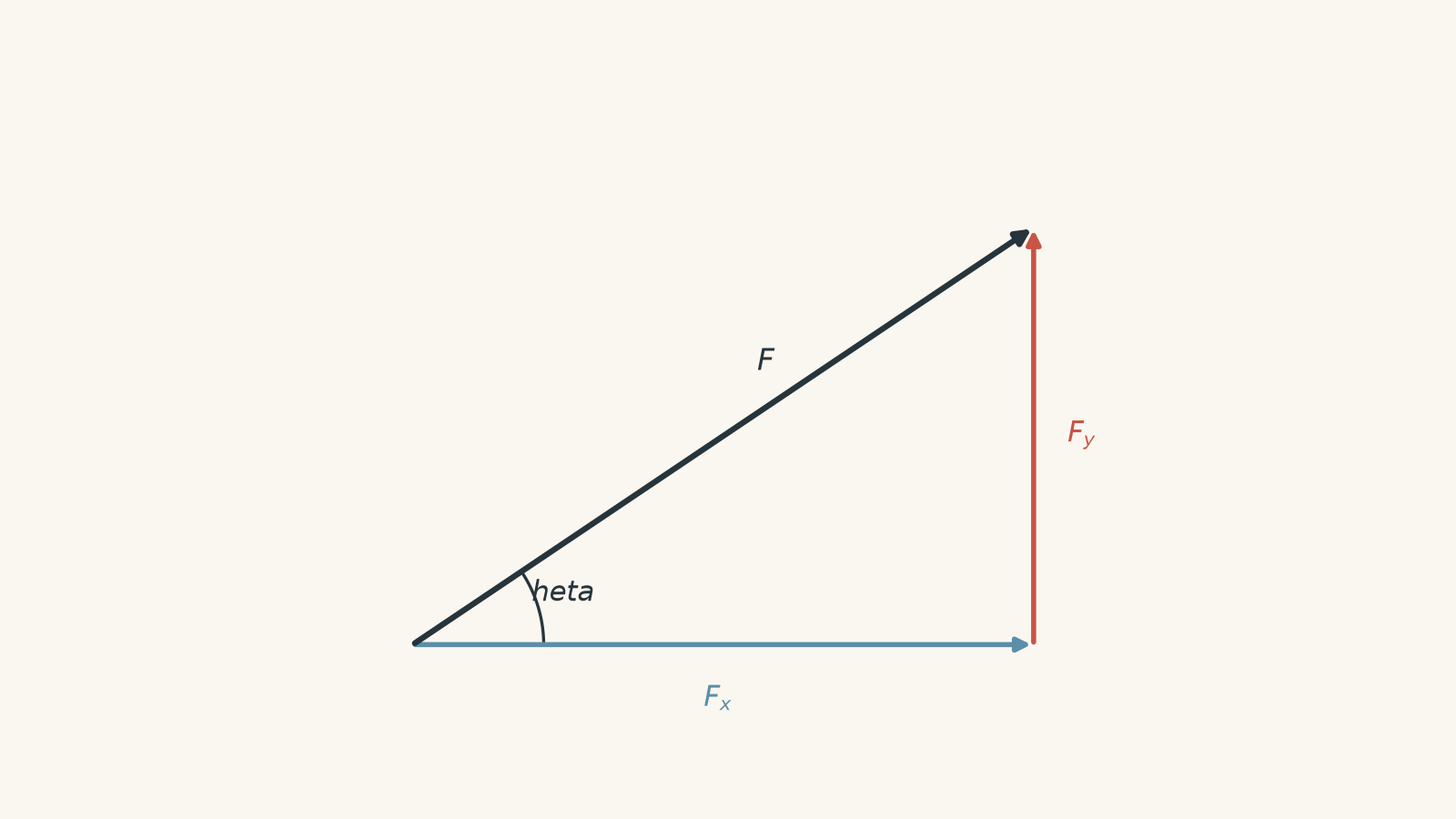
Picture someone walking diagonally across a rectangular park. You could describe their displacement as one diagonal journey, or as some distance east plus some distance north. They did not actually need to walk those two separate paths. The components are simply another way of describing the same displacement.
That analogy has a limit. Vector components are not necessarily separate events happening one after another. They are simultaneous mathematical parts of one vector.
02Why perpendicular components are useful
Physics becomes much easier when we choose axes that match the problem.
For many HSC problems, we use:
- the \(x\)-axis for horizontal motion
- the \(y\)-axis for vertical motion
A diagonal force can then be handled separately in each direction. Newton’s laws can be applied horizontally and vertically, projectile motion can be analysed one axis at a time, and forces on slopes can be compared more cleanly.
The important idea is:
Resolving a vector does not change the vector. It changes how we describe it.
03The trigonometry behind components
Resolving a vector creates a right-angled triangle.
Suppose a vector has magnitude \(V\) and makes an angle \(\theta\) above the positive horizontal axis.
Its components are:
\[
V_x = V\cos\theta
\]
\[
V_y = V\sin\theta
\]
Here:
- \(V\) is the magnitude of the original vector
- \(V_x\) is its horizontal component
- \(V_y\) is its vertical component
- \(\theta\) is the angle measured from the positive horizontal direction
Why cosine horizontally and sine vertically?
Recall the basic trigonometric ratios:
\[
\cos\theta = \frac{\text{adjacent}}{\text{hypotenuse}},
\qquad
\sin\theta = \frac{\text{opposite}}{\text{hypotenuse}}
\]
In our vector triangle, the original vector \(V\) is the hypotenuse. If \(\theta\) is measured from the horizontal, \(V_x\) is adjacent to the angle and \(V_y\) is opposite it.
So:
\[
\cos\theta = \frac{V_x}{V}
\]
which rearranges to \(V_x = V\cos\theta\).
Similarly:
\[
\sin\theta = \frac{V_y}{V}
\]
so \(V_y = V\sin\theta\).
That is where the component formulas come from. They are not formulas to memorise separately from trigonometry.
04Do not memorise “cosine is always horizontal”
This is one of the easiest component mistakes to make.
Suppose the same vector is described using an angle measured from the vertical instead of the horizontal. Which component is now adjacent to the angle?
The vertical component.
So in that case:
\[
V_y = V\cos\theta
\]
and
\[
V_x = V\sin\theta
\]
The useful rule is not “horizontal means cosine”.
The useful rule is:
- adjacent component: use cosine
- opposite component: use sine
Always look at where the angle is drawn.
Worked example: Force at an angle above the horizontal
A rope pulls a crate with a force of \(240\text{ N}\) at \(35^\circ\) above the horizontal. Find the horizontal and vertical components of the force.
Step 1
The \(35^\circ\) angle is measured from the horizontal, so the horizontal component is adjacent. Use cosine.
\[
F_x = F\cos\theta
\]
where \(F = 240\text{ N}\) and \(\theta = 35^\circ\).
Step 2
\[
F_x = 240\cos35^\circ = 196.6\text{ N}
\]
So:
\[
F_x \approx 197\text{ N}
\]
Step 3
The vertical component is opposite the angle, so use sine:
\[
F_y = F\sin\theta
\]
\[
F_y = 240\sin35^\circ = 137.7\text{ N}
\]
Therefore:
\[
F_y \approx 138\text{ N}
\]
The original \(240\text{ N}\) force can therefore be represented as approximately \(197\text{ N}\) horizontally and \(138\text{ N}\) vertically.
Notice that neither component is larger than the original \(240\text{ N}\) force. That is what we expected from the geometry.
05Components need signs, not just magnitudes
So far, our vector has pointed up and to the right. Both components were positive.
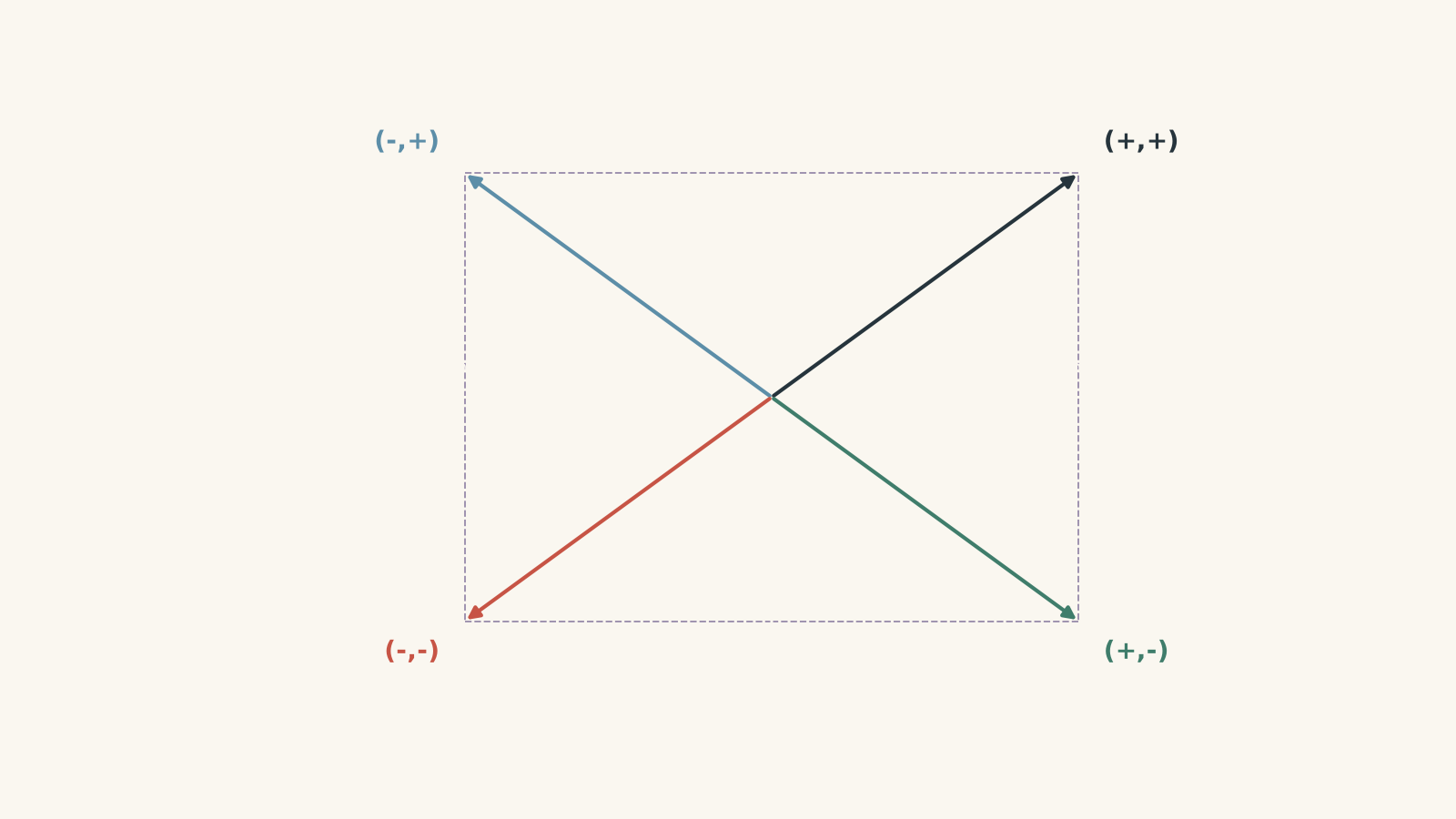
But vectors can point in any direction. Before resolving vectors, choose a sign convention.
A common choice is:
- right is positive \(x\)
- left is negative \(x\)
- up is positive \(y\)
- down is negative \(y\)
The sign tells you the direction of a component. It is not part of the trigonometry itself.
For example, a velocity pointing down and to the right has:
- positive \(x\)-component
- negative \(y\)-component
A force pointing up and to the left has:
- negative \(x\)-component
- positive \(y\)-component
06Work out the direction before touching the calculator
Suppose a velocity points down and left.
Before calculating, you already know:
\[
v_x < 0
\]
and
\[
v_y < 0
\]
This prediction is useful. If your calculator later gives you two positive numbers, you know you have not yet included the directions.
One safe method is:
- find the magnitudes of the components using a right-angled triangle
- assign each component its sign from the diagram and your chosen axes
This is often clearer than relying on calculator signs from unusual angles.
Worked example: Velocity measured from the vertical
A ball has a velocity of \(18.0\text{ m s}^{-1}\), directed \(25^\circ\) to the left of vertically downward. Take right as positive \(x\) and up as positive \(y\). Find its horizontal and vertical velocity components.
Step 1
The ball moves left, so \(v_x\) is negative.
It also moves downward, so \(v_y\) is negative.
Step 2
The \(25^\circ\) angle is measured from the vertical. Therefore, the vertical component is adjacent to the angle.
Its magnitude is:
\[
|v_y| = v\cos\theta
\]
\[
|v_y| = 18.0\cos25^\circ = 16.31\text{ m s}^{-1}
\]
Because the direction is downward:
\[
v_y = -16.3\text{ m s}^{-1}
\]
Step 3
The horizontal component is opposite the \(25^\circ\) angle:
\[
|v_x| = v\sin\theta
\]
\[
|v_x| = 18.0\sin25^\circ = 7.61\text{ m s}^{-1}
\]
Because the direction is left:
\[
v_x = -7.61\text{ m s}^{-1}
\]
So the velocity components are:
\[
v_x = -7.61\text{ m s}^{-1},
\qquad
v_y = -16.3\text{ m s}^{-1}
\]
The negative signs are essential. Without them, we would have the correct component magnitudes but the wrong velocity.
07A quick check using Pythagoras
Components should recombine to give the original vector magnitude.
Because the components are perpendicular:
\[
V^2 = V_x^2 + V_y^2
\]
so:
\[
V = \sqrt{V_x^2 + V_y^2}
\]
For the previous example:
\[
\sqrt{(-7.61)^2 + (-16.3)^2}
\approx 18.0\text{ m s}^{-1}
\]
The negative signs disappear when squared, which makes sense. Pythagoras checks the magnitude, not the direction.
This is a useful error check. If your components give a magnitude nowhere near the original vector, something has gone wrong.
08Components are not pieces that add normally
A tempting mistake is to think that if a \(100\text{ N}\) force has components \(F_x\) and \(F_y\), then:
\[
F_x + F_y = 100\text{ N}
\]
That is generally false.
Why does it feel reasonable? Because ordinary quantities often split into parts that add directly. If $100 were divided between two people, their amounts would add to $100.
Perpendicular vector components do not work that way. They point in different directions. Their vector sum produces the original vector.
For example, a \(100\text{ N}\) force at \(45^\circ\) has components:
\[
F_x = 100\cos45^\circ = 70.7\text{ N}
\]
\[
F_y = 100\sin45^\circ = 70.7\text{ N}
\]
Their ordinary numerical sum is \(141.4\text{ N}\), but the original vector has not somehow grown.
Using Pythagoras:
\[
F = \sqrt{70.7^2 + 70.7^2} \approx 100\text{ N}
\]
Perpendicular components combine geometrically, not by simply adding their magnitudes.
09Choosing axes can make the problem easier
Horizontal and vertical axes are common, but they are not compulsory.
Imagine a block resting on a slope. If you choose ordinary horizontal and vertical axes, several forces may sit at awkward angles. Instead, it is often better to choose:
- one axis parallel to the slope
- one axis perpendicular to the slope
You can then resolve the weight force into components along those axes.
This is the same vector method. Only the coordinate system has changed.
The physics does not care which axes you choose. A sensible choice simply makes the equations easier.
10A reliable method for HSC questions
When resolving a vector, use this sequence:
- Draw or inspect the vector and axes.
- Choose the positive directions.
- Predict the sign of each component.
- Locate the given angle.
- Identify the adjacent and opposite components.
- Use cosine for the adjacent component and sine for the opposite component.
- Apply the correct signs.
- Check that the components make physical sense.
For a vector with magnitude \(V\) at angle \(\theta\) from the positive horizontal axis, this often reduces to:
\[
V_x = V\cos\theta,
\qquad
V_y = V\sin\theta
\]
But that compact formula is safe only when you understand where the angle is measured from and what directions your axes call positive.
11Questions and solutions
Question 1
A cyclist travels at \(12.0\text{ m s}^{-1}\) at \(20^\circ\) north of east. Take east as positive \(x\) and north as positive \(y\).
Find the eastward and northward components of the cyclist’s velocity.
Solution 1
The components are approximately \(11.3\text{ m s}^{-1}\) east and \(4.10\text{ m s}^{-1}\) north.
The angle is measured from the eastward horizontal direction, so the eastward component is adjacent and the northward component is opposite.
\[
v_x = v\cos\theta
\]
\[
v_y = v\sin\theta
\]
Substituting \(v = 12.0\text{ m s}^{-1}\) and \(\theta = 20^\circ\):
\[
v_x = 12.0\cos20^\circ = 11.28\text{ m s}^{-1}
\]
\[
v_y = 12.0\sin20^\circ = 4.10\text{ m s}^{-1}
\]
Therefore:
\[
v_x \approx 11.3\text{ m s}^{-1},
\qquad
v_y \approx 4.10\text{ m s}^{-1}
\]
Both components are positive because the velocity points east and north.
Question 2
A force of \(75.0\text{ N}\) acts \(40^\circ\) to the right of vertically upward. Take right as positive \(x\) and up as positive \(y\).
Find the \(x\)- and \(y\)-components of the force.
Solution 2
The components are \(48.2\text{ N}\) in the positive \(x\)-direction and \(57.5\text{ N}\) in the positive \(y\)-direction.
The trap is that the angle is measured from the vertical, not the horizontal. The vertical component is therefore adjacent to the \(40^\circ\) angle.
For the horizontal component:
\[
F_x = F\sin\theta
\]
\[
F_x = 75.0\sin40^\circ = 48.2\text{ N}
\]
For the vertical component:
\[
F_y = F\cos\theta
\]
\[
F_y = 75.0\cos40^\circ = 57.5\text{ N}
\]
Therefore:
\[
F_x = +48.2\text{ N},
\qquad
F_y = +57.5\text{ N}
\]
Using cosine for the horizontal component simply because “horizontal is cosine” would swap the two answers.
Question 3
A small aircraft has a velocity relative to the air of \(65.0\text{ m s}^{-1}\), directed \(32^\circ\) south of west.
Take east as positive \(x\) and north as positive \(y\).
Find the velocity components and verify that they reproduce the original speed.
Solution 3
The velocity components are approximately \(-55.1\text{ m s}^{-1}\) in the \(x\)-direction and \(-34.4\text{ m s}^{-1}\) in the \(y\)-direction, and they recombine to give \(65.0\text{ m s}^{-1}\).
West is negative \(x\), and south is negative \(y\). The \(32^\circ\) angle is measured from west, which is horizontal.
The horizontal component has magnitude:
\[
|v_x| = v\cos\theta
\]
\[
|v_x| = 65.0\cos32^\circ = 55.1\text{ m s}^{-1}
\]
Therefore:
\[
v_x = -55.1\text{ m s}^{-1}
\]
The vertical component has magnitude:
\[
|v_y| = v\sin\theta
\]
\[
|v_y| = 65.0\sin32^\circ = 34.4\text{ m s}^{-1}
\]
Therefore:
\[
v_y = -34.4\text{ m s}^{-1}
\]
Checking the magnitude:
\[
v = \sqrt{v_x^2 + v_y^2}
= \sqrt{(-55.1)^2 + (-34.4)^2}
\approx 65.0\text{ m s}^{-1}
\]
The check confirms the component magnitudes are consistent with the original velocity. The signs then tell us that the aircraft is moving west and south.
Question 4
A student resolves a \(90.0\text{ N}\) force and obtains components of \(72.0\text{ N}\) to the right and \(54.0\text{ N}\) upward.
Another student says the answer must be wrong because \(72.0 + 54.0 = 126.0\text{ N}\), which is greater than the original \(90.0\text{ N}\).
Determine whether the components are possible, and explain which student’s reasoning is correct.
Solution 4
The components are possible, and the second student’s reasoning is incorrect.
Perpendicular vector components do not have to add numerically to the original magnitude. They combine using Pythagoras because they point at \(90^\circ\) to each other.
The magnitude produced by the proposed components is:
\[
F = \sqrt{F_x^2 + F_y^2}
\]
\[
F = \sqrt{(72.0)^2 + (54.0)^2}
= \sqrt{5184 + 2916}
= \sqrt{8100}
= 90.0\text{ N}
\]
So the components reproduce the original \(90.0\text{ N}\) force exactly.
The tempting mistake is treating perpendicular vector components like ordinary scalar pieces. Their arithmetic sum, \(126.0\text{ N}\), has no useful meaning as the magnitude of the original force.
Question 5
A force has magnitude \(120\text{ N}\). Its horizontal component is \(+120\text{ N}\).
A student argues that the force could still have a non-zero vertical component because the question gives only the horizontal component.
Is that possible? Justify your answer without relying only on a diagram.
Solution 5
No. If the total force has magnitude \(120\text{ N}\) and its horizontal component already has magnitude \(120\text{ N}\), its vertical component must be zero.
The magnitude of a vector and its perpendicular components are related by:
\[
F^2 = F_x^2 + F_y^2
\]
Substituting \(F = 120\text{ N}\) and \(F_x = 120\text{ N}\):
\[
(120)^2 = (120)^2 + F_y^2
\]
Subtracting \((120)^2\) from both sides gives:
\[
F_y^2 = 0
\]
so:
\[
F_y = 0\text{ N}
\]
Any non-zero vertical component would make
\[
\sqrt{F_x^2 + F_y^2}
\]
greater than \(120\text{ N}\).
This is a useful limiting case. A component can equal the full magnitude of a vector only when the vector lies entirely along that component’s axis.
12Where components take you next
Once you can resolve vectors reliably, several HSC Physics ideas become much more manageable. You can separate projectile velocity into horizontal and vertical motion, resolve forces on inclined planes, and apply Newton’s laws independently along chosen axes.
The next step is not learning another pair of trig formulas. It is learning to choose axes that make the physics simple, then treating each direction as its own equation while remembering that both equations describe the same physical situation.