
Distance and Displacement on a Plane: HSC Physics Guide
Learn how to model two-dimensional journeys using distance, displacement, vector components, and resultant vectors, with worked HSC-style examples.
Your fitness tracker says you walked 420 m. A map says you finished only 110 m from where you started. Which measurement is wrong?
Neither. They are measuring different things. Distance cares about the entire path you travelled. Displacement cares only about the change from your starting position to your finishing position.
That difference becomes especially important when motion happens in two dimensions. Once a journey includes east-west and north-south motion, simply adding numbers is no longer enough. You need vectors.
01Start with the path you can picture
Imagine you walk 60 m east, then turn left and walk 80 m north.
Before calculating anything, predict this: is your displacement 140 m?
It cannot be. The 140 m describes the path you actually walked. Your displacement is the straight-line change in position from the start to the finish.
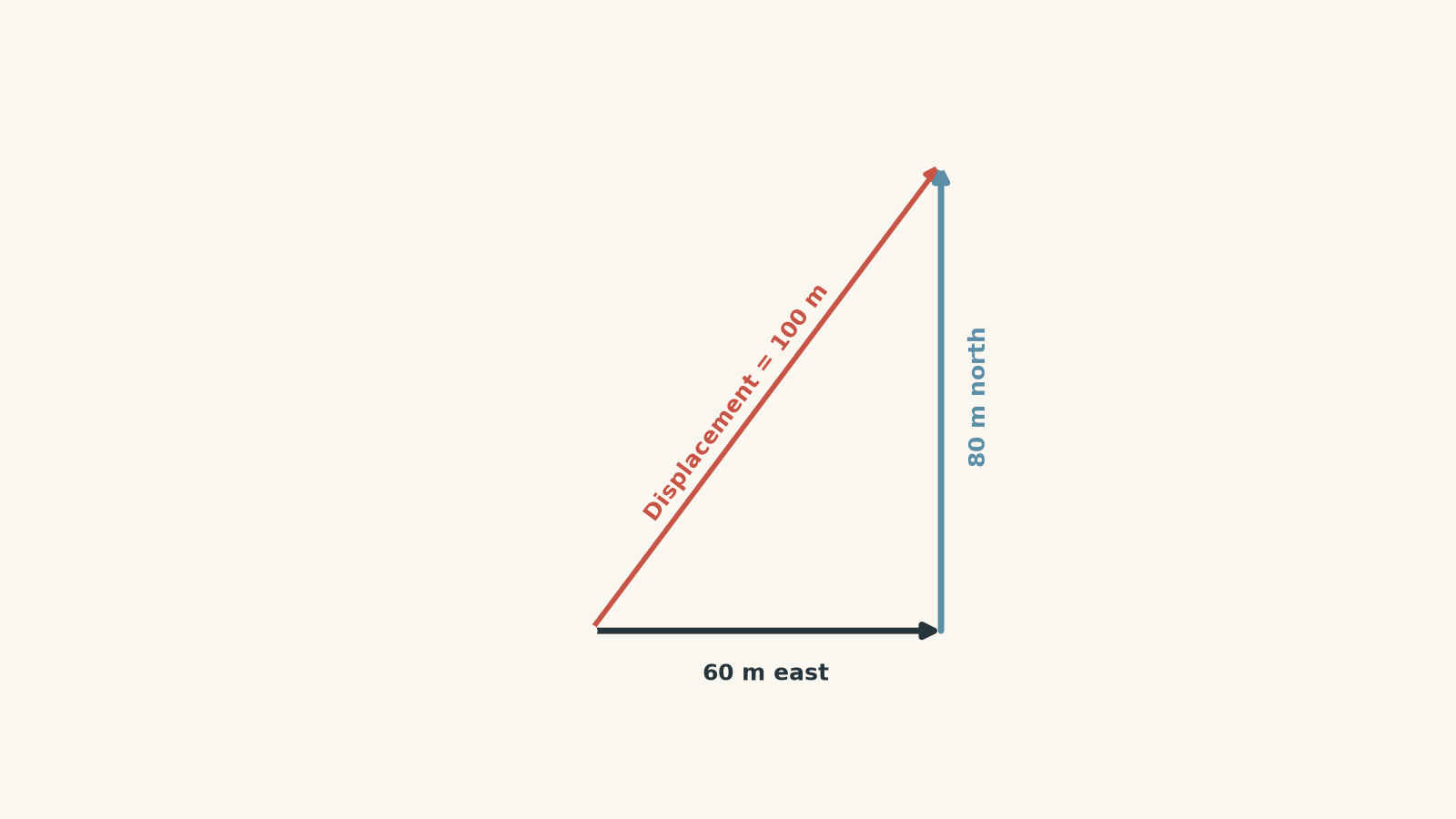
This gives us our first useful distinction:
| Quantity | What it measures | Type |
|---|---|---|
| Distance | Total length of the path travelled | Scalar |
| Displacement | Change in position from start to finish | Vector |
A scalar has magnitude only. A vector has both magnitude and direction.
So 140 m is a valid distance. It is not enough information for a displacement because no direction has been given.
02Displacement ignores the route between the endpoints
Think of displacement as a very impatient friend. You start telling them the whole story of your journey, and they interrupt with, “Fine, but where did you start, and where did you end?”
Everything in between is irrelevant to the displacement.
Formally, displacement is
\[ \Delta \vec r = \vec r_f - \vec r_i \]
where:
- \(\Delta \vec r\) is the displacement vector
- \(\vec r_i\) is the initial position vector
- \(\vec r_f\) is the final position vector
The triangle symbol \(\Delta\) means “change in”.
This definition explains an important result. If you leave home, wander around for 2 km, and finish back at home, your distance is 2 km but your displacement is zero.
Zero displacement does not mean zero movement.
03Adding motion in two dimensions
Suppose an object moves several times before reaching its final position. Each movement can be represented by a vector.
The total displacement is the vector sum:
\[ \Delta \vec r = \vec d_1 + \vec d_2 + \vec d_3 + \cdots \]
where each \(\vec d\) represents one displacement during the journey.
There are two main ways to perform this addition:
- draw the vectors tip-to-tail
- resolve every vector into perpendicular components, then add the components
The drawing method builds intuition. The component method is more reliable for calculations.
Worked example: A right-angle journey
A student walks 30 m east and then 40 m north. Find the total distance and the magnitude and direction of the displacement.
Step 1
\[ \text{distance} = 30 + 40 = 70\text{ m} \]
Distance is a scalar, so the two path lengths can simply be added.
Step 2
The final position is 30 m east and 40 m north of the starting point.
Because these components are perpendicular, the displacement magnitude \(d\) can be found using Pythagoras’ theorem:
\[ d = \sqrt{(30)^2 + (40)^2} = \sqrt{2500} = 50\text{ m} \]
Step 3
Let \(\theta\) be the angle north of east.
\[ \tan\theta = \frac{40}{30} \]
\[ \theta = \tan^{-1}\left(\frac{40}{30}\right) = 53.1^\circ \]
The student travels a distance of 70 m, but their displacement is 50 m at \(53.1^\circ\) north of east.
The smaller displacement makes sense. A straight line between two points is shorter than travelling along the two sides of the right-angled triangle.
04Why Pythagoras does not always work immediately
A common mistake is to see two displacement vectors and immediately write
\[ d = \sqrt{d_1^2+d_2^2} \]
That equation only works when the two quantities being squared are perpendicular components.
If one displacement is north-east and another is west, they are not necessarily perpendicular. First resolve the angled vector into east-west and north-south components.
This is the key move in most two-dimensional displacement problems.
05Resolving a vector into components
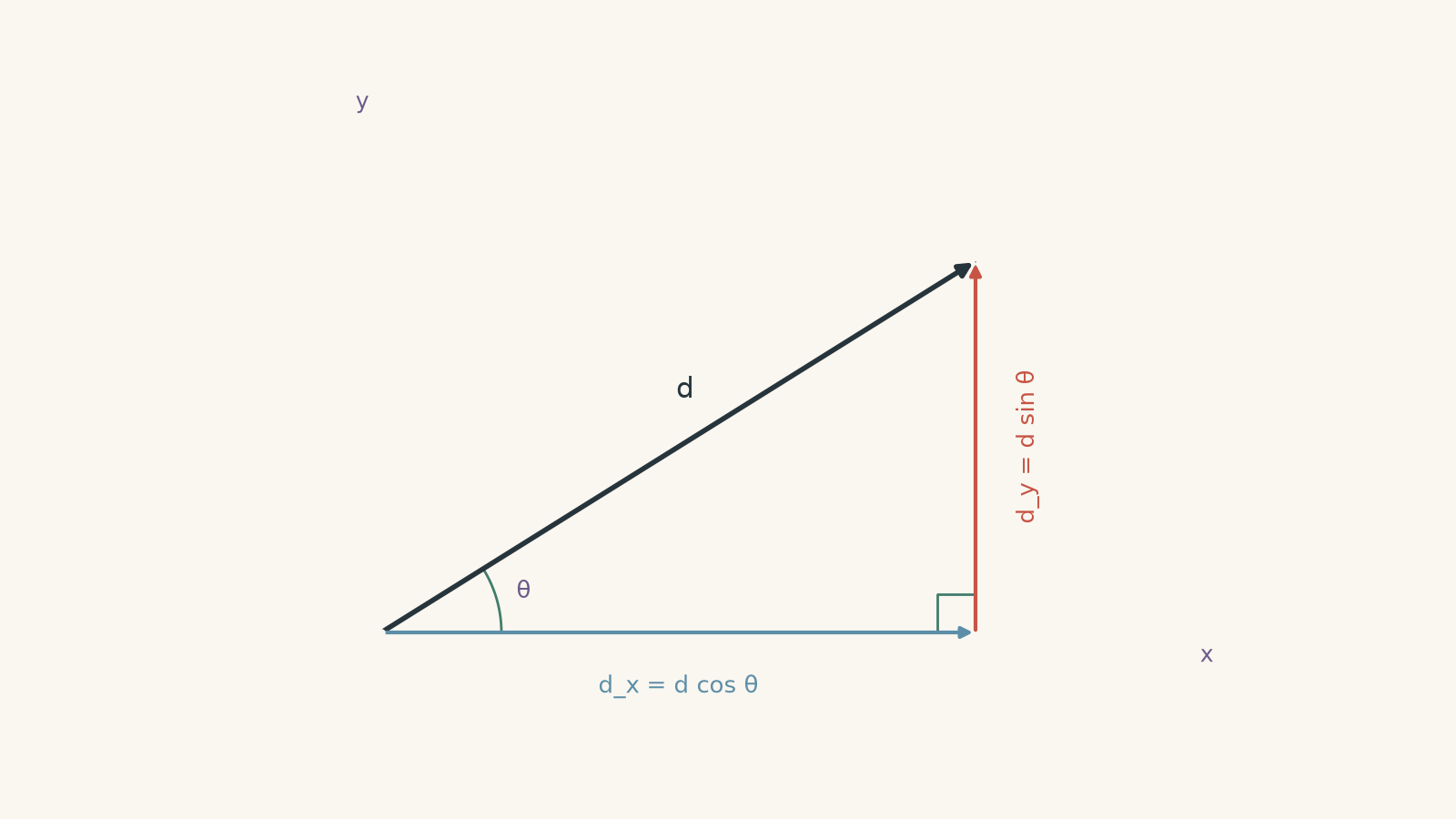
Suppose a displacement of magnitude \(d\) makes an angle \(\theta\) north of east.
You can replace that one angled vector with two perpendicular vectors:
\[ d_x = d\cos\theta \]
\[ d_y = d\sin\theta \]
where:
- \(d_x\) is the horizontal component
- \(d_y\) is the vertical component
- \(d\) is the magnitude of the original displacement
- \(\theta\) is the angle measured from the positive horizontal direction
Why cosine for horizontal and sine for vertical?
In the right-angled triangle formed by the vector, the horizontal component is adjacent to \(\theta\), while the vertical component is opposite \(\theta\).
So:
\[ \cos\theta=\frac{\text{adjacent}}{\text{hypotenuse}} \]
and
\[ \sin\theta=\frac{\text{opposite}}{\text{hypotenuse}} \]
The vector has not physically split into two movements. The components are a mathematical description of the same movement.
06Choose positive directions before calculating
Signs matter because displacement has direction.
A common convention is:
- east: positive \(x\)
- west: negative \(x\)
- north: positive \(y\)
- south: negative \(y\)
You could choose the opposite convention and still get the correct physics, provided you remain consistent.
For example, 25 m west would be
\[ d_x=-25\text{ m} \]
while 12 m north would be
\[ d_y=+12\text{ m} \]
The negative sign does not mean a negative distance. It records direction along your chosen axis.
07Add components before finding the resultant
Once every displacement has been resolved, add all horizontal components together and all vertical components together:
\[ \Delta x = d_{1x}+d_{2x}+\cdots \]
\[ \Delta y = d_{1y}+d_{2y}+\cdots \]
Here, \(\Delta x\) is the net horizontal displacement and \(\Delta y\) is the net vertical displacement.
Then calculate the magnitude of the total displacement:
\[ d=\sqrt{(\Delta x)^2+(\Delta y)^2} \]
and use trigonometry to determine its direction.
This works because \(\Delta x\) and \(\Delta y\) are perpendicular, even if the original displacement vectors were not.
Worked example: An angled journey followed by motion west
A field robot travels 120 m at \(35^\circ\) north of east, then travels 80 m due west. Find its total distance and final displacement.
Step 1
The robot actually travels both path segments, so
\[ \text{distance}=120+80=200\text{ m} \]
Step 2
For the 120 m displacement,
\[ d_x=120\cos35^\circ=98.3\text{ m} \]
\[ d_y=120\sin35^\circ=68.8\text{ m} \]
So the first movement contributes 98.3 m east and 68.8 m north.
Step 3
The second displacement has components
\[ d_x=-80\text{ m}, \qquad d_y=0 \]
Therefore,
\[ \Delta x=98.3-80=18.3\text{ m} \]
\[ \Delta y=68.8+0=68.8\text{ m} \]
The robot finishes 18.3 m east and 68.8 m north of where it started.
Step 4
\[ d=\sqrt{(18.3)^2+(68.8)^2} =71.2\text{ m} \]
Step 5
Let \(\theta\) be the angle north of east.
\[ \tan\theta=\frac{68.8}{18.3} \]
\[ \theta=\tan^{-1}\left(\frac{68.8}{18.3}\right) =75.1^\circ \]
The robot travels a distance of 200 m, but its final displacement is 71.2 m at \(75.1^\circ\) north of east.
Notice what happened. The westward journey cancelled most of the eastward component of the first journey, but it did nothing to cancel the northward component.
08The direction of the resultant needs a sense check
Your calculator might return an angle such as \(30^\circ\), but an angle alone does not tell you which quadrant the vector lies in.
Suppose you calculate
\[ \Delta x=-20\text{ m}, \qquad \Delta y=15\text{ m} \]
The displacement points west and north, so it must lie in the north-west quadrant.
If you calculate
\[ \tan^{-1}\left(\frac{15}{20}\right)=36.9^\circ \]
the complete direction is \(36.9^\circ\) north of west.
Always inspect the signs of the components before stating a direction.
A calculator result is not a substitute for knowing which way the vector points.
09Distance and displacement obey different rules
Students often try to treat distance as though it were another component calculation.
It isn’t.
For a journey made from several straight segments:
\[ \text{distance}=d_1+d_2+d_3+\cdots \]
where each \(d\) is the positive length of one segment.
For displacement, direction matters:
\[ \Delta \vec r=\vec d_1+\vec d_2+\vec d_3+\cdots \]
This leads to a useful rule:
\[ \text{magnitude of displacement}\leq \text{distance travelled} \]
The two quantities are equal only when the object travels directly from its starting point to its finishing point without changing direction or backtracking.
If your calculation gives a displacement magnitude larger than the distance travelled, something has gone wrong.
10A reliable method for two-dimensional journeys
For most HSC-style displacement problems, use this sequence:
- Choose positive \(x\) and \(y\) directions.
- Resolve every angled displacement into \(x\) and \(y\) components.
- Give each component the correct sign.
- Add all \(x\)-components.
- Add all \(y\)-components.
- Use Pythagoras’ theorem on the net components.
- Use trigonometry to find the direction.
- Check the signs to identify the correct quadrant.
- If distance is also required, add the lengths of the actual path segments separately.
The important idea is step 6. Pythagoras belongs at the end, after you have created two perpendicular net components.
11Questions and solutions
Question 1
A cyclist travels 90 m east and then 120 m north.
Calculate the total distance travelled and the cyclist’s displacement from the starting point.
Solution 1
The cyclist travels a distance of 210 m and has a displacement of 150 m at \(53.1^\circ\) north of east.
Distance is the full path length:
\[ \text{distance}=90+120=210\text{ m} \]
The east and north displacements are perpendicular, so the displacement magnitude is
\[ d=\sqrt{(90)^2+(120)^2} =\sqrt{22500} =150\text{ m} \]
For the direction,
\[ \tan\theta=\frac{120}{90} \]
\[ \theta=\tan^{-1}\left(\frac{120}{90}\right) =53.1^\circ \]
The straight-line change in position is therefore 150 m at \(53.1^\circ\) north of east. Adding 90 m and 120 m to obtain 210 m would give the distance, not the displacement.
Question 2
A survey drone travels 150 m at \(40^\circ\) north of east. It then travels 90 m due south.
Find the magnitude and direction of its final displacement from its starting point.
Solution 2
The drone’s final displacement is approximately 115 m at \(33^\circ\) north of east.
First resolve the 150 m displacement:
\[ d_x=150\cos40^\circ=114.9\text{ m} \]
\[ d_y=150\sin40^\circ=96.4\text{ m} \]
The second movement is 90 m south, so its vertical component is \(-90\text{ m}\).
Therefore,
\[ \Delta x=114.9\text{ m} \]
\[ \Delta y=96.4-90=6.4\text{ m} \]
The magnitude is
\[ d=\sqrt{(114.9)^2+(6.4)^2} \approx115.1\text{ m} \]
For the direction,
\[ \theta=\tan^{-1}\left(\frac{6.4}{114.9}\right) \approx3.2^\circ \]
So the displacement is approximately 115 m at \(3.2^\circ\) north of east.
The important trap is assuming the second 90 m movement should be subtracted directly from the 150 m magnitude. It cannot be, because the two vectors do not lie along the same line. Only matching components can be added or subtracted directly.
Question 3
A student walks 70 m east, 40 m north, 70 m west, and 10 m south.
A classmate claims the displacement is zero because the eastward and westward movements cancel.
Determine the distance travelled and the actual displacement. Explain the error in the classmate’s reasoning.
Solution 3
The student travels a distance of 190 m and has a displacement of 30 m north.
The total distance is
\[ \text{distance}=70+40+70+10=190\text{ m} \]
For displacement, add components.
Horizontally,
\[ \Delta x=70-70=0\text{ m} \]
Vertically,
\[ \Delta y=40-10=30\text{ m} \]
Therefore,
\[ d=\sqrt{0^2+30^2}=30\text{ m} \]
The classmate is only partly correct. The east-west components do cancel, but the north-south components do not. The student finishes 30 m north of the starting point.
A vector can have zero displacement in one dimension without having zero total displacement.
Question 4
Two displacement vectors each have a magnitude of 50 m. The angle between them is \(60^\circ\).
A student argues that the resultant displacement must be 100 m because \(50+50=100\).
Without assuming the vectors are perpendicular, determine the magnitude of their resultant.
Solution 4
The resultant displacement has a magnitude of approximately 86.6 m, not 100 m.
Choose the first 50 m displacement to point along the positive \(x\)-axis. Its components are
\[ d_{1x}=50\text{ m}, \qquad d_{1y}=0 \]
The second vector is \(60^\circ\) above it, so
\[ d_{2x}=50\cos60^\circ=25\text{ m} \]
\[ d_{2y}=50\sin60^\circ=43.3\text{ m} \]
The net components are therefore
\[ \Delta x=50+25=75\text{ m} \]
\[ \Delta y=43.3\text{ m} \]
Now the net components are perpendicular, so Pythagoras’ theorem can be used:
\[ d=\sqrt{(75)^2+(43.3)^2} \]
\[ d\approx86.6\text{ m} \]
The student’s 100 m result would be correct only if both displacements pointed in exactly the same direction.
It would also be wrong to calculate \(\sqrt{50^2+50^2}\), because the original vectors are separated by \(60^\circ\), not \(90^\circ\).
Question 5
A robot first moves 100 m at \(30^\circ\) north of east. It then moves due west.
After both movements, the robot is directly north of its starting position.
Determine the distance of the westward movement and the robot’s final displacement.
Solution 5
The robot must move 86.6 m west, and its final displacement is 50.0 m north.
Resolve the first displacement:
\[ d_x=100\cos30^\circ=86.6\text{ m} \]
\[ d_y=100\sin30^\circ=50.0\text{ m} \]
For the robot to finish directly north of its starting position, its net horizontal displacement must be zero.
Therefore the westward movement must cancel the 86.6 m eastward component:
\[ 86.6-d_{\text{west}}=0 \]
so
\[ d_{\text{west}}=86.6\text{ m} \]
The westward movement has no vertical component, so the 50.0 m northward component remains unchanged.
Thus,
\[ \Delta x=0 \]
\[ \Delta y=50.0\text{ m} \]
and the final displacement is 50.0 m north.
The hidden idea is that “directly north” is not merely a description of the angle. It imposes a mathematical constraint: the final horizontal component must equal zero.
12What this unlocks next
Resolving displacement into components is not just a trick for journey problems. The same structure appears throughout HSC Physics.
Velocity can be resolved into horizontal and vertical components. So can acceleration and force. Projectile motion becomes manageable because horizontal and vertical motion can be analysed separately before being recombined.
The habit to keep is simple: when a vector problem looks messy, ask which parts point along your chosen axes. Add those components first. Rebuild the resultant only after the separate directions make sense.