
Boats Crossing a Current: Velocity, Track and Crossing Time
Learn how to combine boat and water velocities, find the ground track, calculate crossing time, and avoid common relative-velocity mistakes.
A boat points straight across a river. Its speed through the water is 3.0 m s\(^{-1}\), while the current flows downstream at 2.0 m s\(^{-1}\). The boat is clearly moving faster relative to the riverbank than 3.0 m s\(^{-1}\), so here is the useful prediction: does the current make it reach the other bank sooner?
No. It reaches the other bank in exactly the same time as it would if the water were still, provided the current is parallel to the banks. The current changes where the boat lands, and the direction of its path over the ground, but it does not add any velocity across the river.
That one distinction solves most HSC boat-and-current questions.
01The boat has more than one velocity
Imagine a giant conveyor belt moving east while you walk north across it.
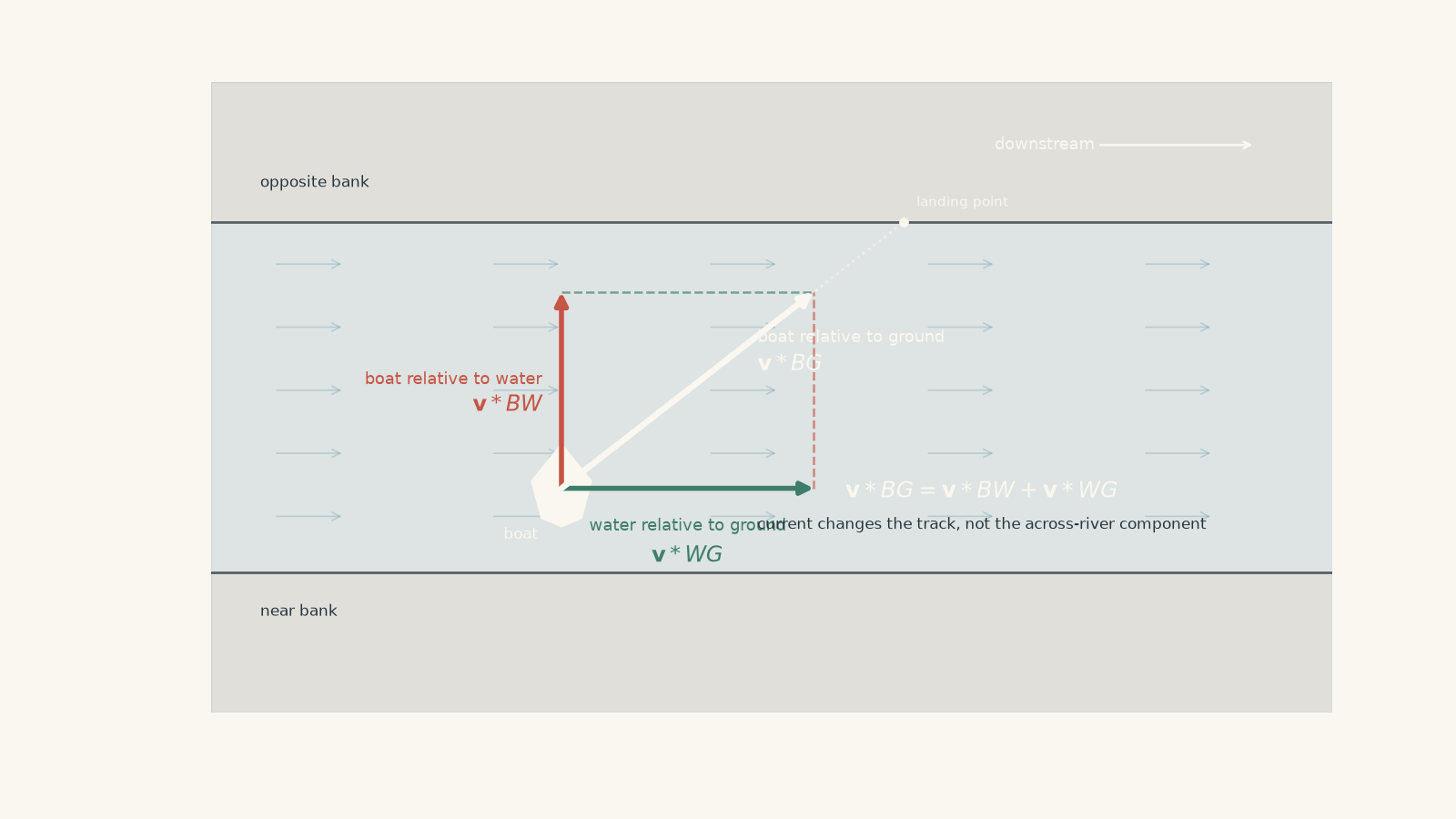
Relative to the belt, you are moving north. Relative to the floor underneath, you are moving north and east. Someone standing on the floor sees the combination of those two motions.
A boat in a river works the same way:
- the motor gives the boat a velocity relative to the water
- the current gives the water a velocity relative to the ground
- someone standing on the riverbank sees the boat’s velocity relative to the ground
The conveyor belt model is useful because it makes the vector addition visible. It is not exact for every river because real currents can change in speed and direction across the river.
We can write the exact relative-velocity relationship as
\[ \vec v_{BG} = \vec v_{BW} + \vec v_{WG} \]
where:
- \(\vec v_{BG}\) is the velocity of the boat relative to the ground
- \(\vec v_{BW}\) is the velocity of the boat relative to the water
- \(\vec v_{WG}\) is the velocity of the water relative to the ground
The riverbank observer sees \(\vec v_{BG}\). That is the velocity that determines the boat’s ground track.
02Resolve the motion into across-river and downstream components
The easiest method is to choose two perpendicular directions:
- across the river, perpendicular to the banks
- downstream, parallel to the banks
Suppose the boat points directly across the river with speed \(v_b\) relative to the water, while the current has speed \(v_c\) downstream.
Then the ground velocity has components
\[ v_{\text{across}} = v_b \]
and
\[ v_{\text{downstream}} = v_c \]
The magnitude of the boat’s ground velocity is therefore
\[ v_g = \sqrt{v_b^2 + v_c^2} \]
where \(v_g\) is the boat’s speed relative to the ground.
Its ground-track angle \(\theta\), measured downstream from the straight-across direction, satisfies
\[ \tan \theta = \frac{v_c}{v_b} \]
Notice what this equation is describing. The boat may be pointing straight across, but it is not necessarily travelling straight across relative to the ground.
Heading and ground track are different things.
03Crossing time depends on the across-river component
Suppose the river has width \(d\).
To reach the other bank, the boat must cover that perpendicular distance. So the crossing time is
\[ t = \frac{d}{v_{\text{across}}} \]
where:
- \(t\) is the crossing time in seconds
- \(d\) is the river width in metres
- \(v_{\text{across}}\) is the component of the boat’s ground velocity perpendicular to the banks, in m s\(^{-1}\)
This is where a tempting mistake appears.
A student might calculate the total ground speed and use
\[ t = \frac{d}{v_g} \]
That feels reasonable because \(t=d/v\) is familiar. The problem is that \(d\) is the distance across the river, while \(v_g\) points diagonally. They are not in the same direction.
When you use \(t=d/v\), the distance and velocity must refer to the same direction.
Worked example: A boat aimed straight across
A river is 150 m wide. A boat moves at 3.0 m s\(^{-1}\) relative to the water and points directly across the river. The current flows downstream at 1.2 m s\(^{-1}\). Find the crossing time, downstream displacement, ground speed, and ground-track direction.
Step 1
Because the current is entirely downstream, it has no across-river component. The boat’s across-river ground velocity is therefore 3.0 m s\(^{-1}\).
\[ t = \frac{d}{v_{\text{across}}} = \frac{150}{3.0} = 50\text{ s} \]
The boat takes 50 s to cross.
Step 2
\[ s_{\text{downstream}} = v_c t = 1.2(50) = 60\text{ m} \]
The boat lands 60 m downstream from the point directly opposite its starting position.
Step 3
\[ v_g = \sqrt{3.0^2 + 1.2^2} = \sqrt{10.44} = 3.23\text{ m s}^{-1} \]
So a person on the bank sees the boat moving at 3.23 m s\(^{-1}\).
Step 4
\[ \tan\theta = \frac{1.2}{3.0} \]
\[ \theta = \tan^{-1}(0.400) = 21.8^\circ \]
The boat’s ground track is 21.8° downstream from the straight-across direction.
The important result is that its ground speed is 3.23 m s\(^{-1}\), but its crossing speed is still only 3.0 m s\(^{-1}\).
04Pointing straight across is not the same as landing straight opposite
Suppose you actually want the boat to arrive at the point directly opposite its starting position.
Should you still point straight across?
No. You need to aim upstream so that part of the boat’s velocity through the water cancels the current.
This is a different problem from the previous example.
Let a boat have speed \(v_b\) relative to the water and let the current have speed \(v_c\). If the boat aims at an angle \(\theta\) upstream from the straight-across direction, then its velocity relative to the water has two components:
\[ v_{\text{boat, across}} = v_b\cos\theta \]
and
\[ v_{\text{boat, upstream}} = v_b\sin\theta \]
To land directly opposite, the upstream component must exactly cancel the downstream current:
\[ v_b\sin\theta = v_c \]
So
\[ \sin\theta = \frac{v_c}{v_b} \]
Once the downstream motion has been cancelled, the boat’s ground velocity is purely across the river.
There is a cost, though. Some of the boat’s speed is being used to fight the current, so less of it remains available for crossing.
Worked example: Landing directly opposite
A boat can travel at 4.0 m s\(^{-1}\) relative to the water. It must cross a 180 m wide river whose current flows at 1.5 m s\(^{-1}\). At what angle should the boat be aimed to land directly opposite its starting point, and how long will the crossing take?
Step 1
\[ v_b\sin\theta = v_c \]
Substituting the speeds,
\[ 4.0\sin\theta = 1.5 \]
\[ \sin\theta = \frac{1.5}{4.0} = 0.375 \]
\[ \theta = \sin^{-1}(0.375) = 22.0^\circ \]
The boat must be aimed 22.0° upstream from the straight-across direction.
Step 2
\[ v_{\text{across}} = 4.0\cos(22.0^\circ) = 3.71\text{ m s}^{-1} \]
You can also obtain this from Pythagoras:
\[ v_{\text{across}} = \sqrt{4.0^2 - 1.5^2} = 3.71\text{ m s}^{-1} \]
Step 3
\[ t = \frac{180}{3.71} = 48.5\text{ s} \]
The boat should aim 22.0° upstream and will take approximately 48.5 s to cross.
Notice that we did not use 4.0 m s\(^{-1}\) in the crossing-time calculation. Once the boat aims upstream, only part of its 4.0 m s\(^{-1}\) velocity points across the river.
05A quick decision rule for river questions
| If the question asks for… | Look for… |
|---|---|
| Crossing time | Ground-velocity component perpendicular to the banks |
| Downstream drift | Downstream ground velocity and the crossing time |
| Ground speed | Magnitude of the vector sum |
| Ground-track direction | Ratio of downstream and across ground-velocity components |
| Heading needed to land opposite | A boat component that cancels the current |
| Whether landing opposite is possible | Whether the boat can cancel the current while still having an across-river component |
The most useful habit is to draw the two axes before touching the calculator.
06The important limiting case
What happens if the current is just as fast as the boat?
Suppose the boat’s maximum speed relative to the water is 3.0 m s\(^{-1}\), and the current also travels at 3.0 m s\(^{-1}\).
To land directly opposite, the boat would need an upstream component of 3.0 m s\(^{-1}\). But the boat’s entire velocity would then have to point upstream.
Its across-river component would be zero.
So although it could cancel the downstream current, it would not cross the river at all.
If the current is faster than the boat, landing directly opposite is also impossible. The boat cannot produce a large enough upstream component to cancel the current.
This gives a more precise condition:
\[ v_b > v_c \]
is required if the boat must both cancel the current and make progress across the river.
07The misconception to avoid
A stronger current usually increases the boat’s ground speed when the boat points straight across. That can make it look as though the boat should cross sooner.
But a larger velocity in the wrong direction does not help you cover the required distance.
It is like being late to meet someone who lives directly north of you, then proudly announcing that you are running very fast east. Impressive speed. Slight navigation problem.
For crossing time, ask one question first:
How fast is the boat actually moving towards the opposite bank?
That component, not the total speed, controls the time.
08Questions and solutions
Question 1
A boat points directly across a 90 m wide river. Its speed relative to the water is 2.5 m s\(^{-1}\), and the current flows downstream at 0.80 m s\(^{-1}\).
Calculate the crossing time and the distance the boat moves downstream.
Solution 1
The boat takes 36 s to cross and lands 28.8 m downstream.
The current is parallel to the banks, so it does not change the boat’s 2.5 m s\(^{-1}\) across-river component.
The crossing time is
\[ t = \frac{d}{v_{\text{across}}} = \frac{90}{2.5} = 36\text{ s} \]
During those 36 s, the current carries the boat downstream:
\[ s_{\text{downstream}} = v_c t = 0.80(36) = 28.8\text{ m} \]
So the boat crosses in 36 s and arrives 28.8 m downstream of the point directly opposite.
The main idea is that crossing and drifting happen simultaneously. You do not add a separate “drifting time” after the boat has crossed.
Question 2
A boat travels at 5.0 m s\(^{-1}\) relative to the water and points directly across a 200 m wide river. The current flows downstream at 3.0 m s\(^{-1}\).
Find:
- the crossing time
- the downstream displacement
- the boat’s ground speed
- the angle of its ground track downstream from the straight-across direction
- the distance travelled relative to the ground during the crossing
Solution 2
The boat crosses in 40 s, moves 120 m downstream, has a ground speed of 5.83 m s\(^{-1}\), follows a track 31.0° downstream from straight across, and travels about 233 m relative to the ground.
The across-river component is 5.0 m s\(^{-1}\), so
\[ t = \frac{200}{5.0} = 40\text{ s} \]
The downstream displacement is
\[ s_{\text{downstream}} = 3.0(40) = 120\text{ m} \]
The ground speed is the magnitude of the vector sum:
\[ v_g = \sqrt{5.0^2 + 3.0^2} = \sqrt{34} = 5.83\text{ m s}^{-1} \]
For the ground-track angle,
\[ \tan\theta = \frac{3.0}{5.0} \]
\[ \theta = \tan^{-1}(0.600) = 31.0^\circ \]
The boat travels diagonally relative to the ground. Its ground-track distance is
\[ s_g = v_g t = 5.83(40) \approx 233\text{ m} \]
The same result follows from the displacement triangle:
\[ s_g = \sqrt{200^2 + 120^2} \approx 233\text{ m} \]
The 200 m river width is not the boat’s total ground-track distance. It is only the perpendicular component of that displacement.
Question 3
Two identical boats must cross separate rivers that are each 160 m wide.
Boat A moves at 4.0 m s\(^{-1}\) relative to still water.
Boat B also moves at 4.0 m s\(^{-1}\) relative to the water, but its river has a 3.0 m s\(^{-1}\) current parallel to the banks.
Both boats point directly across.
A student argues that Boat B will arrive first because its ground speed is
\[ \sqrt{4.0^2 + 3.0^2} = 5.0\text{ m s}^{-1} \]
Is the student correct? Calculate the crossing time for each boat and explain the result.
Solution 3
No. Both boats take 40 s to cross.
Boat A has an across-river velocity of 4.0 m s\(^{-1}\), so
\[ t_A = \frac{160}{4.0} = 40\text{ s} \]
Boat B also has an across-river velocity of 4.0 m s\(^{-1}\). The current adds a 3.0 m s\(^{-1}\) downstream component, but it adds nothing across the river.
Therefore,
\[ t_B = \frac{160}{4.0} = 40\text{ s} \]
Boat B’s ground speed really is 5.0 m s\(^{-1}\), but part of that velocity is downstream. Its extra ground speed does not help it approach the opposite bank.
The student’s calculation of ground speed is correct. The mistake is using the magnitude of the ground velocity to answer a question controlled only by its perpendicular component.
Question 4
A boat can move at 4.0 m s\(^{-1}\) relative to the water. It must cross a 120 m wide river with a 3.0 m s\(^{-1}\) current.
A student correctly calculates that the boat must aim
\[ \sin^{-1}\left(\frac{3.0}{4.0}\right) = 48.6^\circ \]
upstream from the straight-across direction to land directly opposite.
The student then calculates the crossing time as
\[ t = \frac{120}{4.0} = 30\text{ s} \]
Identify the error and calculate the correct crossing time.
Solution 4
The correct crossing time is about 45.4 s. The error is treating the boat’s full 4.0 m s\(^{-1}\) speed as though it points across the river.
The boat is aimed at \(48.6^\circ\) upstream from the straight-across direction. Its 3.0 m s\(^{-1}\) upstream component cancels the current.
That leaves an across-river component of
\[ v_{\text{across}} = \sqrt{4.0^2 - 3.0^2} = \sqrt{7} = 2.65\text{ m s}^{-1} \]
The crossing time is therefore
\[ t = \frac{120}{2.65} = 45.4\text{ s} \]
So the boat takes approximately 45.4 s.
The tempting mistake is to think that because the boat’s speed relative to the water is 4.0 m s\(^{-1}\), it crosses the river at 4.0 m s\(^{-1}\). That is only true when the boat’s entire velocity relative to the water points across the river.
Question 5
A 180 m wide river has a current that changes abruptly halfway across.
For the first 90 m, the current is 1.0 m s\(^{-1}\) downstream. For the second 90 m, it is 3.0 m s\(^{-1}\) downstream.
A boat points directly across throughout the journey and maintains a constant speed of 3.0 m s\(^{-1}\) relative to the local water.
Find the total crossing time and downstream displacement. Is the boat’s ground track a single straight line?
Solution 5
The boat takes 60 s to cross, moves 120 m downstream in total, and its ground track is not a single straight line.
The key observation is that both currents are parallel to the riverbanks. Neither current changes the boat’s 3.0 m s\(^{-1}\) across-river component.
For the first 90 m,
\[ t_1 = \frac{90}{3.0} = 30\text{ s} \]
For the second 90 m,
\[ t_2 = \frac{90}{3.0} = 30\text{ s} \]
Therefore,
\[ t_{\text{total}} = 30 + 30 = 60\text{ s} \]
During the first half, the downstream displacement is
\[ s_1 = 1.0(30) = 30\text{ m} \]
During the second half,
\[ s_2 = 3.0(30) = 90\text{ m} \]
So the total downstream displacement is
\[ s_{\text{downstream}} = 30 + 90 = 120\text{ m} \]
The ground track is not one straight line. In the second half of the river, the downstream component of the ground velocity becomes larger, so the direction of the resultant velocity changes. The path therefore changes direction at the midpoint in this simplified model.
This question exposes an important hidden assumption in simpler river problems: a straight ground track requires the velocity components to remain constant.
09What this idea leads to next
Boat-and-current problems are really relative velocity problems. Once you can separate velocity into perpendicular components and identify the correct reference frame, the same method works for aircraft in wind, swimmers in flowing water, and other motion through a moving medium.
The next useful step is learning to handle cases where the object is given an arbitrary heading rather than simply “straight across” or “aimed to land opposite”. The physics does not change. Resolve the velocity into components, add the medium’s velocity component by component, then use the resulting ground velocity to predict the motion.