
Thermal Convection: Density, Buoyancy and Fluid Motion
Learn how temperature differences change fluid density and drive buoyancy-driven convection. Includes worked examples, misconceptions, and HSC-style practice.
Put a beaker of water on a hotplate and heat it from below. The water touching the base warms first. If heating only increased the energy of those particles, you might expect the bottom to become very hot while the top stayed cool. Instead, the water begins to circulate.
Before reading on, predict the motion. Does the warmer water near the bottom rise, sink, or stay where it is?
It usually rises. The important reason is not that “heat rises”. Heating changes the density of the fluid. Gravity then turns that density difference into bulk motion.
That process is thermal convection.
01Start with density
Density tells us how much mass is packed into a certain volume:
\[
\rho = \frac{m}{V}
\]
where:
- \(\rho\) is density in kilograms per cubic metre (\(\text{kg m}^{-3}\)),
- \(m\) is mass in kilograms (\(\text{kg}\)), and
- \(V\) is volume in cubic metres (\(\text{m}^3\)).
Imagine 1 kg of water squeezed into a smaller volume. Its density is larger. Spread the same 1 kg over a larger volume, and its density is smaller.
That gives us the first step in understanding convection.
When most fluids are heated, they expand. The same mass occupies a larger volume, so its density decreases.
For a fixed mass,
\[
V \uparrow \quad \Rightarrow \quad \rho = \frac{m}{V} \downarrow
\]
This is a useful first model, but it needs one important qualification: how strongly a fluid expands depends on the substance, its temperature, and its pressure. Water also behaves unusually between about \(0^\circ\text{C}\) and \(4^\circ\text{C}\). So “warmer always means less dense” is a useful rule in many HSC situations, not a universal law.
02Why does lower density make a fluid rise?
Suppose a small parcel of warm fluid is surrounded by cooler, denser fluid.
The surrounding fluid pushes on the parcel from all directions. Because pressure increases with depth, the upward pressure force on the bottom of the parcel is slightly greater than the downward pressure force on its top.
The overall result is an upward buoyant force.
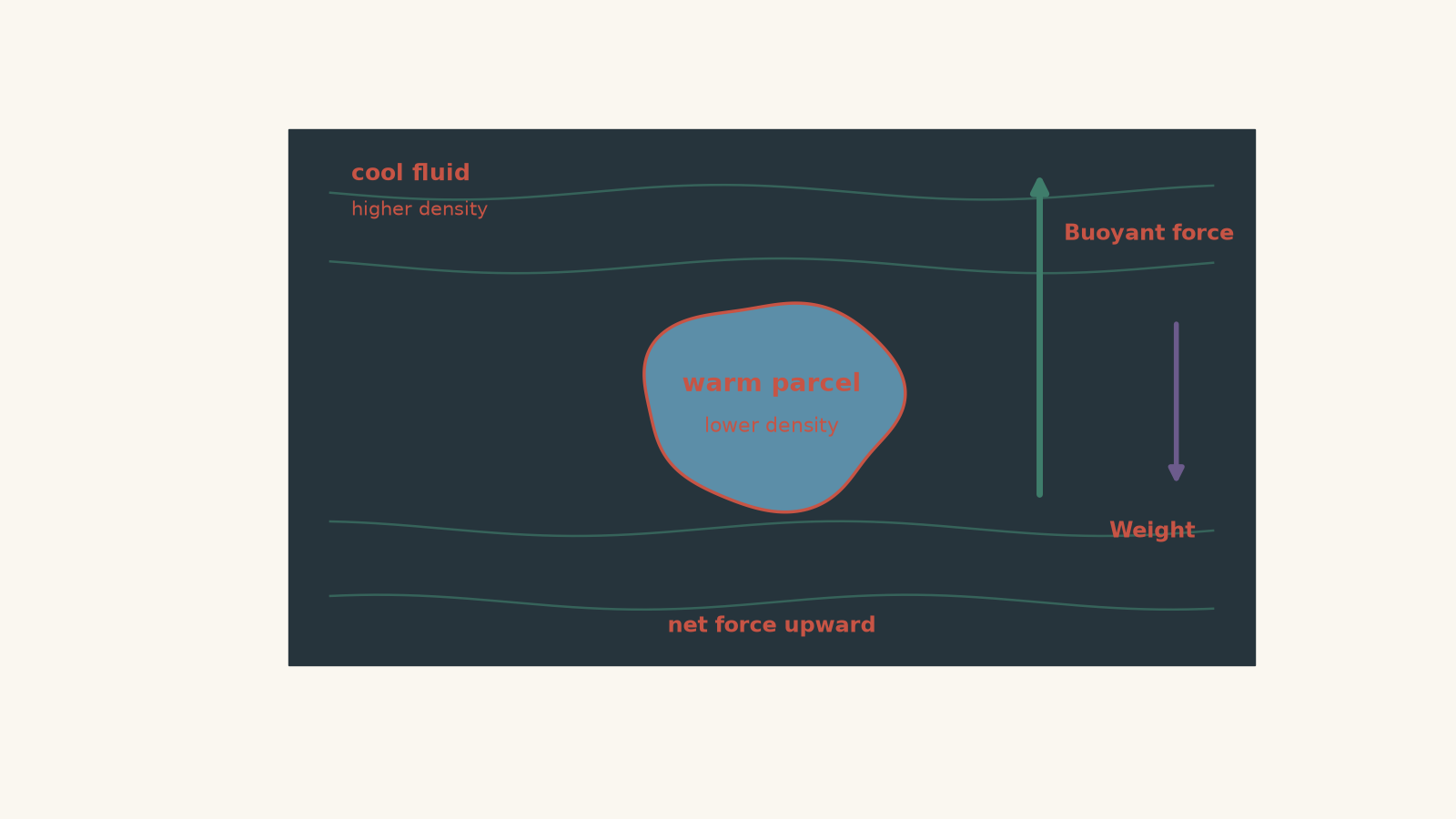
Archimedes’ principle gives the buoyant force as
\[
F_B = \rho_{\text{surrounding}}Vg
\]
where:
- \(F_B\) is the buoyant force in newtons (\(\text{N}\)),
- \(\rho_{\text{surrounding}}\) is the density of the surrounding fluid in \(\text{kg m}^{-3}\),
- \(V\) is the volume of fluid displaced in \(\text{m}^3\), and
- \(g\) is gravitational acceleration, about \(9.8\text{ m s}^{-2}\).
The parcel’s weight is
\[
W = mg
\]
If the parcel is less dense than its surroundings, its mass is smaller than the mass of the surrounding fluid it displaces. Therefore,
\[
F_B > W
\]
and there is a net upward force.
The parcel accelerates upwards.
A denser parcel experiences the opposite situation. Its weight is larger relative to the buoyant force, so it tends to sink.
03Convection needs a cycle, not just one rising blob
Now return to the beaker heated from below.
The sequence is:
- Water near the hot base gains internal energy.
- It warms and usually expands.
- Its density decreases.
- The warmer, less-dense water rises because of buoyancy.
- Cooler, denser water sinks to replace it.
- That cooler water reaches the hot region and is heated.
- The process repeats.
This circulating bulk movement is a convection current.
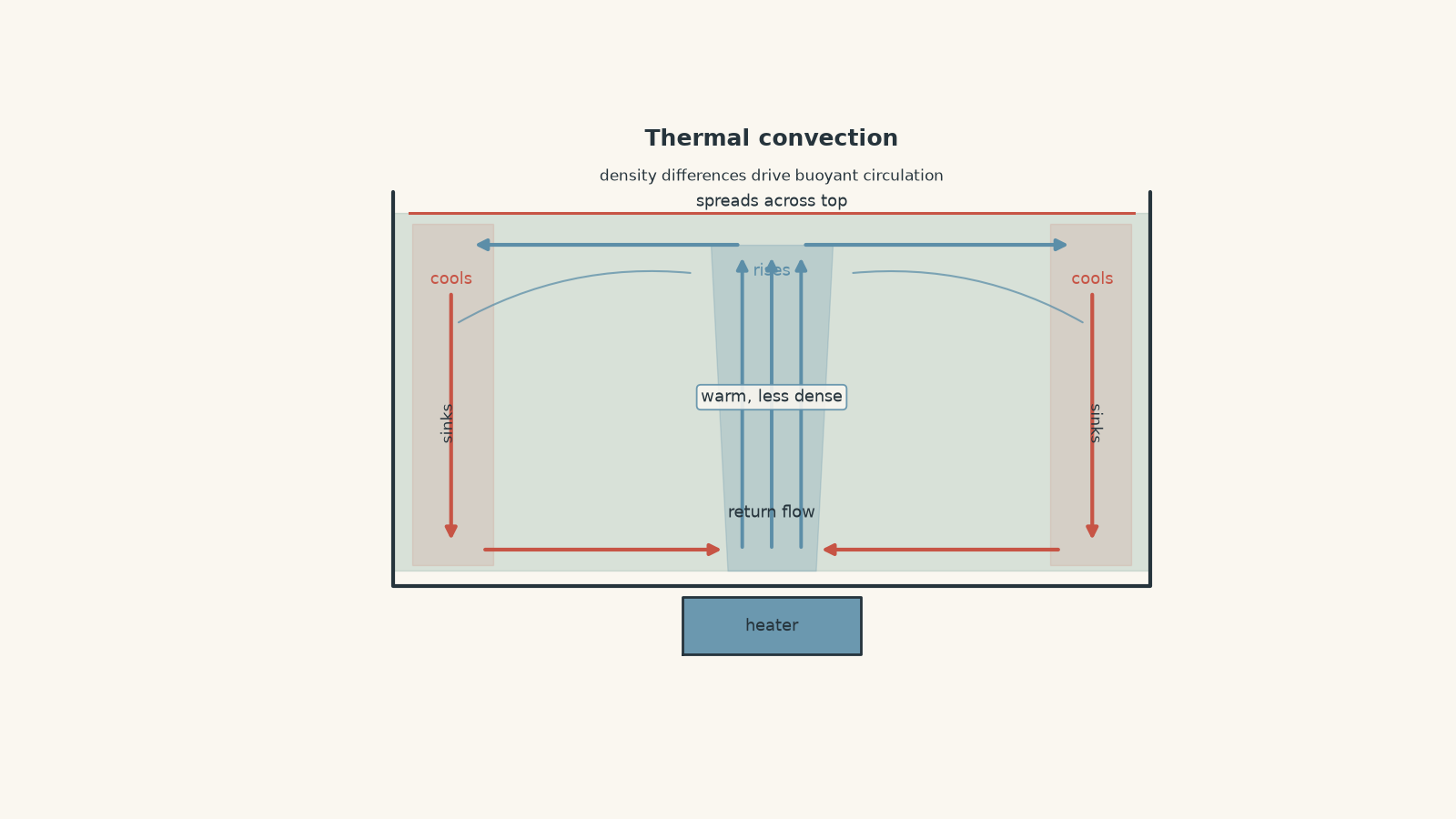
Notice what is actually moving. Convection transfers thermal energy because matter itself moves from one region to another.
That separates convection from conduction. In conduction, energy is transferred through interactions between particles without requiring a large-scale flow of matter. In convection, there is a net bulk motion of the fluid as well.
Worked example: How does heating change the density?
A \(0.75\text{ kg}\) parcel of fluid initially occupies \(6.0\times10^{-4}\text{ m}^3\). After heating, it expands to \(6.3\times10^{-4}\text{ m}^3\). Calculate its density before and after heating.
Step 1
\[
\rho = \frac{m}{V}
\]
Step 2
\[
\rho_i
= \frac{0.75}{6.0\times10^{-4}}
= 1.25\times10^3\text{ kg m}^{-3}
\]
Step 3
\[
\rho_f
= \frac{0.75}{6.3\times10^{-4}}
= 1.19\times10^3\text{ kg m}^{-3}
\]
The fluid’s density decreases from \(1.25\times10^3\text{ kg m}^{-3}\) to about \(1.19\times10^3\text{ kg m}^{-3}\).
The mass hasn’t disappeared. The same mass simply occupies more volume.
If the surrounding fluid remains denser than \(1.19\times10^3\text{ kg m}^{-3}\), this heated parcel will tend to rise.
04What happens in a gas?
For gases, we can make the temperature-density relationship more precise using the ideal gas equation:
\[
pV = nRT
\]
where:
- \(p\) is pressure in pascals (\(\text{Pa}\)),
- \(V\) is volume in \(\text{m}^3\),
- \(n\) is the amount of gas in moles (\(\text{mol}\)),
- \(R\) is the universal gas constant, and
- \(T\) is absolute temperature in kelvin (\(\text{K}\)).
For a fixed amount of one gas at approximately constant pressure,
\[
V \propto T
\]
so increasing the temperature increases the volume.
Because
\[
\rho = \frac{m}{V},
\]
the density decreases as the temperature increases.
At the same pressure and for the same gas, we can summarise this as
\[
\rho \propto \frac{1}{T}
\]
Temperature must be measured in kelvin for this relationship.
This explains why warmed air can rise through cooler surrounding air. It is not because air particles somehow “want” to travel upwards. Heating changes the air’s state, the density falls, and gravity plus the surrounding pressure field produces the buoyant force.
05The dating analogy, with one important limitation
Picture a crowded lift. Suppose the same number of people suddenly decide they need dramatically more personal space after one awkward first date. The group spreads out and occupies a larger volume.
The people represent the fluid’s mass. The space occupied represents its volume. Spreading out means less mass per unit volume, so the density falls.
The analogy stops there. Real fluid expansion comes from changes in particle motion, intermolecular spacing, pressure, and temperature. Fluid particles are not consciously trying to avoid eye contact with someone they kissed badly on Friday night.
06The most tempting misconception: “heat rises”
Students often write, “Heat rises.”
It sounds reasonable because fireplaces warm rooms above them, hot-air balloons rise, and warm water often moves towards the top of a saucepan.
But thermal energy itself doesn’t have an automatic upward direction.
Consider a metal rod heated at one end while lying horizontally. Thermal energy conducts along the rod sideways. Radiation from a hot object travels in many directions. Even in convection, it is the lower-density fluid that rises.
A better statement is:
Heating can reduce a fluid’s density. In a gravitational field, the resulting density difference can produce buoyant motion, carrying thermal energy with the moving fluid.
That wording explains the mechanism instead of memorising the direction.
There is another useful test. Imagine performing the same heating experiment in an environment with effectively no gravity. A hot region could still become less dense, but there would be almost no ordinary buoyant force to make it rise.
So density differences alone are not enough. Thermal convection requires a force, usually gravity, that can turn those density differences into motion.
07Why heating from below matters
Suppose a layer of fluid is heated from below. Warm, less-dense fluid sits underneath cooler, denser fluid.
That arrangement is unstable.
A small upward movement of the warm fluid places it among denser surroundings, so buoyancy tends to push it further upwards. Likewise, a small downward movement of cool fluid places it among less-dense surroundings, and it tends to keep sinking.
The motion can therefore grow into convection currents.
Now reverse the situation. Heat the fluid from above.
The warmer, less-dense fluid is already sitting on top of the cooler, denser fluid. That arrangement is much more stable. The low-density fluid has little reason to move down through the denser fluid below it.
Conduction can still transfer energy downwards, but strong natural convection is less likely.
This is why the location of the heating matters, not merely the fact that two regions have different temperatures.
08Natural and forced convection
The convection described so far is more precisely called natural convection.
Natural convection occurs when temperature differences create density differences, and buoyancy drives the fluid motion.
There is also forced convection, where an external device moves the fluid. Examples include:
- a fan pushing air across a hot computer component,
- a pump moving coolant through an engine, and
- a fan-forced oven circulating hot air.
In forced convection, the fluid still carries thermal energy through bulk motion, but buoyancy does not have to be the main cause of that motion.
For HSC explanations, check what is driving the fluid.
| Situation | What moves the fluid? | Type |
|---|---|---|
| Warm air rising above a heater | Density difference and buoyancy | Natural convection |
| Water circulating in a pot heated underneath | Density difference and buoyancy | Natural convection |
| Air pushed across a radiator by a fan | Fan | Forced convection |
| Coolant pumped through a pipe | Pump | Forced convection |
Worked example: Is the warm air parcel pushed upwards?
A warm air parcel has a mass of \(0.90\text{ kg}\) and a volume of \(0.78\text{ m}^3\). It is surrounded by cooler air with density \(1.20\text{ kg m}^{-3}\). Ignore drag and mixing.
Calculate the buoyant force, the parcel’s weight, and its initial acceleration.
Step 1
\[
\begin{aligned}
F_B &= \rho_{\text{surrounding}}Vg\\
&=(1.20)(0.78)(9.8)\\
&=9.17\text{ N}
\end{aligned}
\]
So the surrounding air provides an upward force of about \(9.17\text{ N}\).
Step 2
\[
\begin{aligned}
W &= mg\\
&=(0.90)(9.8)\\
&=8.82\text{ N}
\end{aligned}
\]
Step 3
Taking upwards as positive,
\[
\begin{aligned}
F_{\text{net}} &= F_B-W\\
&=9.17-8.82\\
&=0.35\text{ N}
\end{aligned}
\]
The net force is upward.
Step 4
\[
\begin{aligned}
F_{\text{net}} &= ma\\
a &= \frac{F_{\text{net}}}{m}\\
&=\frac{0.35}{0.90}\\
&=0.39\text{ m s}^{-2}
\end{aligned}
\]
The parcel initially accelerates upwards at about \(0.39\text{ m s}^{-2}\).
This doesn’t mean it will continue accelerating at that rate. As the air rises, it can expand, cool, mix with its surroundings, and experience drag. Our calculation describes the simplified initial situation.
09Temperature is not the only thing that determines density
It is tempting to turn the whole topic into a rule:
hot = low density = rises
That is too simple.
Density can depend on several variables. For a gas, pressure matters as well as temperature. Different gases can also have different densities at the same temperature and pressure.
Using the ideal gas equation, a gas can be hot but still relatively dense if its pressure is sufficiently large.
So when deciding whether one region of fluid rises through another, the most reliable question is not:
“Which one is hotter?”
It is:
“Which one is less dense under the conditions being compared?”
Temperature often creates the density difference. Density is what directly matters to buoyancy.
10Questions and solutions
Question 1
Water in a saucepan is heated from the base. Explain why water near the base tends to rise and why cooler water near the top tends to move downwards.
Solution 1
The water near the base tends to rise because heating usually makes it expand and become less dense than the cooler water above it.
The lower-density water experiences a buoyant force that is large enough relative to its weight to produce upward motion. Cooler water is denser, so it tends to sink into the space left behind. This creates a convection current that transfers thermal energy through the bulk movement of the water.
The key mechanism is the density difference. Saying only that “heat rises” does not explain why the fluid moves.
Question 2
A \(0.48\text{ kg}\) parcel of liquid has a volume of \(4.0\times10^{-4}\text{ m}^3\). After heating, its volume becomes \(4.2\times10^{-4}\text{ m}^3\).
Calculate the density before and after heating, and determine the percentage decrease in density.
Solution 2
The density decreases from \(1.20\times10^3\text{ kg m}^{-3}\) to approximately \(1.14\times10^3\text{ kg m}^{-3}\), which is a decrease of about \(4.8\%\).
Using
\[
\rho=\frac{m}{V},
\]
the initial density is
\[
\begin{aligned}
\rho_i
&=\frac{0.48}{4.0\times10^{-4}}\\
&=1.20\times10^3\text{ kg m}^{-3}.
\end{aligned}
\]
After heating,
\[
\begin{aligned}
\rho_f
&=\frac{0.48}{4.2\times10^{-4}}\\
&=1.14\times10^3\text{ kg m}^{-3}.
\end{aligned}
\]
The percentage decrease is
\[
\begin{aligned}
\%\text{ decrease}
&=\frac{\rho_i-\rho_f}{\rho_i}\times100\\
&=\frac{1200-1143}{1200}\times100\\
&\approx4.8\%.
\end{aligned}
\]
The decrease occurs because the same \(0.48\text{ kg}\) of liquid occupies a larger volume after heating.
Question 3
A parcel of warm air occupies \(0.50\text{ m}^3\) and has a mass of \(0.57\text{ kg}\). The surrounding air has density \(1.18\text{ kg m}^{-3}\).
Determine the initial net vertical force on the parcel. Ignore drag.
Solution 3
The parcel experiences an initial net force of approximately \(0.20\text{ N}\) upwards, so it will initially accelerate upwards.
The buoyant force is
\[
\begin{aligned}
F_B
&=\rho_{\text{surrounding}}Vg\\
&=(1.18)(0.50)(9.8)\\
&=5.78\text{ N}.
\end{aligned}
\]
The parcel’s weight is
\[
\begin{aligned}
W
&=mg\\
&=(0.57)(9.8)\\
&=5.59\text{ N}.
\end{aligned}
\]
Therefore,
\[
\begin{aligned}
F_{\text{net}}
&=F_B-W\\
&=5.78-5.59\\
&=0.19\text{ N}.
\end{aligned}
\]
Rounding appropriately gives about \(0.20\text{ N}\) upwards.
The important comparison is between the parcel’s weight and the weight of the surrounding air it displaces. Because the surrounding displaced air would have slightly more mass, the buoyant force is slightly larger than the parcel’s weight.
Question 4
Two regions contain the same gas. Region A is at \(300\text{ K}\) and pressure \(100\text{ kPa}\). Region B is at \(330\text{ K}\) and pressure \(120\text{ kPa}\).
A student says, “Region B must be less dense because it is hotter.”
Using the ideal gas relationship, determine whether the student’s conclusion is correct.
Solution 4
The student’s conclusion is incorrect. Region B is actually denser, because its increase in pressure is proportionally greater than its increase in absolute temperature.
For the same gas,
\[
\rho \propto \frac{p}{T}.
\]
We can therefore compare the two densities using
\[
\frac{\rho_B}{\rho_A}
=
\frac{p_B/T_B}{p_A/T_A}.
\]
Substituting,
\[
\begin{aligned}
\frac{\rho_B}{\rho_A}
&=
\frac{120/330}{100/300}\\
&=
\frac{0.3636}{0.3333}\\
&\approx1.09.
\end{aligned}
\]
So Region B has about \(1.09\) times the density of Region A, or roughly \(9\%\) greater density.
The trap is assuming that temperature alone determines gas density. Warmer gas is less dense only when other relevant conditions, particularly pressure and gas composition, are suitably controlled.
Question 5
Two identical sealed containers of fluid are heated from below in the same way.
Container X is on Earth. Container Y is inside a spacecraft where the effective gravitational field is negligible.
Both fluids develop a hotter, less-dense region near the heater. A student predicts that both containers will develop similar natural convection currents because both have density differences.
Evaluate the prediction.
Solution 5
The prediction is incorrect. Container X can develop ordinary buoyancy-driven convection, while Container Y will not develop the same natural convection current when the effective gravitational field is negligible.
In Container X, the less-dense heated fluid experiences buoyancy in Earth’s gravitational field and tends to rise. Cooler, denser fluid sinks to replace it, producing bulk circulation.
In Container Y, heating can still change the fluid’s temperature and density. However, with negligible effective gravity, there is essentially no ordinary upward buoyant force that selects a direction for the low-density fluid to rise.
Thermal energy can still spread by conduction, and fluid may move for other reasons, but the familiar natural convection loop is suppressed.
The hidden assumption in the statement “density differences cause convection” is that a body force such as gravity is available to turn those density differences into bulk motion.
11What convection lets you explain next
Thermal convection gives you a mechanism for connecting three ideas that are often taught separately:
\[
\text{temperature difference}
\rightarrow
\text{density difference}
\rightarrow
\text{buoyant motion}
\rightarrow
\text{energy transport}
\]
Once that chain is clear, larger systems become easier to analyse. Atmospheric circulation, sea breezes, convection in liquids, and parts of stellar interiors all involve the same basic question: how does a density difference behave in a gravitational field?
The next useful comparison is with conduction and thermal radiation. All three transfer energy, but only convection requires bulk fluid motion.