
Thermal Equilibrium and Net Energy Flow in HSC Physics
Learn what thermal equilibrium really means, why equal temperature gives zero net energy flow, and how to solve equilibrium temperature problems.
Put a hot metal spoon into a mug of cool water. The spoon cools and the water warms. That part is easy to predict.
But what happens once they reach the same temperature? Does energy transfer completely stop, or do particles keep exchanging energy while the transfers balance?
The second picture is closer to the truth. Thermal equilibrium means there is no net thermal energy transfer between systems. Equal temperature is the condition that produces that balance.
That distinction matters because “no net energy flow” is not the same as “nothing is happening”.
01Start with the direction of energy flow
Imagine two solid blocks touching.
- Block A is at \(80^\circ\text{C}\).
- Block B is at \(20^\circ\text{C}\).
Before reading on, predict what happens. Does thermal energy move from A to B, from B to A, or both?
At the macroscopic level, the useful answer is that thermal energy is transferred from the hotter block to the cooler block. Block A loses energy and cools. Block B gains energy and warms.
This continues until they reach the same temperature.
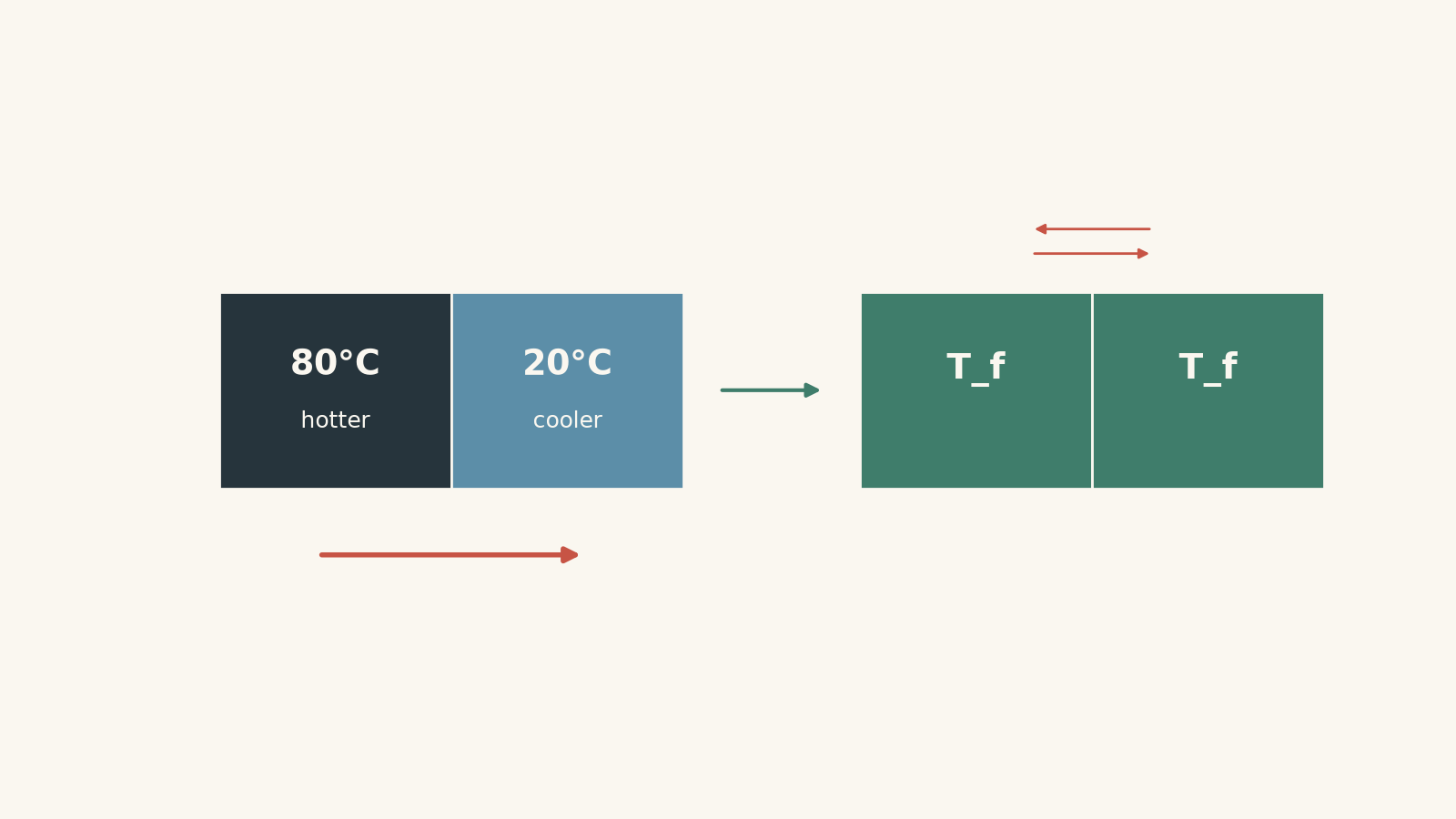
The important word is net.
At the microscopic level, particles at the boundary interact in both directions. Energy can be transferred from a particle in A to one in B, and from B back to A. When A is hotter, however, the transfers are unbalanced overall. More energy crosses from A to B than from B to A.
Once both systems are at the same temperature, those microscopic exchanges balance on average. There is no longer a preferred direction for thermal energy transfer.
02What equal temperature actually means
Temperature is not a measure of “how much heat an object contains”.
An object does not contain heat. Heat is energy transferred because of a temperature difference.
Temperature instead describes the thermal state of a system. In the particle model used at HSC level, temperature is connected to the particles’ average kinetic energy. You can review that connection in Temperature and Average Kinetic Energy in HSC Physics.
Now consider two objects at the same temperature.
A huge swimming pool at \(25^\circ\text{C}\) contains vastly more internal energy than a teaspoon of water at \(25^\circ\text{C}\). Yet if the teaspoon could somehow be placed in thermal contact with the pool while remaining identifiable, there would be no net thermal energy transfer caused by a temperature difference.
Why? Their temperatures are already equal.
So equal temperature does not mean:
- equal mass,
- equal internal energy,
- equal total particle kinetic energy, or
- equal thermal capacity.
It means there is no temperature difference driving a net thermal energy transfer between the systems.
03Thermal equilibrium
Two systems are in thermal equilibrium when they are in thermal contact and there is no net transfer of thermal energy between them because their temperatures are equal.
A useful mental model is two people repeatedly passing coins across a table.
If one person is handing over 20 coins each minute while receiving only 8, there is a net flow of 12 coins per minute in one direction. If each person passes 15 coins per minute to the other, coins are still moving, but the net flow is zero.
The analogy breaks because microscopic energy transfer does not literally involve discrete people choosing to pass packets back and forth. The useful part is simply the idea that opposite transfers can occur while their net effect is zero.
At thermal equilibrium,
\[
T_A = T_B
\]
where \(T_A\) and \(T_B\) are the temperatures of systems A and B.
The consequence is
\[
Q_{\text{net between A and B}} = 0
\]
over time.
Here \(Q\) represents thermal energy transferred, measured in joules (\(\text{J}\)).
04Equal temperature is the endpoint, not necessarily the starting condition
Suppose a \(90^\circ\text{C}\) piece of metal is placed in \(20^\circ\text{C}\) water inside a well-insulated container.
The final temperature must lie somewhere between \(20^\circ\text{C}\) and \(90^\circ\text{C}\), provided that:
- no phase change occurs,
- no significant energy enters or leaves the container, and
- there are no other energy transfers, such as electrical heating.
The metal loses thermal energy. The water gains thermal energy.
At equilibrium,
\[
Q_{\text{lost}} = Q_{\text{gained}}
\]
in magnitude.
A more careful signed form is
\[
Q_{\text{metal}} + Q_{\text{water}} = 0
\]
because one \(Q\) is negative and the other is positive.
If there is no phase change, we can use
\[
Q = mc\Delta T
\]
where:
- \(Q\) is the thermal energy transferred in joules (\(\text{J}\)),
- \(m\) is mass in kilograms (\(\text{kg}\)),
- \(c\) is specific heat capacity in joules per kilogram per kelvin (\(\text{J kg}^{-1}\text{K}^{-1}\)),
- \(\Delta T = T_f-T_i\) is the temperature change, and
- \(T_f\) and \(T_i\) are the final and initial temperatures.
A temperature difference of \(1^\circ\text{C}\) has the same size as a temperature difference of \(1\text{ K}\), so either unit can be used for \(\Delta T\).
For a fuller treatment of this equation, see Specific Heat Capacity: Using Q = mcΔT in HSC Physics.
Worked example: equal masses of water mixed together
A \(0.20\text{ kg}\) sample of water at \(70^\circ\text{C}\) is mixed with \(0.20\text{ kg}\) of water at \(30^\circ\text{C}\) in a perfectly insulated container. Find the equilibrium temperature. Assume no water evaporates.
Step 1
The hot water must cool and the cold water must warm. Because the samples have equal masses and are the same substance, they have equal thermal capacities.
We should therefore expect the final temperature to be halfway between \(70^\circ\text{C}\) and \(30^\circ\text{C}\).
Step 2
The total thermal energy lost by the hot water equals the total thermal energy gained by the cold water:
\[
m c (70-T_f) = m c (T_f-30)
\]
The common factors \(m\) and \(c\) cancel:
\[
70-T_f = T_f-30
\]
Step 3
\[
\begin{aligned}
100 &= 2T_f \\
T_f &= 50^\circ\text{C}
\end{aligned}
\]
So the equilibrium temperature is
\[
\boxed{50^\circ\text{C}}
\]
Both samples finish at \(50^\circ\text{C}\). Once they reach that temperature, there is no net thermal energy transfer between them.
Notice why \(50^\circ\text{C}\) worked here. It was not simply because “the answer is always the average”. It worked because the two samples had the same mass and the same specific heat capacity.
05The equilibrium temperature is not always the numerical average
Now imagine replacing the cold water with a material that requires much less energy to change its temperature.
Would you still expect the final temperature to sit exactly halfway between the two starting temperatures?
No.
The equilibrium temperature depends on each object’s thermal capacity, which for an object with constant specific heat capacity is
\[
mc
\]
The product \(mc\) tells us how much energy is required to change the object’s temperature by one degree.
An object with a large \(mc\) is harder to shift in temperature. It pulls the final equilibrium temperature closer to its own initial temperature.
Worked example: aluminium placed in water
A \(0.50\text{ kg}\) aluminium block at \(100^\circ\text{C}\) is placed in \(0.20\text{ kg}\) of water at \(20^\circ\text{C}\). The system is insulated. Take
\[
c_{\text{Al}} = 900\text{ J kg}^{-1}\text{K}^{-1}
\]
and
\[
c_{\text{water}} = 4200\text{ J kg}^{-1}\text{K}^{-1}.
\]
Find the final equilibrium temperature.
Step 1
The aluminium has thermal capacity
\[
m_{\text{Al}}c_{\text{Al}}=(0.50)(900)=450\text{ J K}^{-1}.
\]
The water has thermal capacity
\[
m_{\text{water}}c_{\text{water}}=(0.20)(4200)=840\text{ J K}^{-1}.
\]
The water has the larger thermal capacity. Its temperature is therefore harder to change, so the final temperature should be closer to \(20^\circ\text{C}\) than to \(100^\circ\text{C}\).
That prediction gives us a useful check before doing any algebra.
Step 2
The aluminium cools:
\[
Q_{\text{lost}}=m_{\text{Al}}c_{\text{Al}}(100-T_f).
\]
The water warms:
\[
Q_{\text{gained}}=m_{\text{water}}c_{\text{water}}(T_f-20).
\]
Therefore,
\[
(0.50)(900)(100-T_f)
=
(0.20)(4200)(T_f-20).
\]
Step 3
\[
\begin{aligned}
450(100-T_f) &= 840(T_f-20) \\
45000-450T_f &= 840T_f-16800 \\
61800 &= 1290T_f \\
T_f &\approx 47.9^\circ\text{C}
\end{aligned}
\]
So,
\[
\boxed{T_f \approx 48^\circ\text{C}}
\]
The result matches our prediction. The final temperature is much closer to the water’s initial \(20^\circ\text{C}\) because the water has the greater thermal capacity.
06A compact equilibrium equation
For two objects in an insulated system, with no phase changes,
\[
m_1c_1(T_f-T_1)+m_2c_2(T_f-T_2)=0
\]
where:
- \(m_1\) and \(m_2\) are the masses,
- \(c_1\) and \(c_2\) are the specific heat capacities,
- \(T_1\) and \(T_2\) are the initial temperatures, and
- \(T_f\) is their common final equilibrium temperature.
This equation is just conservation of energy. It is not a separate thermal-equilibrium law to memorise.
Each term \(mc(T_f-T_i)\) is the energy change of one object. The sum is zero because, in the ideal insulated model, energy lost by one part of the system is gained by another.
07The most tempting misconception: “same temperature means no energy transfer at all”
This is close, but too strong.
Suppose two objects at the same temperature face each other. Both emit thermal radiation. Both can also absorb radiation from the other.
So energy transfer can still occur in each direction.
At equilibrium, what vanishes is the net transfer caused by a temperature difference. If each body transfers energy to the other at the same average rate, neither undergoes a net energy change from that exchange.
This is similar to two equally popular people texting each other the same number of messages. Messages are definitely being sent. But neither person’s unread-message count is drifting upward because of the exchange.
The analogy stops being useful once you start asking about the actual mechanism of radiation or particle collisions. Molecules do not have phones, which is probably for the best.
08Equal temperature by itself needs context
Seeing two thermometers both read \(40^\circ\text{C}\) does not automatically prove that an entire system is in complete thermal equilibrium.
For example, two objects might momentarily have the same measured temperature while:
- one is being electrically heated,
- the other is losing energy to cold surroundings, or
- strong temperature gradients exist inside one of the objects.
Their thermometer readings may match at that instant, yet the broader system is still changing.
Thermal equilibrium describes a state in which there is no net thermal energy flow driven by temperature differences within the systems being considered.
That is why you should always ask: what is the system, and what energy transfers are allowed?
09Thermal equilibrium and the zeroth law
There is one more useful consequence.
Suppose object A is in thermal equilibrium with object C. Object B is also in thermal equilibrium with object C.
What can you conclude about A and B?
They have the same temperature. Therefore, A and B would also be in thermal equilibrium with each other if placed in thermal contact.
This is the zeroth law of thermodynamics.
In symbols, if
\[
T_A=T_C
\]
and
\[
T_B=T_C,
\]
then
\[
T_A=T_B.
\]
This idea is what makes thermometers useful. You do not need to compare every object directly with every other object. You compare each one with a common measuring system.
10Questions and solutions
Question 1
A copper block at \(65^\circ\text{C}\) is placed in contact with another copper block at \(25^\circ\text{C}\). The blocks are thermally isolated from their surroundings.
Before equilibrium is reached, state the direction of the net thermal energy transfer. Then state what happens to that net transfer once the blocks reach the same temperature.
Solution 1
Thermal energy is transferred net from the \(65^\circ\text{C}\) block to the \(25^\circ\text{C}\) block, and the net transfer becomes zero when their temperatures become equal.
The temperature difference gives the thermal energy transfer a preferred net direction. The hotter block loses internal energy and cools, while the cooler block gains internal energy and warms.
At thermal equilibrium,
\[
T_{\text{hot}}=T_{\text{cold}}.
\]
Microscopic energy exchanges may still occur in both directions, but they balance on average, so there is no net thermal energy transfer.
The common mistake is to say that all energy transfer stops. Thermal equilibrium requires zero net transfer, not necessarily the complete absence of microscopic exchanges.
Question 2
Two equal masses of the same liquid, with no phase change, are mixed in an insulated container. One begins at \(18^\circ\text{C}\) and the other at \(62^\circ\text{C}\).
Find their equilibrium temperature.
Solution 2
The equilibrium temperature is \(40^\circ\text{C}\).
Because the two samples have equal mass and the same specific heat capacity, they have equal thermal capacities.
Using conservation of energy,
\[
mc(62-T_f)=mc(T_f-18).
\]
Cancel \(m\) and \(c\):
\[
\begin{aligned}
62-T_f &= T_f-18 \\
80 &= 2T_f \\
T_f &= 40^\circ\text{C}.
\end{aligned}
\]
Therefore,
\[
\boxed{T_f=40^\circ\text{C}}.
\]
Each sample changes temperature by \(22^\circ\text{C}\). The warmer sample loses exactly as much thermal energy as the cooler sample gains.
The arithmetic mean works here only because the thermal capacities are equal.
Question 3
A \(0.30\text{ kg}\) brass object at \(90^\circ\text{C}\) is placed into \(0.10\text{ kg}\) of water at \(20^\circ\text{C}\). The system is perfectly insulated.
Use
\[
c_{\text{brass}}=380\text{ J kg}^{-1}\text{K}^{-1}
\]
and
\[
c_{\text{water}}=4200\text{ J kg}^{-1}\text{K}^{-1}.
\]
Calculate the equilibrium temperature.
Solution 3
The equilibrium temperature is approximately \(35^\circ\text{C}\).
The brass loses thermal energy while the water gains it.
For the brass,
\[
Q_{\text{lost}}
=
m_{\text{b}}c_{\text{b}}(90-T_f).
\]
For the water,
\[
Q_{\text{gained}}
=
m_{\text{w}}c_{\text{w}}(T_f-20).
\]
Conservation of energy gives
\[
(0.30)(380)(90-T_f)
=
(0.10)(4200)(T_f-20).
\]
So,
\[
\begin{aligned}
114(90-T_f) &= 420(T_f-20) \\
10260-114T_f &= 420T_f-8400 \\
18660 &= 534T_f \\
T_f &\approx 34.9^\circ\text{C}.
\end{aligned}
\]
Therefore,
\[
\boxed{T_f\approx35^\circ\text{C}}.
\]
The result is much closer to the water’s initial temperature. Even though there is less water by mass, water’s much larger specific heat capacity gives the water a larger thermal capacity:
\[
m_{\text{water}}c_{\text{water}}
=
(0.10)(4200)
=
420\text{ J K}^{-1},
\]
compared with
\[
m_{\text{brass}}c_{\text{brass}}
=
(0.30)(380)
=
114\text{ J K}^{-1}.
\]
The water therefore requires much more energy per degree of temperature change.
Question 4
A student says:
Two objects are both at \(30^\circ\text{C}\), so they must contain the same amount of thermal energy.
One object is a \(2.0\text{ kg}\) steel plate and the other is a \(5.0\text{ g}\) steel screw.
Explain what is wrong with the student’s reasoning. If the plate and screw are placed in thermal contact while both remain at \(30^\circ\text{C}\), state the net thermal energy transfer between them.
Solution 4
The student’s claim is incorrect. The two objects have equal temperature, but they do not have equal internal energy. The net thermal energy transfer between them is zero.
Temperature does not measure the total energy stored in an object. The plate contains much more matter than the screw, so it contains many more particles. Although the average thermal behaviour associated with temperature is the same, the plate’s total internal energy is not the same as the screw’s.
Because both objects are at
\[
30^\circ\text{C},
\]
there is no temperature difference between them. Therefore, there is no preferred direction for net thermal energy transfer.
So,
\[
\boxed{Q_{\text{net}}=0}.
\]
The trap is confusing temperature, which describes a thermal state, with total internal energy, which also depends on how much material is present and what that material is.
Question 5
An electric heater keeps object A at exactly \(50^\circ\text{C}\). Object B is also measured at \(50^\circ\text{C}\), but B is steadily losing energy to a cold room.
A student claims, “A and B have equal temperatures, so the entire arrangement must be in thermal equilibrium.”
Assess the claim.
Solution 5
The claim is not valid for the entire arrangement. Equal thermometer readings at one instant do not guarantee that the full system is in thermal equilibrium.
Objects A and B have equal temperatures at the stated moment, so there is no net thermal energy transfer between A and B caused solely by a temperature difference between them.
However, the broader arrangement includes other energy transfers. Object A receives energy from an electric heater, while object B is losing energy to the surroundings. The system is therefore not in an unchanging equilibrium state.
For true thermal equilibrium of the whole arrangement, there must be no net thermal energy flows driven by temperature differences within the system being considered.
The hidden assumption in the student’s reasoning is that equal temperature alone is sufficient, without checking the system boundary or whether external energy transfers are occurring.
Question 6
Two insulated objects, X and Y, are placed in thermal contact. X begins at \(60^\circ\text{C}\) and Y at \(20^\circ\text{C}\).
After some time, both are measured at \(35^\circ\text{C}\).
A student argues that the measurements must be impossible because \(35^\circ\text{C}\) is not halfway between \(20^\circ\text{C}\) and \(60^\circ\text{C}\).
Without knowing either object’s mass or specific heat capacity, determine whether the student’s conclusion is justified. Then determine which object must have the greater thermal capacity \(mc\).
Solution 6
The student’s conclusion is not justified, and object Y must have the greater thermal capacity.
The final equilibrium temperature needs to be the simple average only when the two objects have equal thermal capacities.
Object X cools from \(60^\circ\text{C}\) to \(35^\circ\text{C}\), so
\[
\Delta T_X=25^\circ\text{C}.
\]
Object Y warms from \(20^\circ\text{C}\) to \(35^\circ\text{C}\), so
\[
\Delta T_Y=15^\circ\text{C}.
\]
Because the system is insulated,
\[
Q_{\text{lost by X}}=Q_{\text{gained by Y}}.
\]
Therefore,
\[
(m_Xc_X)(25)=(m_Yc_Y)(15).
\]
Rearranging,
\[
\frac{m_Yc_Y}{m_Xc_X}
=
\frac{25}{15}
=
\frac{5}{3}.
\]
So,
\[
\boxed{m_Yc_Y=\frac{5}{3}m_Xc_X}.
\]
Object Y has the larger thermal capacity. It undergoes the smaller temperature change while exchanging the same amount of energy.
This is why the equilibrium temperature ends up closer to Y’s initial \(20^\circ\text{C}\) than to X’s initial \(60^\circ\text{C}\).
The useful next step is to connect this equilibrium model to situations where \(Q=mc\Delta T\) is no longer enough. If a substance reaches a melting or boiling point, energy can still be transferred while its temperature remains constant. That leads directly to Latent Heat and Phase Changes: HSC Physics Explained.