
Electrical Power in HSC Physics: Using P = VI and Equivalent Forms
Learn how to use P = VI, P = I²R, and P = V²/R to analyse electrical devices, compare operating conditions, and avoid common power misconceptions.
A 12 V device draws 0.50 A. Another device also runs at 12 V, but draws 2.0 A. Which one is doing more electrically?
You might be tempted to say they are the same because the voltage is the same. But voltage only tells you how much electrical energy is transferred per unit charge. We also need to know how quickly charge is moving through the device.
The second device draws four times the current, so four times as much charge passes through it each second. At the same voltage, that means electrical energy is being transferred four times as quickly.
That rate of energy transfer is electrical power.
01What electrical power actually measures
Power is the rate at which energy is transferred:
\[ P = \frac{E}{t} \]
where:
- \(P\) is power in watts (W),
- \(E\) is energy transferred in joules (J),
- \(t\) is time in seconds (s).
One watt means one joule of energy transferred each second:
\[ 1\text{ W} = 1\text{ J s}^{-1} \]
So a 60 W device transfers energy at 60 J every second.
That doesn’t mean all 60 J becomes useful energy. A motor might convert some electrical energy into kinetic energy and some into thermal energy. A heater is deliberately designed so that thermal energy is the useful output.
To calculate the electrical power entering a device, we need to connect two ideas you may already know:
- voltage tells us the energy transferred per unit charge,
- current tells us the charge flowing per unit time.
If either idea feels shaky, it is worth revisiting potential difference and electrical work using \(W=qV\) and current as charge flow rate using \(I=q/t\).
02Why \(P = VI\)
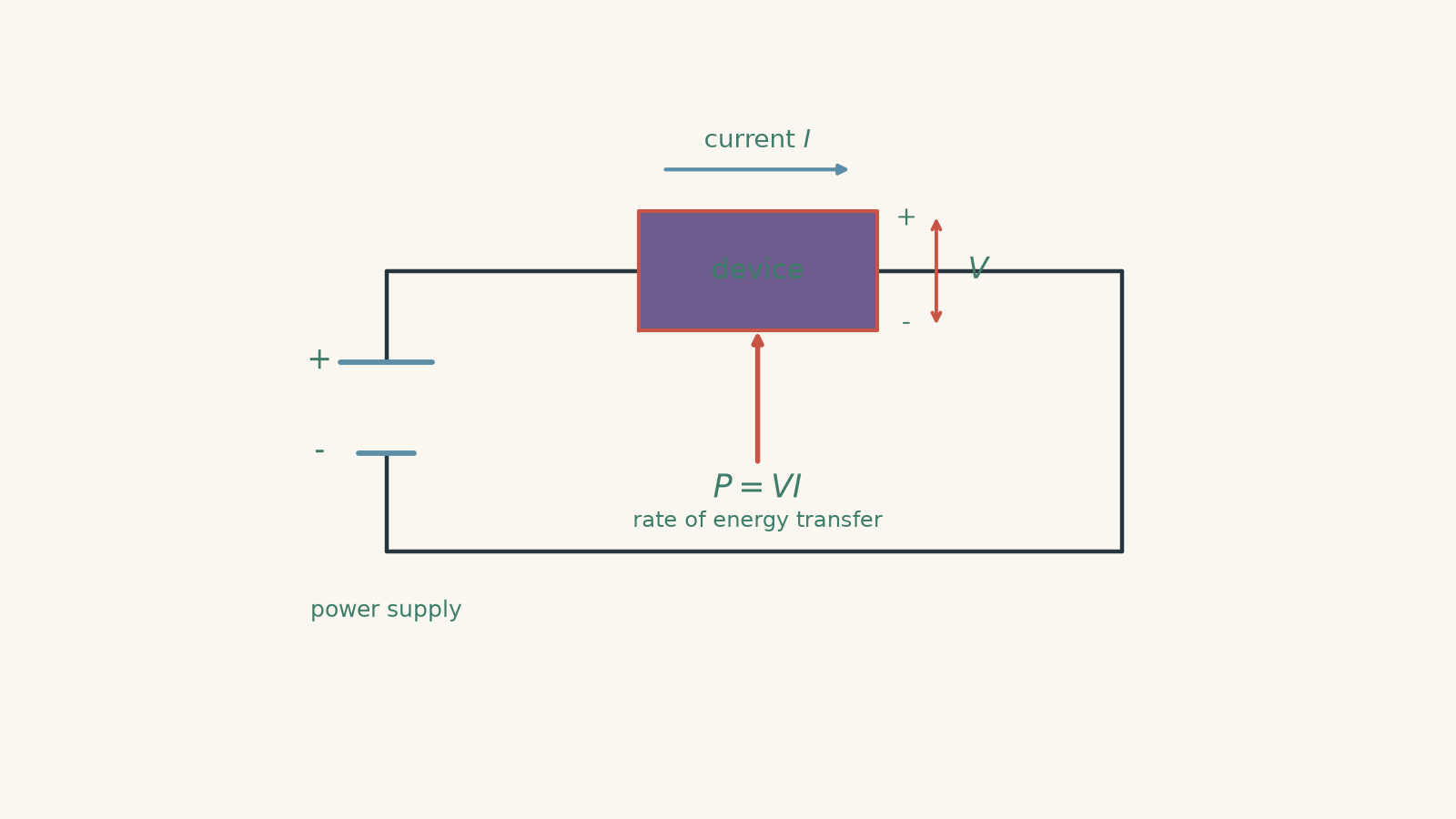
Suppose charge \(q\) passes through a device with potential difference \(V\).
The electrical work done is:
\[ E = qV \]
Power is energy transferred per unit time, so:
\[ P = \frac{E}{t} \]
Substitute \(E=qV\):
\[ P = \frac{qV}{t} \]
But current is:
\[ I = \frac{q}{t} \]
Therefore:
\[ \boxed{P = VI} \]
where:
- \(P\) is electrical power in watts (W),
- \(V\) is potential difference across the device in volts (V),
- \(I\) is current through the device in amperes (A).
The equation is not just a formula to memorise. It says:
electrical power depends on both the energy transferred to each coulomb of charge and the number of coulombs passing each second.
Worked example: Power used by a small lamp
A 12 V lamp draws a current of 0.50 A. Calculate the electrical power transferred to the lamp.
Step 1
We know the voltage and current, so use:
\[ P = VI \]
Step 2
\[ P = (12\text{ V})(0.50\text{ A}) \]
Step 3
\[ P = 6.0\text{ W} \]
The lamp receives electrical energy at a rate of 6.0 J each second.
Notice what that result does not tell us. It does not say the lamp produces 6.0 W of visible light. Some of the electrical energy will also become thermal energy.
03The equivalent forms: \(P = I^2R\) and \(P = \frac{V^2}{R}\)
Sometimes a question gives resistance instead of both voltage and current.
For a conductor where the relationship \(V=IR\) can be used at the operating point, we can combine it with:
\[ P = VI \]
Start by replacing \(V\) with \(IR\):
\[ P = I(IR) \]
so:
\[ \boxed{P = I^2R} \]
Alternatively, rearrange Ohm’s law:
\[ I = \frac{V}{R} \]
and substitute this into \(P=VI\):
\[ P = V\left(\frac{V}{R}\right) \]
giving:
\[ \boxed{P = \frac{V^2}{R}} \]
These three forms are useful in different situations:
| Information available | Useful form |
|---|---|
| \(V\) and \(I\) | \(P=VI\) |
| \(I\) and \(R\) | \(P=I^2R\) |
| \(V\) and \(R\) | \(P=\frac{V^2}{R}\) |
The important habit is not “pick the formula with the right letters”. Ask what is physically being held constant.
That becomes especially important when resistance changes.
04A common trap: does larger resistance mean larger power?
Here is a prediction worth making.
Suppose the resistance of a device increases. Does its power increase or decrease?
There is no single answer.
That can feel annoying because:
\[ P=I^2R \]
seems to say that increasing \(R\) increases \(P\).
But:
\[ P=\frac{V^2}{R} \]
seems to say that increasing \(R\) decreases \(P\).
Both are correct. They describe different constraints.
If current is held constant
Using:
\[ P=I^2R \]
if \(I\) stays fixed, increasing \(R\) increases the power.
For example, doubling \(R\) while keeping \(I\) constant doubles \(P\).
If voltage is held constant
Using:
\[ P=\frac{V^2}{R} \]
if \(V\) stays fixed, increasing \(R\) decreases the power.
Doubling \(R\) while keeping \(V\) constant halves \(P\).
Think of this like someone asking whether bringing a third person on a date makes the conversation faster or slower. The answer depends rather heavily on what else you’re assuming stays the same. Resistance by itself is not enough information.
The analogy breaks because electrical resistance has a precise quantitative relationship with voltage and current, while awkward dinner conversations do not.
Worked example: A resistor on a fixed-voltage supply
A \(180\ \Omega\) resistor is connected across a 12 V supply. Calculate the power transferred to the resistor.
Step 1
We know \(V\) and \(R\), so:
\[ P=\frac{V^2}{R} \]
Step 2
\[ P=\frac{(12\text{ V})^2}{180\ \Omega} \]
Step 3
\[ P=\frac{144}{180}\text{ W}=0.80\text{ W} \]
The resistor converts electrical energy into thermal energy at a rate of 0.80 J per second.
Now suppose the resistance were doubled to \(360\ \Omega\) while the supply remained at 12 V:
\[ P=\frac{(12)^2}{360}=0.40\text{ W} \]
At a fixed voltage, doubling the resistance has halved the power.
05Why changing voltage can have a surprisingly large effect
Imagine an ideal resistor whose resistance stays constant.
If its voltage doubles, what happens to its power?
A first guess might be “power doubles” because \(P=VI\) contains \(V\).
But increasing the voltage also increases the current.
Since:
\[ I=\frac{V}{R} \]
doubling \(V\) doubles \(I\) when \(R\) remains constant.
So in:
\[ P=VI \]
both factors double:
\[ P_{\text{new}}=(2V)(2I)=4VI \]
Power becomes four times as large.
The same result appears directly from:
\[ P=\frac{V^2}{R} \]
With \(R\) constant:
\[ P\propto V^2 \]
So:
- doubling voltage gives four times the power,
- tripling voltage gives nine times the power,
- halving voltage gives one-quarter of the power.
This square relationship is easy to miss.
Worked example: Operating a heating element at a different voltage
An idealised heating element has a constant resistance of \(24\ \Omega\). It is first connected to 12 V, then to 18 V. Calculate the power in each case and determine the factor by which the power changes.
Step 1
Because voltage and resistance are known:
\[ P_1=\frac{V_1^2}{R} \]
\[ P_1=\frac{(12\text{ V})^2}{24\ \Omega} =\frac{144}{24}\text{ W} =6.0\text{ W} \]
Step 2
\[ P_2=\frac{V_2^2}{R} \]
\[ P_2=\frac{(18\text{ V})^2}{24\ \Omega} =\frac{324}{24}\text{ W} =13.5\text{ W} \]
Step 3
\[ \frac{P_2}{P_1} = \frac{13.5}{6.0} = 2.25 \]
The voltage increased by a factor of:
\[ \frac{18}{12}=1.5 \]
but the power increased by:
\[ (1.5)^2=2.25 \]
So the element transfers energy 2.25 times as quickly at 18 V, assuming its resistance remains constant.
That last assumption matters.
06When resistance is not constant
Real devices do not always have a constant resistance.
An incandescent filament, for example, becomes hotter as its current increases. Its resistance changes with temperature. In that situation, you cannot assume one fixed value of \(R\) will describe the device at every voltage.
This is where blindly using:
\[ P=\frac{V^2}{R} \]
can cause trouble.
The equation itself is not the problem. The problem is treating \(R\) as though it were unchanged when the device’s behaviour says otherwise.
For an ohmic conductor at constant physical conditions, \(V\) is proportional to \(I\), so resistance remains constant. The assumptions behind that relationship are covered in Ohm’s law in HSC Physics.
For a non-ohmic device, use the actual voltage and current at the operating point whenever they are available:
\[ P=VI \]
A useful decision rule
When analysing a device:
- If you know \(V\) and \(I\), use \(P=VI\).
- If you need an equivalent form involving \(R\), check whether the resistance is known for that operating condition.
- Before making statements such as “more resistance means more power”, identify what is being held constant.
- If the device is non-ohmic, do not assume that one fixed resistance applies as voltage or current changes.
07Power ratings describe an operating condition
A device labelled 24 W is telling you the rate at which it transfers energy when operating under the stated conditions.
Suppose a device is rated:
- 12 V,
- 24 W.
We can calculate its operating current:
\[ I=\frac{P}{V} \]
\[ I=\frac{24\text{ W}}{12\text{ V}} =2.0\text{ A} \]
If it behaves as a \(6.0\ \Omega\) resistance at that operating point, then:
\[ R=\frac{V}{I} =\frac{12\text{ V}}{2.0\text{ A}} =6.0\ \Omega \]
The three quantities agree:
\[ P=VI=(12)(2.0)=24\text{ W} \]
and:
\[ P=I^2R=(2.0)^2(6.0)=24\text{ W} \]
as well as:
\[ P=\frac{V^2}{R}=\frac{12^2}{6.0}=24\text{ W} \]
These are not three different types of power. They are three ways of describing the same rate of energy transfer.
08Questions and solutions
Question 1
A portable fan operates at 9.0 V and draws a current of 0.40 A.
Calculate the electrical power supplied to the fan and explain what your answer means physically.
Solution 1
The fan receives electrical power of \(3.6\text{ W}\), meaning electrical energy is transferred to it at \(3.6\text{ J}\) each second.
Use:
\[ P=VI \]
Substitute:
\[ P=(9.0\text{ V})(0.40\text{ A}) \]
\[ P=3.6\text{ W} \]
A watt is a joule per second, so the result means the fan receives 3.6 J of electrical energy every second. That energy may become kinetic energy of the blades, thermal energy, sound, and other forms.
Question 2
A \(50\ \Omega\) heating element carries a current of 0.30 A.
Calculate the electrical power transferred to the element.
If the current is doubled while the resistance remains constant, determine the new power.
Solution 2
The original power is \(4.5\text{ W}\), and doubling the current increases the power to \(18\text{ W}\).
With current and resistance known:
\[ P=I^2R \]
Initially:
\[ P=(0.30\text{ A})^2(50\ \Omega) \]
\[ P=(0.090)(50)\text{ W} =4.5\text{ W} \]
After the current doubles:
\[ I_{\text{new}}=0.60\text{ A} \]
so:
\[ P_{\text{new}}=(0.60\text{ A})^2(50\ \Omega) \]
\[ P_{\text{new}}=(0.36)(50)\text{ W} =18\text{ W} \]
The current has doubled, but the power has increased by a factor of four because:
\[ P\propto I^2 \]
when resistance is constant.
Question 3
An ideal \(30\ \Omega\) resistor is connected first to a 6.0 V supply and then to a 12 V supply.
Without calculating first, predict how the power changes. Then calculate the power in each case.
Solution 3
The power becomes four times as large, increasing from \(1.2\text{ W}\) to \(4.8\text{ W}\).
Because the resistance remains constant:
\[ P=\frac{V^2}{R} \]
Doubling \(V\) therefore multiplies \(P\) by:
\[ 2^2=4 \]
At 6.0 V:
\[ P_1=\frac{(6.0\text{ V})^2}{30\ \Omega} =\frac{36}{30}\text{ W} =1.2\text{ W} \]
At 12 V:
\[ P_2=\frac{(12\text{ V})^2}{30\ \Omega} =\frac{144}{30}\text{ W} =4.8\text{ W} \]
The tempting mistake is to assume that doubling voltage only doubles power. That ignores the fact that, for a constant resistance, the current also doubles.
Question 4
Two identical resistive elements each have resistance \(R\).
Element A is connected to a supply that keeps the voltage across it constant. Its resistance then rises by 25 per cent because its temperature increases.
Element B is connected to a different circuit that keeps the current through it constant. Its resistance also rises by 25 per cent.
Determine how the power of each element changes.
Solution 4
Element A’s power decreases by 20 per cent, while Element B’s power increases by 25 per cent.
The different results occur because different quantities are being held constant.
For Element A, voltage is constant, so:
\[ P=\frac{V^2}{R} \]
Let the original resistance be \(R\). After a 25 per cent increase:
\[ R_{\text{new}}=1.25R \]
Therefore:
\[ P_{\text{new}} = \frac{V^2}{1.25R} = \frac{1}{1.25}P_{\text{old}} = 0.80P_{\text{old}} \]
So its power decreases by:
\[ 100\%-80\%=20\% \]
For Element B, current is constant, so:
\[ P=I^2R \]
Hence:
\[ P_{\text{new}} = I^2(1.25R) = 1.25P_{\text{old}} \]
Its power increases by 25 per cent.
The trap is saying “higher resistance means higher power” or “higher resistance means lower power” without first checking the circuit constraint.
Question 5
A student investigates a non-ohmic device and records these operating points:
| Potential difference \(V\) (V) | Current \(I\) (A) |
|---|---|
| 2.0 | 0.40 |
| 4.0 | 0.65 |
| 6.0 | 0.82 |
The student says:
“When the voltage rises from 2.0 V to 6.0 V, the voltage triples, so the power must become nine times larger because \(P=V^2/R\).”
Determine the power at 2.0 V and 6.0 V, and assess the student’s reasoning.
Solution 5
The power rises from \(0.80\text{ W}\) to \(4.92\text{ W}\), which is a factor of \(6.15\), not nine. The student’s reasoning incorrectly assumes constant resistance.
At 2.0 V:
\[ P=VI \]
\[ P=(2.0\text{ V})(0.40\text{ A}) =0.80\text{ W} \]
At 6.0 V:
\[ P=(6.0\text{ V})(0.82\text{ A}) =4.92\text{ W} \]
The factor increase is:
\[ \frac{4.92}{0.80}=6.15 \]
The student’s nine-times prediction would only follow if the resistance stayed constant, because then:
\[ P=\frac{V^2}{R} \]
would give:
\[ P\propto V^2 \]
But the measured data show that current has not tripled when voltage triples.
At 2.0 V, the operating resistance is:
\[ R=\frac{V}{I} =\frac{2.0}{0.40} =5.0\ \Omega \]
At 6.0 V:
\[ R=\frac{6.0}{0.82} \approx7.3\ \Omega \]
The resistance has changed, so the constant-\(R\) prediction is not valid.
This is why \(P=VI\) is often the safest starting point when actual voltage and current values are given for a non-ohmic device.
09What this lets you analyse next
Electrical power connects circuit quantities to energy transfer. Once you can move confidently between \(P=VI\), \(P=I^2R\), and \(P=V^2/R\), you can do more than calculate a number in watts.
You can predict how a device responds when its supply voltage changes, compare heating under different circuit conditions, interpret power ratings, and spot when an assumed constant resistance is hiding inside a calculation.
That last point becomes especially important when studying real components. Their current-voltage behaviour tells you whether a constant-resistance model is appropriate, and therefore whether simple proportional predictions such as \(P\propto V^2\) can actually be trusted.