
Magnetic and Ferromagnetic Materials Explained for HSC Physics
Learn how magnets, magnetic materials, and ferromagnets differ, including domains, induced magnetisation, and permanent magnet behaviour.
A magnet sticks strongly to a steel paper clip, but barely reacts to a copper coin. So is steel a magnet and copper “non-magnetic”? Not quite. The paper clip can be strongly attracted without being a permanent magnet itself.
Before reading on, predict what happens if you bring the north pole of a permanent magnet towards an unmagnetised iron nail. Will the nail be attracted, repelled, or unaffected?
It is attracted. More surprisingly, the nail is also attracted if you turn the magnet around and bring its south pole towards it. Understanding why separates three ideas that are easy to mix up: magnets, magnetic materials, and ferromagnetic materials.
01A magnet and a magnetic material are not the same thing
Start with the simplest useful distinction.
A magnet produces its own macroscopic magnetic field. A permanent bar magnet does this even when there is no other magnet nearby.
A magnetic material is a material whose magnetic behaviour changes when it is placed in a magnetic field. In school physics, this phrase is often used loosely for materials that respond strongly to magnets.
A ferromagnetic material is a particular type of magnetic material that responds very strongly to an external magnetic field and can be magnetised. Familiar examples include iron, cobalt, nickel, and many alloys containing them.
That gives us an important decision rule:
| Object or material | Produces its own significant field when isolated? | Strongly attracted to a magnet? | Can be magnetised strongly? |
|---|---|---|---|
| Permanent magnet | Yes | Depends on orientation and the other object | Already magnetised |
| Unmagnetised iron | Not overall | Yes | Yes |
| Unmagnetised mild steel | Not overall | Yes | Yes |
| Copper | No | Not strongly in ordinary classroom situations | No, not ferromagnetically |
| Aluminium | No | Not strongly in ordinary classroom situations | No, not ferromagnetically |
The table hides some deeper physics. Strictly speaking, almost all materials have some response to a magnetic field. For HSC problems about strong magnetic attraction and magnetisation, however, the important category is usually ferromagnetism.
So “not ferromagnetic” does not mean “physics says absolutely nothing magnetic happens”. It means the material does not show the strong domain-based behaviour we are studying here.
02What makes a ferromagnet different?
Imagine cutting an iron bar into smaller and smaller pieces. Eventually, the everyday picture of little chunks of iron stops being useful. At the atomic scale, electrons give atoms magnetic properties.
In a ferromagnetic material, interactions between neighbouring atoms cause many atomic magnetic moments to line up together. A region containing a large number of aligned moments is called a magnetic domain.
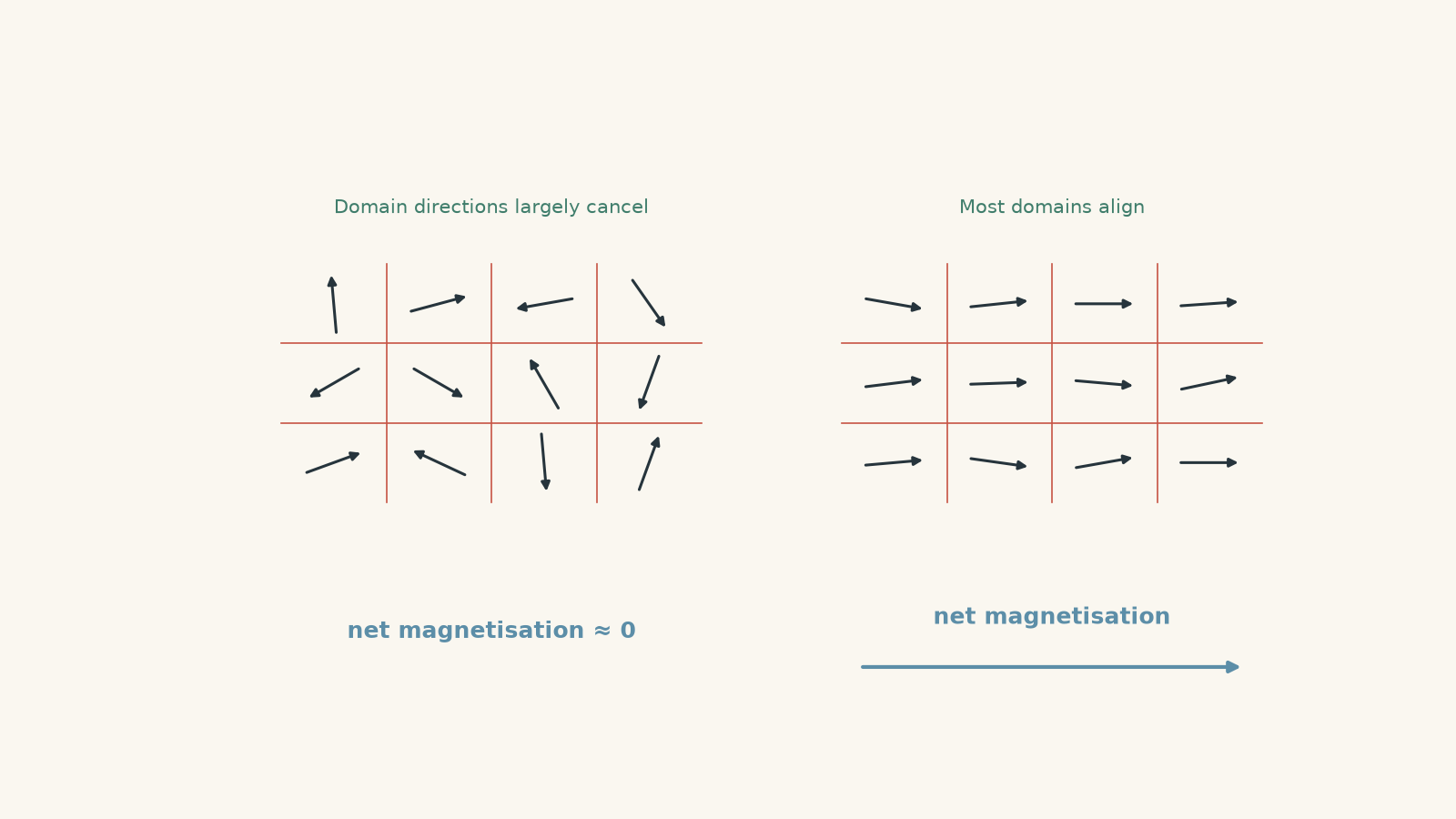
A useful picture is a school oval divided into groups of people holding tiny arrows. Everyone inside one group agrees on which way to point, but different groups point in different directions.
If the groups are spread across every direction, their effects mostly cancel. The whole oval has no strong overall direction.
That is roughly what happens in an unmagnetised ferromagnet. It already contains magnetic domains. The domains are simply arranged so that there is little or no net magnetisation across the whole object.
The analogy has a limit. Magnetic domains are not literally crowds of tiny compass needles that rotate independently. Domain behaviour comes from quantum interactions between atomic magnetic moments, and magnetisation often involves domain boundaries moving as well as moments changing direction.
03An unmagnetised ferromagnet still contains magnetic regions
This is a common trap.
A student might reason:
If an iron nail is unmagnetised, its atoms must not be acting like magnets yet.
That feels sensible because the nail does not behave like a permanent bar magnet. But the missing idea is cancellation.
The nail can contain many magnetically ordered domains while having almost zero overall magnetic moment. One domain points one way, another points somewhere else, and their contributions largely cancel.
When an external magnetic field is applied, that balance changes.
Domains whose magnetisation is favourably aligned with the applied field tend to grow, while others shrink. Magnetic moments can also rotate towards the field direction.
The result is a larger net magnetisation.
So the external field does not create ferromagnetism from nothing. It changes the arrangement of magnetic order that was already present in the material.
04Why an iron nail is attracted to either pole
Return to the prediction from the opening.
Suppose you bring the north pole of a permanent magnet close to an unmagnetised iron nail.
The magnet’s field causes the nail to become inducedly magnetised. The end nearest the magnet behaves like a south pole, while the farther end behaves like a north pole.
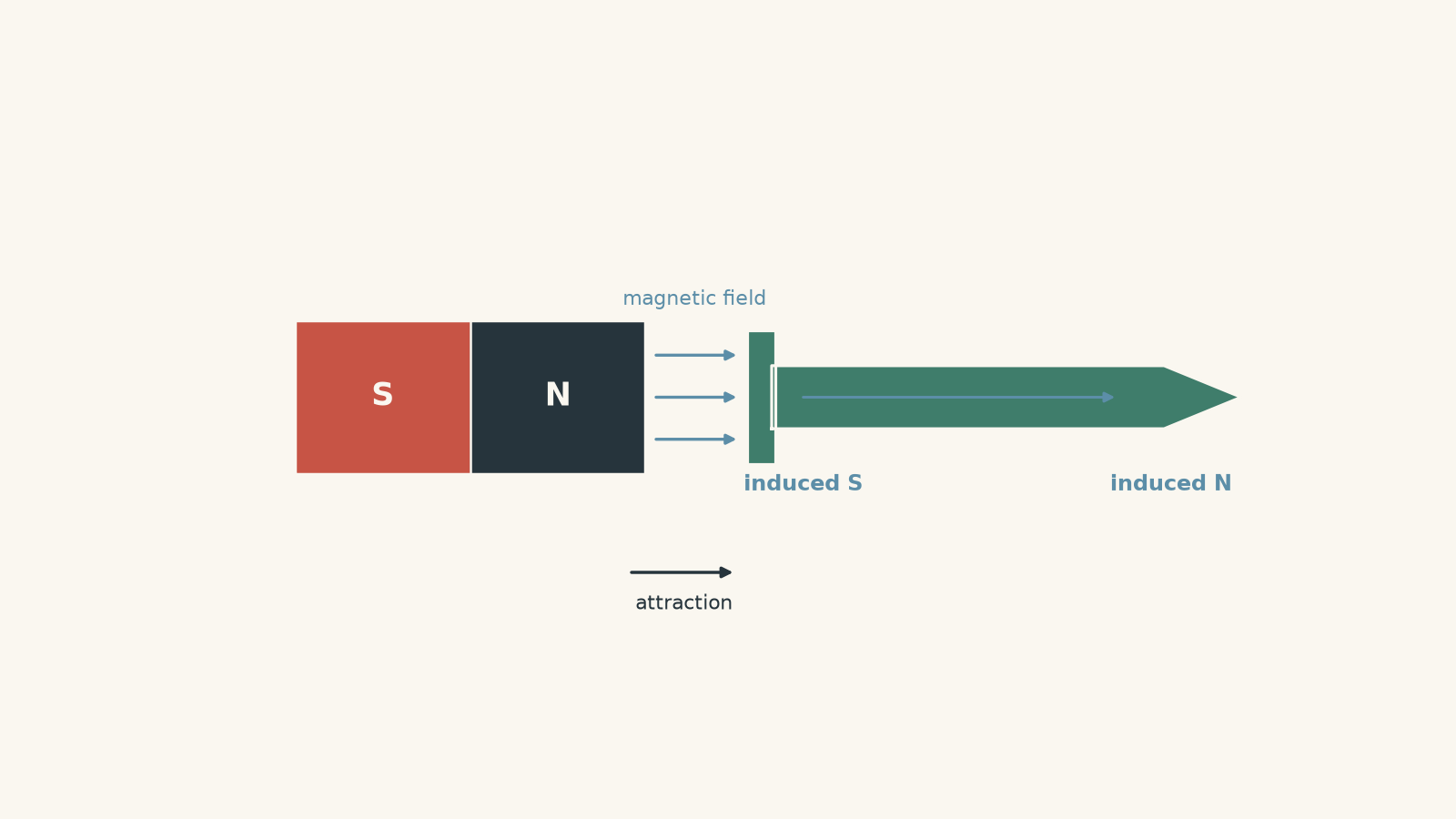
The nearby opposite poles attract strongly. The farther like poles do produce a repulsive interaction, but they are farther apart, so the nearby attraction dominates.
Turn the permanent magnet around. The induced magnetisation of the nail also reverses. The end nearest the south pole now behaves like a north pole.
The nail is still attracted.
This tells us something useful:
Attraction does not prove that both objects were magnets before they interacted.
One can be a permanent magnet, while the other is simply a ferromagnetic material becoming magnetised in the first object’s field.
Example: What is the paper clip doing?
A steel paper clip is initially unable to pick up another paper clip. You then hold one end against a strong permanent magnet. While it is touching the magnet, the free end can pick up a second paper clip.
The first paper clip has become magnetised by the external field. Its domains have become more strongly aligned, giving the paper clip a net magnetic field.
The second paper clip can then become inducedly magnetised as well.
This is why chains of paper clips can sometimes hang from one magnet. The permanent magnet has not somehow “sent magnetism” down the chain as a substance. Each ferromagnetic object is responding to the magnetic field around it.
05Permanent magnetisation depends on what happens after the field is removed
Now imagine removing the external magnet.
Predict what must happen to the domains. Do they all immediately return to their original arrangement?
Not necessarily.
Some ferromagnetic materials lose most of their induced magnetisation once the external field disappears. Others retain substantial alignment and remain magnetised.
This gives us a useful distinction between magnetically soft and magnetically hard ferromagnetic materials.
| Property | Magnetically soft material | Magnetically hard material |
|---|---|---|
| Easy to magnetise | Yes | Usually requires a stronger magnetising process |
| Easy to demagnetise | Yes | No |
| Retains strong magnetisation after the field is removed | Relatively little | Relatively well |
| Useful for | Electromagnet cores, transformers | Permanent magnets |
“Soft” and “hard” here describe magnetic behaviour, not simply whether the material feels physically soft or hard.
Example: Choosing materials for two devices
Suppose you are designing two devices.
The first is an electromagnetic lifting mechanism that must become strongly magnetic when current flows, then release its load when the current is switched off.
The second needs to provide a magnetic field continuously without electrical power.
For the lifting mechanism, a magnetically soft ferromagnetic core is useful. Its domains respond readily while the applied field is present, but much of the magnetisation disappears afterwards.
For the second device, you want a magnetically hard material that can retain substantial domain alignment after the magnetising field is removed. That allows it to behave as a permanent magnet.
The same broad phenomenon, ferromagnetism, can therefore produce very different useful behaviour depending on how easily the domain arrangement changes.
06Where electromagnets fit into the picture
A magnet does not have to be a permanent piece of ferromagnetic material.
An electric current produces a magnetic field. A coil carrying current can therefore act as an electromagnet, even without an iron core.
Adding a ferromagnetic core can make the magnetic effect much stronger. The field from the coil magnetises the core, aligning more of its domains.
This gives us two different mechanisms that students sometimes merge together:
- the electric current creates a magnetic field around the coil
- the ferromagnetic core responds to that field by becoming magnetised
The iron is not the original cause of the coil’s magnetic field. The current is. The iron changes the resulting field because of its ferromagnetic response.
07Four statements that sound similar but mean different things
These are worth separating carefully.
“The object is a magnet.”
It has a net magnetic moment large enough to produce a significant external magnetic field.
“The material is ferromagnetic.”
Its atomic magnetic moments can form domains, and it can respond strongly to an applied magnetic field.
“The object is unmagnetised.”
Its domains are arranged so their magnetic effects largely cancel across the whole object.
“The object has been magnetised.”
Its domains have become sufficiently aligned to give the object a non-zero net magnetisation.
An object can therefore be ferromagnetic and unmagnetised at the same time.
That sentence resolves one of the most common misunderstandings in this topic.
08A magnet does not attract every metal
Another tempting shortcut is:
metal = magnetic
It does not work.
Iron, cobalt, nickel, and many materials containing them can show strong ferromagnetic behaviour. Copper does not. Aluminium does not behave ferromagnetically under ordinary HSC laboratory conditions either.
This is why identifying something as “metal” is not enough to predict whether a permanent magnet will strongly attract it.
Even the word steel needs some care. Steels are iron-based alloys, but their exact magnetic properties depend on their composition and structure. For ordinary HSC reasoning, common iron and steel objects are often treated as ferromagnetic unless the problem gives information suggesting otherwise.
The better question is not:
“Is it metal?”
Ask:
“Is the material ferromagnetic, and what is its current state of magnetisation?”
09Questions and solutions
Question 1
A permanent magnet strongly attracts an iron washer that was not previously magnetised.
Does the attraction prove that the washer was already a magnet? Explain what happens to the washer as the magnet approaches.
Solution 1
No. The attraction does not prove that the washer was already a magnet.
Iron is ferromagnetic, so the permanent magnet’s field changes the arrangement of magnetic domains inside the washer. This gives the washer an induced net magnetisation.
The part of the washer nearest the permanent magnet develops a magnetic pole opposite to the nearby pole of the permanent magnet. The resulting nearby attraction is stronger than the interaction involving the farther end.
The trap is assuming that attraction can only occur between two objects that were already permanent magnets. A permanent magnet can attract an initially unmagnetised ferromagnetic object by inducing magnetisation in it.
Question 2
Three small blocks are made from iron, copper, and a hard permanent-magnet alloy. Their labels have fallen off.
Block A produces a measurable magnetic field when it is sitting by itself.
Block B does not produce a significant external field by itself, but it is strongly attracted when a permanent magnet is brought nearby.
Block C shows neither of these behaviours to any noticeable extent in the classroom.
Identify the most likely material for A, B, and C, and explain your reasoning.
Solution 2
A is the hard permanent-magnet alloy, B is iron, and C is copper.
Block A produces a significant magnetic field even without another field being applied. That is the defining observation expected from the permanent magnet.
Block B is strongly attracted but does not initially produce a significant external field. That is consistent with unmagnetised iron. Its domains initially have little net alignment, but an external field can rearrange them and produce strong induced magnetisation.
Block C is most likely copper. Copper is not ferromagnetic, so it does not show the strong attraction and domain alignment expected from iron.
The key distinction is between being magnetised already and being capable of strong magnetisation.
Question 3
Two iron rods are placed inside separate current-carrying coils. Rod P becomes strongly magnetised while current flows but has very little magnetisation after the current is switched off. Rod Q remains strongly magnetised after the current is switched off.
A device needs a core that repeatedly switches its magnetic field on and off.
Which rod is more suitable, and what domain behaviour explains the choice?
Solution 3
Rod P is more suitable because it behaves as a magnetically soft ferromagnetic material.
While current flows, the coil produces an external magnetic field. Domains in rod P respond strongly, producing a large net magnetisation.
When the current stops, much of that alignment is lost, so the rod retains little magnetisation. That is useful in a device whose magnetic action must switch off when the current does.
Rod Q retains substantial domain alignment after the external field disappears. That behaviour is useful for permanent magnets, but it is less suitable when the device must repeatedly return to a weakly magnetised state.
The important point is that “easier to keep magnetised” is not automatically “better”. The required magnetic behaviour depends on what the device must do.
Question 4
A student says:
An unmagnetised iron bar cannot contain aligned atomic magnetic moments, because otherwise the bar would already be a magnet.
Explain precisely what is wrong with this reasoning.
Solution 4
The error is confusing local alignment inside magnetic domains with net alignment across the entire bar.
Inside each magnetic domain, many atomic magnetic moments are already aligned. However, different domains in an unmagnetised bar can point in different directions.
Their contributions then largely cancel, leaving little or no net magnetisation for the complete bar.
Applying an external magnetic field changes the domain arrangement. Favourably aligned domains can grow, and magnetic moments can rotate towards the field, so the cancellation becomes less complete and the bar develops a net magnetic moment.
The student is therefore correct that a strongly magnetised bar requires substantial overall alignment, but incorrect in assuming an unmagnetised bar contains no local magnetic order.
Question 5
A permanent magnet has its north pole held close to the left end of an initially unmagnetised iron rod. The rod is attracted towards the magnet.
A student gives this explanation:
The magnet turns the left end of the rod into a south pole and the right end into a north pole. The south pole is attracted, while the north pole is repelled, so those forces should cancel and the rod should not move.
The predicted cancellation does not occur. Explain why.
Solution 5
The forces do not cancel because the attractive and repulsive interactions occur at different distances from the permanent magnet.
The external field magnetises the iron rod. Its left end, which is closer to the permanent magnet’s north pole, behaves approximately like an induced south pole. Its right end behaves approximately like a north pole.
The left end experiences attraction, while the farther right end corresponds to a repulsive interaction. However, magnetic interactions become weaker as separation increases. The attractive interaction at the near end is therefore stronger than the opposing interaction associated with the farther end.
The net force is towards the permanent magnet.
The trap is treating the induced poles as though equal and opposite forces must automatically cancel. Equal magnetic pole strengths do not guarantee equal forces when the separations and magnetic field strengths are different.
Question 6
A student wants to prove that a piece of ferromagnetic material has become a permanent magnet. They bring a known permanent magnet close to it and observe a strong attraction.
Why is this observation insufficient? Describe what kind of evidence would distinguish permanent magnetisation from simple induced magnetisation.
Solution 6
Strong attraction alone is insufficient because an unmagnetised ferromagnetic object can be attracted through induced magnetisation.
When the known magnet approaches, its field can align domains inside the test object. The object may therefore become temporarily magnetised and experience a strong attraction even if it had little net magnetisation beforehand.
Evidence of retained magnetisation after the external field has been removed would be more useful. For example, the object could be tested for a persistent magnetic field when isolated from the magnet that originally magnetised it.
A particularly important idea is that behaviour while an external field is present does not by itself tell you what will happen after that field disappears. That distinction leads directly into magnetic hysteresis, retentivity, and coercivity, which describe how ferromagnetic materials respond as an applied magnetic field is changed and removed.