
Magnetic Field Around a Current-Carrying Wire: HSC Physics
Learn how to use the right-hand rule and calculate magnetic field strength around a long straight current-carrying wire. Includes worked examples and HSC-style practice.
A compass is sitting beside a straight wire. With no current, it points roughly north. Switch the current on, and the compass needle turns sideways.
Which way should it turn? And if you move the compass twice as far from the wire, will the magnetic field become half as strong, one-quarter as strong, or stay the same?
Those two questions capture the main idea of the magnetic field around a current-carrying wire. The current sets the direction of the field, and the current and distance determine its strength.
01What does the field around the wire look like?
Start with a long, straight wire carrying a steady current upwards.
A tempting first picture is that the magnetic field also points upwards, following the moving charges. It doesn’t. The magnetic field wraps around the wire.
Imagine looking straight down the wire. The wire is a dot in front of you, and the magnetic field forms circles centred on that dot.
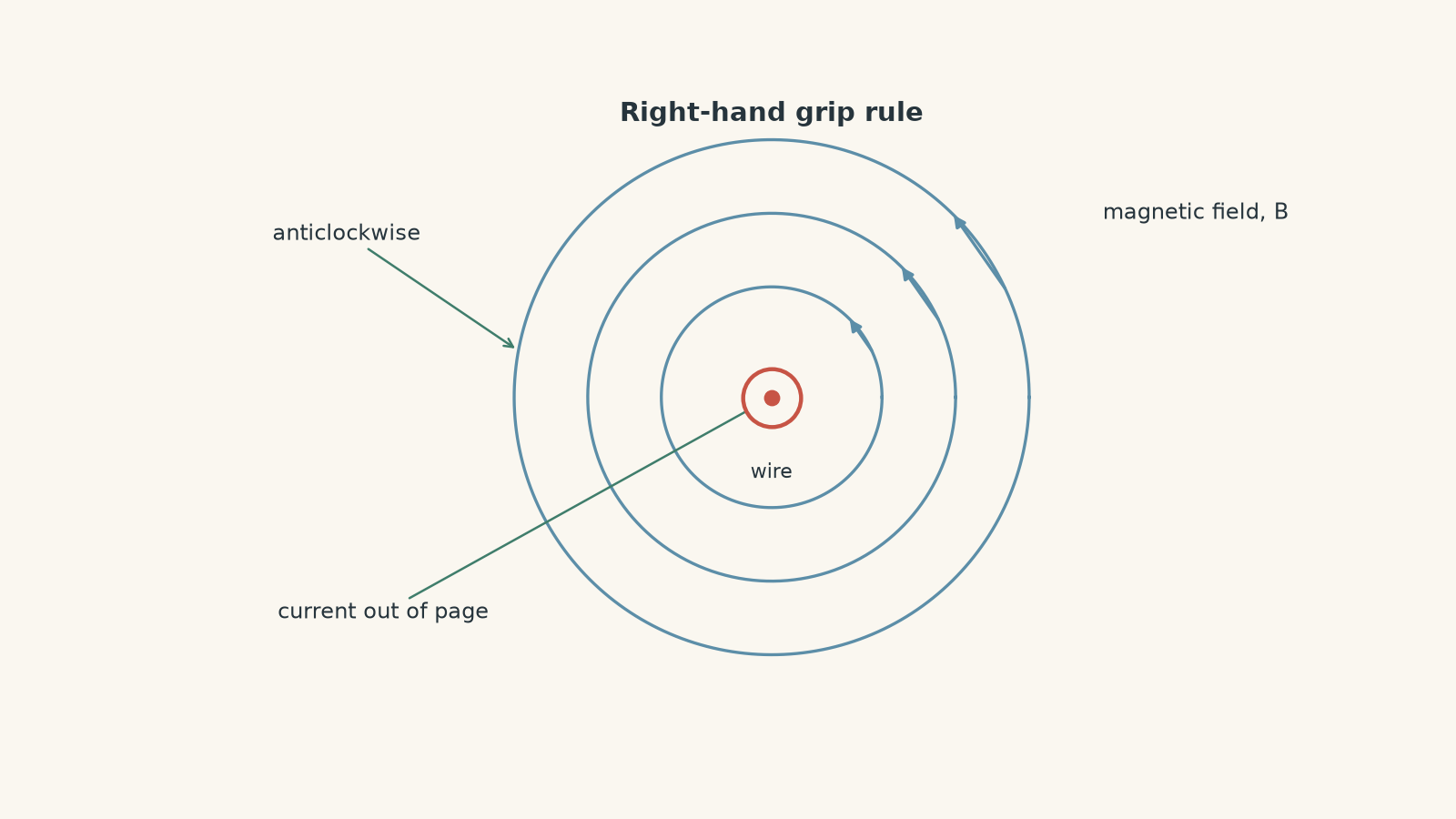
Each circle is a magnetic field line. Close to the wire, the field is stronger. Further away, it is weaker.
This is different from the field around a bar magnet, where field lines curve from one pole towards the other. If you need a refresher on what field lines actually represent, see Magnetic Field Lines Around Permanent Magnets.
The circular picture is our first useful model. It assumes the wire is straight and effectively very long compared with the distances we care about. Near the end of a short wire, the field is more complicated.
02Finding the direction: the right-hand grip rule
The field circles the wire, but it can circle in either direction. To choose the correct direction, use the right-hand grip rule.
Point the thumb of your right hand in the direction of conventional current. Your curled fingers show the direction of the magnetic field.
For example:
- current upwards means the field curls around the wire in one direction,
- reversing the current reverses the magnetic field,
- increasing the current makes the field stronger, but does not change this directional rule.
The word conventional matters. Conventional current is defined as the direction positive charge would move. In a metal wire, the electrons actually drift in the opposite direction.
Into and out of the page
Physics diagrams often show a wire perpendicular to the page.
A dot, \(\odot\), means the current is coming out of the page towards you. Picture the tip of an arrow flying towards your face.
A cross, \(\otimes\), means the current is going into the page away from you. Picture the feathers at the back of an arrow disappearing into the page.
Try this before reading on: if the current comes out of the page, does the magnetic field run clockwise or anticlockwise?
Point your right thumb towards yourself. Your fingers curl anticlockwise. So:
| Current direction | Magnetic field direction |
|---|---|
| Out of the page \(\odot\) | Anticlockwise |
| Into the page \(\otimes\) | Clockwise |
This is worth knowing by reasoning rather than memorising as two separate facts. If you forget the table, your right hand rebuilds it.
A slightly silly way to picture the rule is that the wire and its magnetic field are in a very clingy relationship. The current goes straight ahead, while the field insists on wrapping around it. The analogy stops there, of course. A magnetic field isn’t a physical object wrapped around the wire.
03How strong is the magnetic field?
For a long, straight wire carrying current \(I\), the magnetic field strength at perpendicular distance \(r\) from the wire is
\[ B = \frac{\mu_0 I}{2\pi r} \]
where:
- \(B\) is the magnetic flux density in tesla, \(\text{T}\),
- \(\mu_0\) is the permeability of free space, usually taken in HSC calculations as \(4\pi \times 10^{-7}\ \text{T m A}^{-1}\),
- \(I\) is the current in amperes, \(\text{A}\),
- \(r\) is the perpendicular distance from the wire in metres, \(\text{m}\).
For air, using \(\mu_0\) is an excellent approximation for HSC problems.
Before calculating anything, look at the structure:
\[ B \propto I \]
so doubling the current doubles the magnetic field.
But
\[ B \propto \frac{1}{r} \]
so doubling the distance halves the magnetic field.
It does not make the field one-quarter as strong.
That mistake often comes from remembering inverse-square laws such as gravity or the electric field of a point charge. A long straight wire has different geometry, so its magnetic field follows an inverse-distance relationship instead.
04Why does distance give \(1/r\), not \(1/r^2\)?
Picture one circular magnetic field line centred on the wire.
At a larger radius, the circle has a larger circumference. The circumference is
\[ 2\pi r \]
so it grows directly with \(r\). The magnetic effect is spread around a longer circular path as you move further from the wire.
That gives the \(1/r\) behaviour in
\[ B = \frac{\mu_0 I}{2\pi r}. \]
This picture helps explain the mathematical pattern, but don’t push it too far. The field is not a substance being physically smeared around a circular tube. The exact relationship comes from electromagnetism, and for HSC purposes this equation describes the field around a long straight current-carrying wire.
Worked example: Find the field beside a wire
A long straight wire carries a current of \(3.0\ \text{A}\). Find the magnetic flux density at a point \(5.0\ \text{cm}\) from the wire.
Step 1
\[ r = 5.0\ \text{cm} = 0.050\ \text{m} \]
Step 2
\[ B = \frac{\mu_0 I}{2\pi r} \]
Step 3
\[ \begin{aligned} B &= \frac{(4\pi \times 10^{-7})(3.0)} {2\pi(0.050)} \\ &= 1.2\times10^{-5}\ \text{T} \end{aligned} \]
Step 4
The magnetic flux density is
\[ \boxed{B = 1.2\times10^{-5}\ \text{T}} \]
at \(5.0\ \text{cm}\) from the wire.
Notice that the calculation tells us the magnitude of the field. We would need the current direction and the right-hand grip rule to state the field’s direction at a particular point.
05Direction at one particular point
Saying “the field is anticlockwise” describes the overall circulation, but an HSC question may ask for the field direction at a point.
Suppose current comes out of the page, so the field runs anticlockwise.
At a point directly to the right of the wire, the field points upwards. At a point directly above the wire, it points left.
Why? A magnetic field vector is tangent to the circular field line at that position.
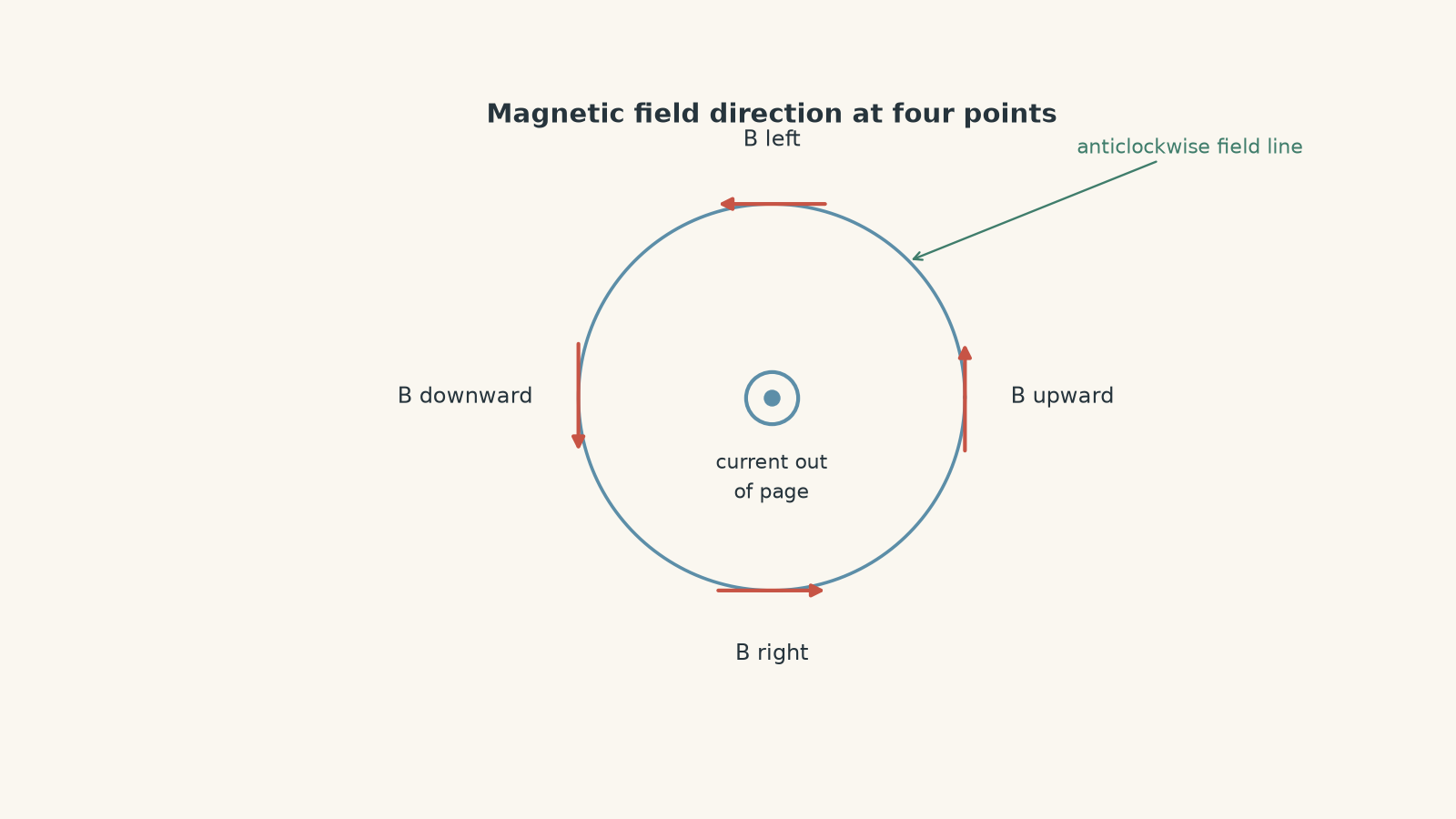
That distinction is easy to miss. The field does not point towards or away from the wire. It points along the circle.
Worked example: Find both magnitude and direction
A long straight wire carries a current of \(8.0\ \text{A}\) into the page. Point \(P\) is \(12\ \text{cm}\) directly to the right of the wire. Determine the magnetic flux density at \(P\), including its direction.
Step 1
Current is into the page. Point your right thumb into the page. Your fingers curl clockwise.
At a point to the right of the wire, a clockwise circular field points downwards.
So the magnetic field at \(P\) is downwards.
Step 2
\[ r = 12\ \text{cm} = 0.12\ \text{m} \]
Step 3
\[ \begin{aligned} B &= \frac{\mu_0 I}{2\pi r} \\ &= \frac{(4\pi \times 10^{-7})(8.0)} {2\pi(0.12)} \\ &= 1.33\times10^{-5}\ \text{T} \end{aligned} \]
Step 4
\[ \boxed{B = 1.3\times10^{-5}\ \text{T downward}} \]
The equation gave the size of the field. The right-hand rule supplied the direction. You usually need both ideas.
06A useful shortcut for comparing fields
If you only need to compare two situations involving the same type of wire, you often don’t need to substitute \(\mu_0\).
Because
\[ B \propto \frac{I}{r}, \]
you can compare two fields using
\[ \frac{B_2}{B_1} = \frac{I_2}{I_1} \frac{r_1}{r_2}. \]
Suppose the current triples while the distance doubles. Then
\[ \frac{B_2}{B_1} = 3\times\frac{1}{2} = 1.5. \]
The new magnetic field is \(1.5\) times the original field.
This is often safer than calculating two separate field strengths and dividing them afterwards.
07The most common traps
| Tempting idea | What actually happens |
|---|---|
| The magnetic field points in the direction of the current. | The field circles around the wire. |
| Electron flow determines the thumb direction. | Use conventional current for the right-hand rule. |
| Doubling \(r\) makes \(B\) one-quarter as large. | \(B\propto 1/r\), so doubling \(r\) halves \(B\). |
| A larger current changes the circular direction. | Current magnitude changes field strength. Reversing current changes field direction. |
| The field at a point points along the radius. | It points tangent to the circular field line. |
| \(r\) is measured along the wire. | \(r\) is the shortest, perpendicular distance from the wire. |
| \(B=\mu_0I/(2\pi r)\) works for every piece of wire. | It applies to an idealised long, straight wire. |
One final subtlety: as \(r\) approaches zero, the ideal equation suggests that \(B\) becomes extremely large. A real wire has a finite radius, so you cannot keep treating the entire current as if it were concentrated along an infinitely thin line all the way to \(r=0\). The model has a limit.
08Questions and solutions
Question 1
A long straight wire carries a current of \(5.0\ \text{A}\). Calculate the magnetic flux density \(8.0\ \text{cm}\) from the wire.
Solution 1
The magnetic flux density is \(\boxed{1.25\times10^{-5}\ \text{T}}\).
For a long straight wire,
\[ B=\frac{\mu_0 I}{2\pi r}. \]
The distance must first be converted to metres:
\[ r=8.0\ \text{cm}=0.080\ \text{m}. \]
Substituting,
\[ \begin{aligned} B &=\frac{(4\pi\times10^{-7})(5.0)} {2\pi(0.080)}\\ &=1.25\times10^{-5}\ \text{T}. \end{aligned} \]
So a point \(8.0\ \text{cm}\) from the wire experiences a magnetic flux density of approximately \(12.5\ \mu\text{T}\).
Question 2
A wire carries current out of the page. Point \(Q\) is directly below the wire.
What is the direction of the magnetic field at \(Q\)? Explain your reasoning using the right-hand rule.
Solution 2
The magnetic field at \(Q\) points to the right.
With conventional current coming out of the page, point your right thumb towards yourself. Your fingers curl anticlockwise.
The magnetic field therefore follows an anticlockwise circle around the wire. At the point directly below the wire, the tangent to that circle points to the right.
The common trap is to say that the field points downwards because \(Q\) is below the wire. That would make the field radial. The actual field is tangent to the circular field line.
Question 3
At point \(P\), a wire carrying \(2.0\ \text{A}\) produces a magnetic field of magnitude \(B\).
The current is increased to \(6.0\ \text{A}\), and point \(P\) is moved from \(4.0\ \text{cm}\) to \(12\ \text{cm}\) from the wire.
Determine the new magnetic field in terms of \(B\).
Solution 3
The new magnetic field has the same magnitude, \(B\).
For a long straight wire,
\[ B\propto\frac{I}{r}. \]
Comparing the new and original fields,
\[ \begin{aligned} \frac{B_2}{B_1} &= \frac{I_2}{I_1} \frac{r_1}{r_2}\\ &= \frac{6.0}{2.0} \times \frac{4.0}{12}\\ &=3\times\frac13\\ &=1. \end{aligned} \]
Therefore,
\[ B_2=B_1=B. \]
The current became three times larger, which by itself would triple the field. The distance also became three times larger, which reduces the field by a factor of three. The two effects exactly cancel.
Question 4
Two students disagree about a long straight wire carrying a steady current.
Student A says: “If I move twice as far away, the magnetic field should become one-quarter as strong because fields get weaker with distance squared.”
Student B says: “It becomes half as strong.”
Which student is correct? Explain why the other argument is tempting but does not apply here.
Solution 4
Student B is correct: doubling the distance halves the magnetic field.
For a long straight current-carrying wire,
\[ B=\frac{\mu_0 I}{2\pi r}, \]
so
\[ B\propto\frac1r. \]
If the distance changes from \(r\) to \(2r\),
\[ B_{\text{new}} = \frac{\mu_0 I}{2\pi(2r)} = \frac12 B_{\text{original}}. \]
Student A’s reasoning is tempting because several familiar fields, including the gravitational field of a point mass and the electric field of a point charge, follow an inverse-square relationship.
But the geometry is different. The magnetic field of an ideal long straight wire forms concentric circles, and the relevant relationship is \(1/r\), not \(1/r^2\). You should not assume that every field obeys the same distance law.
Question 5
A long straight wire carries \(10\ \text{A}\) out of the page. Point \(R\) is initially \(20\ \text{cm}\) directly to the right of the wire.
The current is then reversed and reduced to \(4.0\ \text{A}\), while \(R\) is moved to \(8.0\ \text{cm}\) from the wire, still directly to the right.
Compare the final magnetic field at \(R\) with the initial magnetic field. State both its relative magnitude and its direction.
Solution 5
The final field has the same magnitude as the initial field, but the opposite direction.
First compare magnitudes using
\[ B\propto\frac{I}{r}. \]
Therefore,
\[ \begin{aligned} \frac{B_{\text{final}}}{B_{\text{initial}}} &= \frac{4.0}{10} \times \frac{0.20}{0.080}\\ &=0.40\times2.5\\ &=1. \end{aligned} \]
So the magnitude is unchanged.
Now consider direction.
Initially, the current is out of the page. The right-hand grip rule gives an anticlockwise magnetic field. At a point directly to the right of the wire, that field points upwards.
The current is then reversed, so it goes into the page. The magnetic field reverses and becomes clockwise. At the same side of the wire, it therefore points downwards.
Hence,
\[ \boxed{\text{same magnitude, opposite direction}} \]
with the final field directed downwards.
The trap is to look only at \(I/r\). That ratio determines magnitude, but it cannot tell you the direction. Reversing the current must be handled separately with the right-hand rule.
Question 6
A student uses
\[ B=\frac{\mu_0I}{2\pi r} \]
to argue that the magnetic field of a real wire must become infinite at the exact centre of the wire because \(r=0\).
Is that conclusion valid? Explain what has gone wrong without needing to calculate the field inside the wire.
Solution 6
No. The conclusion is not valid because the equation is being used outside the situation for which this simple form applies.
The expression
\[ B=\frac{\mu_0I}{2\pi r} \]
treats the wire as an idealised long, thin current-carrying conductor when finding the external magnetic field.
A real wire has a finite radius. At points inside the wire, some of the current lies outside the circular path through that point, so the external-field expression cannot simply be extended all the way to \(r=0\).
The apparent infinity is therefore a warning that the model has been pushed beyond its assumptions, not evidence that a real wire contains an infinite magnetic field at its centre.
This is a useful habit in Physics: when an equation produces an extreme or impossible result, check the assumptions before trusting the arithmetic.
09Where this idea leads next
Once you can find both the magnitude and direction of the field around one wire, you can analyse what happens when two magnetic fields overlap.
That leads naturally to fields produced by multiple wires, coils and solenoids, and then to the magnetic force on moving charges and current-carrying conductors. It also connects back to the broader idea that magnetic fields can exert attractive or repulsive effects, explored in Forces Between Magnets: Attraction, Repulsion and Fields.
The key habit to carry forward is simple: treat magnitude and direction as separate jobs. Use \(B=\mu_0I/(2\pi r)\) for the size of the field, and the right-hand grip rule for the way it points.