
Resolving Projectile Motion into Components for HSC Physics
Learn how to separate projectile motion into horizontal and vertical components, use a shared time, and recombine velocity correctly in HSC Physics problems.
Imagine two identical balls at the same height. You drop one straight down. At exactly the same instant, you fire the other horizontally.
Which one hits the ground first?
It is tempting to think the fired ball stays in the air longer because it has “extra motion”. In the ideal projectile model, though, they hit the ground at the same time. The horizontal speed of the second ball does not delay its vertical fall.
That result is the key to projectile motion: treat the horizontal and vertical motions separately, using the same clock, then combine them when you need the projectile’s actual position or velocity.
01One projectile, two motions
Picture a ball moving through the air after it leaves your hand. Once it has been released, suppose we ignore air resistance.
What forces act on it?
Only its weight. Gravity pulls vertically downwards. There is no horizontal force.
That gives us two much simpler motions hidden inside one curved path:
| Direction | Acceleration | What happens to velocity? |
|---|---|---|
| Horizontal, \(x\) | \(a_x = 0\) | Horizontal velocity stays constant |
| Vertical, \(y\) | \(a_y = -g\) | Vertical velocity changes continuously |
Here \(g = 9.8\ \text{m s}^{-2}\) near Earth’s surface.
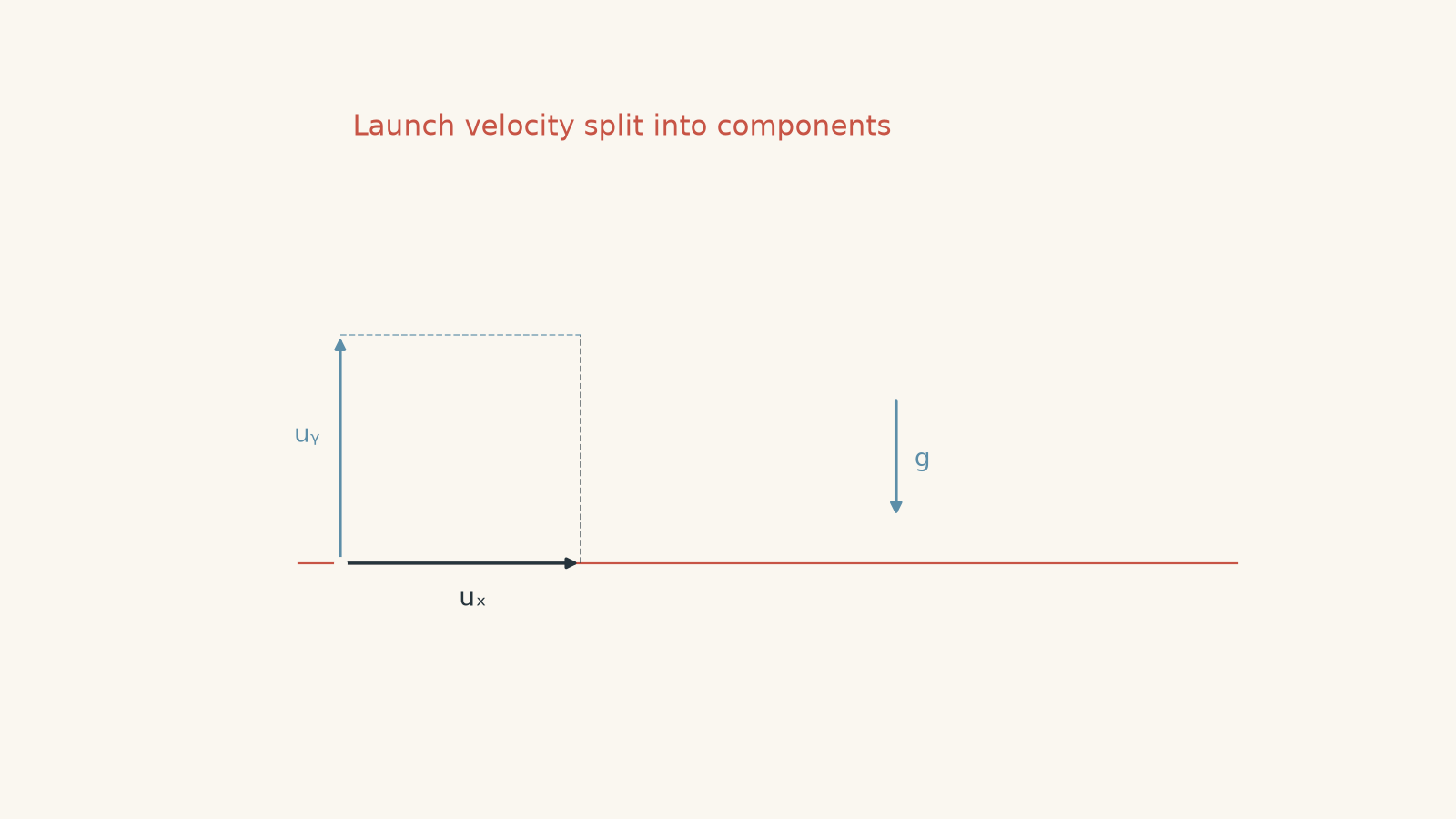
The curved trajectory is therefore not one complicated type of motion. It is constant-velocity motion sideways happening at the same time as constant-acceleration motion vertically.
A useful mental picture is two students carrying opposite ends of a giant whiteboard. One student controls only the sideways movement. The other controls only the up-and-down movement. The final position of the board depends on both, but neither student directly changes what the other is doing.
The analogy breaks because a projectile is one object, not two people. The important idea is simply that perpendicular components of motion can be analysed separately.
02Resolving the initial velocity
Suppose a projectile is launched with speed \(u\) at an angle \(\theta\) above the horizontal.
The velocity vector can be split into:
\[
u_x = u\cos\theta
\]
and
\[
u_y = u\sin\theta
\]
where:
- \(u_x\) is the initial horizontal velocity in metres per second,
- \(u_y\) is the initial vertical velocity in metres per second,
- \(u\) is the launch speed in metres per second, and
- \(\theta\) is the launch angle above the horizontal.
This is just right-angle trigonometry. If \(\theta\) is measured from the horizontal, the horizontal component is adjacent to the angle, so it uses cosine. The vertical component is opposite, so it uses sine.
For example, if a ball is launched at \(20\ \text{m s}^{-1}\) at \(30^\circ\),
\[
u_x = 20\cos30^\circ = 17.3\ \text{m s}^{-1}
\]
and
\[
u_y = 20\sin30^\circ = 10.0\ \text{m s}^{-1}.
\]
So the projectile begins with two simultaneous motions: \(17.3\ \text{m s}^{-1}\) horizontally and \(10.0\ \text{m s}^{-1}\) upwards.
The speed has not somehow become \(27.3\ \text{m s}^{-1}\). Components are not added like ordinary numbers because they act at right angles.
03The same clock runs in both directions
This is the part that makes projectile questions work.
Suppose the projectile has been moving for \(1.2\ \text{s}\). Its horizontal motion has been happening for \(1.2\ \text{s}\), and its vertical motion has also been happening for \(1.2\ \text{s}\).
There are not two different times.
For horizontal motion, because \(a_x=0\),
\[
x = x_0 + u_x t
\]
and
\[
v_x = u_x.
\]
For vertical motion, taking upwards as positive,
\[
y = y_0 + u_y t – \frac{1}{2}gt^2
\]
and
\[
v_y = u_y-gt.
\]
Here:
- \(x_0\) and \(y_0\) are the initial coordinates in metres,
- \(x\) and \(y\) are the later coordinates,
- \(t\) is the elapsed time in seconds,
- \(v_x\) and \(v_y\) are the later velocity components in metres per second.
Notice the connection between the two sets of equations: \(t\).
That shared time is usually how you move from one component to the other. You might use the vertical motion to find how long the projectile remains airborne, then put that time into the horizontal equation to find its range.
Worked example: A ball rolling off a bench
A ball leaves a \(1.80\ \text{m}\) high bench horizontally at \(6.00\ \text{m s}^{-1}\). Ignore air resistance. Find how long it takes to reach the floor, how far from the bench it lands, and its velocity immediately before impact.
Step 1
Take upwards as positive. The initial vertical velocity is zero because the ball leaves horizontally:
\[
u_x = 6.00\ \text{m s}^{-1}, \qquad u_y=0.
\]
The vertical displacement to the floor is
\[
\Delta y=-1.80\ \text{m}.
\]
Step 2
The vertical displacement equation is
\[
\Delta y=u_y t-\frac{1}{2}gt^2.
\]
Substituting,
\[
-1.80=0-\frac{1}{2}(9.8)t^2.
\]
Therefore,
\[
t=\sqrt{\frac{3.60}{9.8}}=0.606\ \text{s}.
\]
The horizontal launch speed did not appear anywhere in this calculation. That is why a horizontally fired ball and a dropped ball fall through the same height in the same time.
Step 3
\[
\Delta x=u_x t=(6.00)(0.606)=3.64\ \text{m}.
\]
The ball lands \(3.64\ \text{m}\) from the point directly below the edge of the bench.
Step 4
The horizontal velocity is unchanged:
\[
v_x=6.00\ \text{m s}^{-1}.
\]
Vertically,
\[
v_y=u_y-gt=0-(9.8)(0.606)=-5.94\ \text{m s}^{-1}.
\]
The negative sign means downwards.
Step 5
The speed is
\[
v=\sqrt{v_x^2+v_y^2}
=\sqrt{(6.00)^2+(-5.94)^2}
=8.44\ \text{m s}^{-1}.
\]
Its direction below the horizontal is
\[
\phi=\tan^{-1}\left(\frac{5.94}{6.00}\right)=44.7^\circ.
\]
So just before impact, the ball is travelling at \(8.44\ \text{m s}^{-1}\), \(44.7^\circ\) below the horizontal.
04What “independent” does and does not mean
Saying horizontal and vertical motion are independent can cause trouble if you take the word too literally.
It means that, in the ideal model, gravity changes the vertical velocity without changing the horizontal velocity.
It does not mean the horizontal and vertical calculations are unrelated. They describe the same projectile, so they must agree on the time.
Suppose a projectile reaches a wall after \(2.0\ \text{s}\). You cannot then use \(1.6\ \text{s}\) in the vertical equation just because it produces a convenient height. Both components describe the same instant.
This shared-time constraint is one of the most useful error checks in projectile motion.
05Gravity does not “run out” at the top
Now consider an angled launch.
As the projectile rises, \(v_y\) decreases because gravity acts downwards. At the highest point,
\[
v_y=0.
\]
Predict what happens to the acceleration at that instant. Does it also become zero?
No. Gravity is still acting, so
\[
a_y=-9.8\ \text{m s}^{-2}
\]
even at the very top.
Zero vertical velocity means the projectile has stopped moving upwards for one instant. It does not mean the force of gravity has disappeared.
Meanwhile,
\[
v_x=u_x
\]
throughout the entire ideal flight.
So at the highest point of an ordinary angled projectile, its velocity is horizontal, but its acceleration is vertical and downwards.
Worked example: Will the projectile clear the wall?
A projectile is launched from a platform \(5.00\ \text{m}\) above the ground at \(20.0\ \text{m s}^{-1}\), \(35.0^\circ\) above the horizontal. A vertical wall is \(25.0\ \text{m}\) horizontally from the launch point and is \(10.0\ \text{m}\) high. Ignore air resistance.
Does the projectile clear the wall? Also find its velocity as it passes the wall.
Step 1
\[
u_x=(20.0)\cos35.0^\circ=16.4\ \text{m s}^{-1}
\]
and
\[
u_y=(20.0)\sin35.0^\circ=11.5\ \text{m s}^{-1}.
\]
Step 2
Because the horizontal velocity is constant,
\[
t=\frac{\Delta x}{u_x}
=\frac{25.0}{16.4}
=1.53\ \text{s}.
\]
Step 3
\[
y=y_0+u_y t-\frac{1}{2}gt^2.
\]
Substituting,
\[
y=5.00+(11.5)(1.53)-\frac{1}{2}(9.8)(1.53)^2
=11.1\ \text{m}.
\]
The wall is \(10.0\ \text{m}\) high, so the projectile clears it by approximately
\[
11.1-10.0=1.1\ \text{m}.
\]
Step 4
Horizontally,
\[
v_x=16.4\ \text{m s}^{-1}.
\]
Vertically,
\[
v_y=11.5-(9.8)(1.53)=-3.48\ \text{m s}^{-1}.
\]
The projectile is already descending when it reaches the wall.
Step 5
\[
v=\sqrt{(16.4)^2+(-3.48)^2}=16.7\ \text{m s}^{-1}.
\]
The angle below the horizontal is
\[
\phi=\tan^{-1}\left(\frac{3.48}{16.4}\right)=12.0^\circ.
\]
So it clears the wall and passes it at about \(16.7\ \text{m s}^{-1}\), \(12.0^\circ\) below the horizontal.
Notice that the launch angle was above the horizontal, but the velocity angle at the wall is below it. A projectile’s direction changes even though its horizontal velocity does not.
06Recombining the motion
Sometimes a question asks only for a horizontal distance or a maximum height. In that case, you may never need to recombine the components.
But if you need the projectile’s actual velocity, use the Pythagorean theorem:
\[
v=\sqrt{v_x^2+v_y^2}.
\]
Its direction relative to the horizontal can be found from
\[
\tan\phi=\frac{v_y}{v_x}.
\]
Be careful with signs. If \(v_y<0\) while \(v_x>0\), the projectile is travelling below the horizontal.
You can do the same thing with displacement components. If an object has moved \(x\) metres horizontally and \(y\) metres vertically from some reference point, those components together locate the projectile in two dimensions.
07Why the trajectory is curved
Horizontal displacement grows linearly with time:
\[
x=u_x t
\]
if the projectile starts at \(x=0\).
Vertical displacement contains a \(t^2\) term:
\[
y=y_0+u_y t-\frac{1}{2}gt^2.
\]
If \(u_x\neq0\), then
\[
t=\frac{x}{u_x}.
\]
Substituting this into the vertical equation gives
\[
y=y_0+\frac{u_y}{u_x}x-\frac{g}{2u_x^2}x^2.
\]
For a launch speed \(u\) at angle \(\theta\), this can also be written as
\[
y=y_0+x\tan\theta-\frac{gx^2}{2u^2\cos^2\theta}.
\]
The important feature is the \(x^2\) term. In the ideal constant-gravity model, the trajectory is a parabola.
You do not need this equation for every projectile problem. Often the component equations with a shared time are clearer and harder to misuse.
08The misconception that causes half the trouble
A common picture goes like this:
The projectile was pushed forwards, so some forward force must keep acting on it.
That feels reasonable because everyday objects slow down after you push them.
But they usually slow because of friction or air resistance. In the ideal projectile model, once the object has left the launcher, there is no continuing horizontal force.
Newton’s first law then tells us that its horizontal velocity remains constant.
Another tempting mistake is almost the opposite: “Gravity acts on the projectile, so all of its velocity must decrease.”
Gravity changes only the component parallel to gravity. With our usual axes, that is \(v_y\). It does not directly change \(v_x\).
09When the simple component model stops being exact
The HSC projectile model usually assumes:
- air resistance is negligible,
- gravitational acceleration is constant and vertically downwards, and
- Earth’s curvature and rotation can be ignored over the distance involved.
Under those assumptions,
\[
a_x=0,\qquad a_y=-g.
\]
Real projectiles can experience drag. Drag points opposite the object’s velocity, so it can have both horizontal and vertical components. Then \(v_x\) no longer stays constant.
Resolving vectors into components is still valid. What changes is the physics you put into each component equation.
That distinction matters: components are a mathematical method, while “constant horizontal velocity” is a consequence of a particular physical model.
10A reliable method for HSC projectile questions
When a projectile question looks messy, use this order:
- Choose positive \(x\) and \(y\) directions.
- Draw or identify the initial velocity vector.
- Resolve it into \(u_x\) and \(u_y\).
- Write \(a_x=0\) and \(a_y=-g\) if the ideal projectile assumptions apply.
- Decide which component contains enough information to find time.
- Use that same time in the other component.
- Recombine components only if the question asks for a total speed, direction, or displacement.
- Check whether the signs and physical result make sense.
A negative \(v_y\) is often perfectly sensible: it means the projectile is descending. A negative time usually is not the physical solution you want.
11Questions and solutions
Question 1
A ball is projected horizontally at \(14.0\ \text{m s}^{-1}\) from the top of a \(19.6\ \text{m}\) cliff. Ignore air resistance.
Find:
a. the time taken to reach the ground,
b. the horizontal distance travelled, and
c. the velocity immediately before impact.
Solution 1
The ball takes \(2.00\ \text{s}\) to fall, travels \(28.0\ \text{m}\) horizontally, and strikes the ground at \(24.1\ \text{m s}^{-1}\), \(54.5^\circ\) below the horizontal.
For the vertical motion,
\[
u_y=0,\qquad \Delta y=-19.6\ \text{m},\qquad a_y=-9.8\ \text{m s}^{-2}.
\]
Using
\[
\Delta y=u_y t-\frac{1}{2}gt^2,
\]
we get
\[
-19.6=-4.9t^2.
\]
Therefore,
\[
t=2.00\ \text{s}.
\]
The tempting mistake here is to use the \(14.0\ \text{m s}^{-1}\) horizontal speed when calculating the fall time. It has no role in the vertical equation.
Now use the same \(2.00\ \text{s}\) horizontally:
\[
\Delta x=u_x t=(14.0)(2.00)=28.0\ \text{m}.
\]
Immediately before impact,
\[
v_x=14.0\ \text{m s}^{-1}
\]
and
\[
v_y=u_y-gt=0-(9.8)(2.00)=-19.6\ \text{m s}^{-1}.
\]
Therefore,
\[
v=\sqrt{(14.0)^2+(-19.6)^2}=24.1\ \text{m s}^{-1}.
\]
The impact angle is
\[
\phi=\tan^{-1}\left(\frac{19.6}{14.0}\right)=54.5^\circ.
\]
Because \(v_y\) is negative, this is \(54.5^\circ\) below the horizontal.
Question 2
A projectile is launched from level ground at \(25.0\ \text{m s}^{-1}\), \(53.1^\circ\) above the horizontal. A \(19.5\ \text{m}\) high wall stands \(30.0\ \text{m}\) from the launch point.
Assume \(u_x=15.0\ \text{m s}^{-1}\) and \(u_y=20.0\ \text{m s}^{-1}\) to three significant figures.
Determine:
a. whether the projectile clears the wall,
b. whether it is rising or falling as it passes the wall, and
c. where it eventually returns to launch height.
Solution 2
The projectile clears the wall by \(0.90\ \text{m}\), is still rising very slightly as it passes the wall, and returns to launch height about \(61.2\ \text{m}\) from the launch point.
First find the time at which it reaches the wall:
\[
t=\frac{x}{u_x}
=\frac{30.0}{15.0}
=2.00\ \text{s}.
\]
At this time,
\[
y=u_y t-\frac{1}{2}gt^2.
\]
So
\[
y=(20.0)(2.00)-\frac{1}{2}(9.8)(2.00)^2
=40.0-19.6
=20.4\ \text{m}.
\]
The wall is \(19.5\ \text{m}\) high, so the clearance is
\[
20.4-19.5=0.90\ \text{m}.
\]
Now check the vertical velocity:
\[
v_y=u_y-gt
=20.0-(9.8)(2.00)
=0.40\ \text{m s}^{-1}.
\]
It is positive, so the projectile is still moving upwards.
This is a useful warning against judging the direction from the shape of a rough sketch. The projectile is extremely close to its highest point, but it has not quite reached it.
To find when it returns to launch height, set the vertical displacement to zero:
\[
0=20.0t-4.9t^2.
\]
Factoring,
\[
0=t(20.0-4.9t).
\]
The solution \(t=0\) is the launch instant. The later solution is
\[
t=\frac{20.0}{4.9}=4.08\ \text{s}.
\]
Hence the horizontal range is
\[
R=(15.0)(4.08)=61.2\ \text{m}.
\]
A common wrong route is to assume that reaching the wall after \(2.00\ \text{s}\) means the projectile must be at its apex because \(2.00\ \text{s}\) is “about half” the total flight. The component equation gives the precise answer: \(v_y\) is still \(+0.40\ \text{m s}^{-1}\).
Question 3
A hillside is approximated by the straight line
\[
y=0.250x,
\]
where \(x\) and \(y\) are measured in metres from the launch point.
A projectile is fired from the origin at \(24.0\ \text{m s}^{-1}\), \(50.0^\circ\) above the horizontal. Ignore air resistance.
Find the point where the projectile next strikes the hillside, and its velocity immediately before impact.
Solution 3
The projectile strikes the hillside at approximately \((45.7\ \text{m},\,11.4\ \text{m})\) with a speed of \(18.8\ \text{m s}^{-1}\), directed \(34.7^\circ\) below the horizontal.
Resolve the initial velocity:
\[
u_x=(24.0)\cos50.0^\circ=15.4\ \text{m s}^{-1},
\]
\[
u_y=(24.0)\sin50.0^\circ=18.4\ \text{m s}^{-1}.
\]
At time \(t\),
\[
x=15.4t
\]
and
\[
y=18.4t-4.9t^2.
\]
At impact, the projectile must be on the hillside, so it must also satisfy
\[
y=0.250x.
\]
Substituting \(x=15.4t\),
\[
18.4t-4.9t^2=0.250(15.4t).
\]
Thus,
\[
18.4t-4.9t^2=3.86t.
\]
Rearranging,
\[
t(14.5-4.9t)=0.
\]
The solution \(t=0\) is the launch point. The next intersection occurs at
\[
t=\frac{14.5}{4.9}\approx2.96\ \text{s}.
\]
The horizontal coordinate is therefore
\[
x=(15.4)(2.96)\approx45.7\ \text{m}.
\]
The hillside height there is
\[
y=0.250(45.7)\approx11.4\ \text{m}.
\]
Now find the impact velocity. Horizontally,
\[
v_x=15.4\ \text{m s}^{-1}.
\]
Vertically,
\[
v_y=18.4-(9.8)(2.96)
\approx-10.7\ \text{m s}^{-1}.
\]
Therefore,
\[
v=\sqrt{(15.4)^2+(-10.7)^2}
\approx18.8\ \text{m s}^{-1}.
\]
Its direction is
\[
\phi=\tan^{-1}\left(\frac{10.7}{15.4}\right)
\approx34.7^\circ
\]
below the horizontal.
The tempting shortcut is to set \(y=0\) to find the impact time. That would find where the projectile returns to the horizontal level of its launch point. The ground here is not horizontal: after launch, it follows \(y=0.250x\). The physical boundary condition has to match the actual hillside.
Question 4
A projectile is launched from ground level and later passes through point \(A\), located \(20.0\ \text{m}\) horizontally from the launch point and \(15.0\ \text{m}\) above it.
On the way down, it passes through point \(B\), which is \(50.0\ \text{m}\) horizontally from the launch point and also \(15.0\ \text{m}\) high.
Ignore air resistance.
Determine:
a. the initial horizontal and vertical velocity components,
b. the launch speed and angle, and
c. the horizontal position and height of the highest point.
Solution 4
The initial components are \(u_x=18.1\ \text{m s}^{-1}\) and \(u_y=19.0\ \text{m s}^{-1}\). The launch speed is \(26.2\ \text{m s}^{-1}\) at \(46.4^\circ\), and the apex occurs at \(x=35.0\ \text{m}\), \(18.4\ \text{m}\) above the launch point.
Let the times at \(A\) and \(B\) be \(t_1\) and \(t_2\).
Because horizontal velocity is constant,
\[
t_1=\frac{20.0}{u_x},
\qquad
t_2=\frac{50.0}{u_x}.
\]
Vertically, both points satisfy
\[
15.0=u_y t-\frac{1}{2}gt^2.
\]
Rearranging gives the quadratic
\[
\frac{1}{2}gt^2-u_y t+15.0=0.
\]
Its two roots are \(t_1\) and \(t_2\).
For a quadratic \(at^2+bt+c=0\), the product of the roots is \(c/a\). Therefore,
\[
t_1t_2=\frac{15.0}{4.9}.
\]
But from the horizontal motion,
\[
t_1t_2
=
\frac{20.0}{u_x}\frac{50.0}{u_x}
=
\frac{1000}{u_x^2}.
\]
Hence,
\[
\frac{1000}{u_x^2}=\frac{15.0}{4.9}.
\]
So
\[
u_x^2=\frac{1000(4.9)}{15.0},
\]
giving
\[
u_x=18.1\ \text{m s}^{-1}.
\]
The corresponding times are
\[
t_1=\frac{20.0}{18.1}=1.11\ \text{s},
\]
\[
t_2=\frac{50.0}{18.1}=2.77\ \text{s}.
\]
For the same quadratic, the sum of the roots is
\[
t_1+t_2=\frac{u_y}{4.9}.
\]
Therefore,
\[
u_y=4.9(t_1+t_2)
=4.9(1.11+2.77)
\approx19.0\ \text{m s}^{-1}.
\]
The launch speed is
\[
u=\sqrt{u_x^2+u_y^2}
=\sqrt{(18.1)^2+(19.0)^2}
=26.2\ \text{m s}^{-1}.
\]
The launch angle is
\[
\theta=\tan^{-1}\left(\frac{19.0}{18.1}\right)
=46.4^\circ.
\]
At the apex,
\[
v_y=0.
\]
So
\[
0=u_y-gt,
\]
giving
\[
t_{\text{apex}}=\frac{19.0}{9.8}=1.94\ \text{s}.
\]
Hence
\[
x_{\text{apex}}=(18.1)(1.94)=35.0\ \text{m}.
\]
The vertical rise to the apex can be found from
\[
v_y^2=u_y^2+2a_y\Delta y.
\]
Thus,
\[
0=(19.0)^2-2(9.8)\Delta y,
\]
so
\[
\Delta y=18.4\ \text{m}.
\]
The tempting prediction is that because \(A\) and \(B\) have the same height, their times should somehow be equal. They cannot be: the projectile is in two different places.
What is symmetric is their timing around the apex. Indeed,
\[
\frac{t_1+t_2}{2}
=
\frac{1.11+2.77}{2}
=
1.94\ \text{s},
\]
exactly the time of maximum height. That is also why the apex lies halfway between \(x=20.0\ \text{m}\) and \(x=50.0\ \text{m}\): with constant \(v_x\), equal time intervals correspond to equal horizontal distances.
Question 5
Projectile \(A\) is launched at \(t=0\) from \((0,0)\) with initial velocity components
\[
u_{Ax}=18.0\ \text{m s}^{-1},
\qquad
u_{Ay}=22.0\ \text{m s}^{-1}.
\]
Projectile \(B\) is initially at \((54.0\ \text{m},12.0\ \text{m})\). It is launched with components
\[
u_{Bx}=-9.00\ \text{m s}^{-1},
\qquad
u_{By}=16.0\ \text{m s}^{-1}.
\]
Both projectiles experience the same gravitational acceleration and negligible air resistance.
a. If they are launched simultaneously, determine whether they collide before either reaches the ground. If so, find the collision position.
b. Projectile \(B\) is now launched \(0.500\ \text{s}\) after \(A\), with the same velocity as before. A student argues that the delay makes no difference because gravity accelerates both projectiles equally. Test the claim by finding their vertical separation when they reach the same horizontal position.
c. Keeping the \(0.500\ \text{s}\) delay and \(u_{Bx}=-9.00\ \text{m s}^{-1}\), find the value of \(u_{By}\) required for an actual collision.
Solution 5
With simultaneous launches, the projectiles collide at \(t=2.00\ \text{s}\) at \((36.0\ \text{m},24.4\ \text{m})\). With projectile \(B\) delayed by \(0.500\ \text{s}\), it passes \(0.392\ \text{m}\) above \(A\) when their horizontal positions match. Reducing \(B\)’s vertical launch component to approximately \(15.8\ \text{m s}^{-1}\) restores the collision.
For part a, write the horizontal positions.
For \(A\),
\[
x_A=18.0t.
\]
For \(B\),
\[
x_B=54.0-9.00t.
\]
At a collision,
\[
x_A=x_B.
\]
Therefore,
\[
18.0t=54.0-9.00t,
\]
so
\[
27.0t=54.0
\]
and
\[
t=2.00\ \text{s}.
\]
Now check the vertical positions at this same time.
For \(A\),
\[
y_A=22.0t-4.9t^2.
\]
Thus,
\[
y_A=(22.0)(2.00)-4.9(2.00)^2
=44.0-19.6
=24.4\ \text{m}.
\]
For \(B\),
\[
y_B=12.0+16.0t-4.9t^2.
\]
So
\[
y_B=12.0+(16.0)(2.00)-4.9(2.00)^2
=24.4\ \text{m}.
\]
Their horizontal and vertical coordinates match at the same time, so they collide at
\[
(36.0\ \text{m},24.4\ \text{m}).
\]
The cancellation hidden inside this result is important. Because both objects have the same gravitational acceleration, their relative acceleration is zero while both are in flight. Gravity changes both vertical velocities by the same amount.
For part b, projectile \(B\) now begins \(0.500\ \text{s}\) late.
Let \(t\) still mean the time since \(A\) was launched. Then the time for which \(B\) has actually been moving is
\[
t_B=t-0.500.
\]
For \(A\),
\[
x_A=18.0t.
\]
For \(B\),
\[
x_B=54.0-9.00(t-0.500).
\]
Set these equal:
\[
18.0t
=
54.0-9.00(t-0.500).
\]
Expanding,
\[
18.0t=58.5-9.00t.
\]
Hence,
\[
27.0t=58.5
\]
and
\[
t=2.167\ \text{s}.
\]
At this instant, \(B\) has been moving for
\[
t_B=2.167-0.500=1.667\ \text{s}.
\]
Projectile \(A\)’s height is
\[
y_A
=
(22.0)(2.167)-4.9(2.167)^2
=
24.664\ \text{m}.
\]
Projectile \(B\)’s height is
\[
y_B
=
12.0+(16.0)(1.667)-4.9(1.667)^2
=
25.056\ \text{m}.
\]
Therefore,
\[
y_B-y_A
=
25.056-24.664
=
0.392\ \text{m}.
\]
So \(B\) passes about \(0.392\ \text{m}\) above \(A\). There is no collision.
The student’s reasoning contains a subtle truth but uses it incorrectly. Once \(B\) has been launched, both projectiles do indeed have the same gravitational acceleration, so their relative acceleration is zero.
But during the first \(0.500\ \text{s}\), only \(A\) is in projectile motion. By the time \(B\) begins moving, \(A\) has already changed position and vertical velocity. Equal accelerations from that point onwards do not erase the different starting state.
For part c, the horizontal meeting time is unchanged because only \(B\)’s vertical launch component is being adjusted. Therefore,
\[
t=2.167\ \text{s},
\qquad
t_B=1.667\ \text{s}.
\]
For a collision, \(B\)’s height must equal \(A\)’s height, which we found to be \(24.664\ \text{m}\).
Let the required vertical launch component of \(B\) be \(u_{By}\). Then
\[
24.664
=
12.0+u_{By}(1.667)-4.9(1.667)^2.
\]
Rearranging,
\[
u_{By}
=
\frac{24.664-12.0+4.9(1.667)^2}{1.667}.
\]
Therefore,
\[
u_{By}=15.8\ \text{m s}^{-1}
\]
to three significant figures.
The surprising part is that \(B\) needs a slightly smaller vertical component than before, not a larger one. With \(u_{By}=16.0\ \text{m s}^{-1}\), it was already too high when the two projectiles reached the same horizontal position.
That is the central discipline of component analysis: matching one coordinate is not enough. A collision, an impact, or any other two-dimensional event must satisfy the horizontal condition and the vertical condition at the same instant.
Once that idea is secure, the next useful step is to use the same component method for relative motion, projectile trajectories, and situations where the landing surface itself is moving or sloped.