
Horizontal Range of a Projectile: HSC Physics Guide
Learn how to calculate projectile range from launch speed, angle, flight time, and landing height, including when the standard range formula does not apply.
Two projectiles leave the same point at the same speed. One is launched at \(30^\circ\), and the other at \(60^\circ\). Which travels farther horizontally before returning to the launch height?
You could argue for \(30^\circ\): it has more horizontal speed. You could argue for \(60^\circ\): it stays in the air longer. Under the usual HSC projectile model, those two effects cancel exactly. They have the same horizontal range.
That cancellation is the key to understanding range. A projectile gets farther by moving sideways quickly, staying in the air for a long time, or both.
01Range is horizontal speed multiplied by time
Imagine splitting the projectile’s motion into two jobs.
The horizontal part carries it across the ground. The vertical part decides how long it remains airborne. Under the standard projectile-motion assumptions, gravity changes the vertical velocity but does not change the horizontal velocity.
For a projectile launched with speed \(u\) at an angle \(\theta\) above the horizontal,
\[
u_x=u\cos\theta
\]
and
\[
u_y=u\sin\theta
\]
where \(u_x\) is the initial horizontal velocity and \(u_y\) is the initial vertical velocity. If resolving vectors is still uncomfortable, review projectile initial velocity components first.
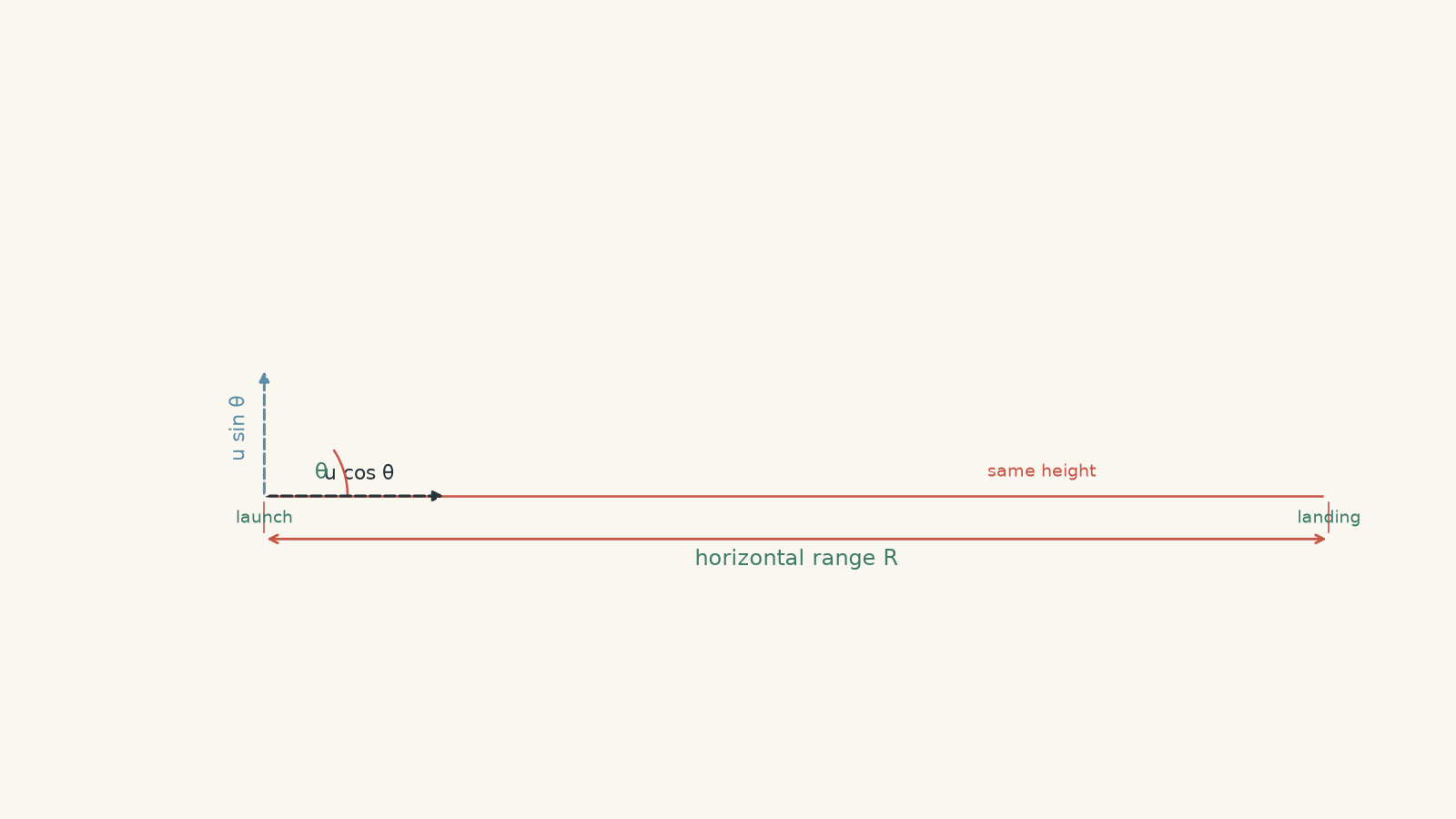
If the projectile remains in the air for a time \(T\), its horizontal range \(R\) is
\[
R=u_xT=u\cos\theta\,T
\]
That is the most useful starting equation for range.
It says something important: there isn’t really a separate mysterious “range motion”. Range comes from combining horizontal motion with the time determined by the vertical motion.
Also notice what range is not. It is not the curved distance travelled along the trajectory. It is the horizontal displacement between the launch point and landing point.
02Why the landing height matters
Suppose the projectile lands at exactly the same height from which it was launched.
Take upwards as positive. The vertical acceleration is then \(a_y=-g\), where \(g=9.8\text{ m s}^{-2}\) near Earth’s surface.
The vertical displacement after time \(T\) is
\[
\Delta y=u_yT-\frac12gT^2
\]
For a same-height landing, \(\Delta y=0\), so
\[
0=u\sin\theta\,T-\frac12gT^2
\]
Factor out \(T\):
\[
T\left(u\sin\theta-\frac12gT\right)=0
\]
There are two solutions. \(T=0\) describes the instant of launch. The later landing occurs when
\[
T=\frac{2u\sin\theta}{g}
\]
Now substitute that flight time into \(R=u\cos\theta\,T\):
\[
R=u\cos\theta\left(\frac{2u\sin\theta}{g}\right)
=\frac{2u^2\sin\theta\cos\theta}{g}
\]
Using \(2\sin\theta\cos\theta=\sin(2\theta)\),
\[
R=\frac{u^2\sin(2\theta)}{g}
\]
This is the familiar projectile range formula.
But it is a shortcut with a condition attached: the projectile must land at the same vertical level from which it was launched.
What the range formula tells you
For a same-height launch and landing with negligible air resistance:
| Change | Effect on range |
|---|---|
| Increase \(u\) while keeping \(\theta\) fixed | \(R\) increases with \(u^2\) |
| Double \(u\) | \(R\) becomes four times as large |
| Increase \(g\) | \(R\) decreases |
| Change \(\theta\) | \(R\) changes according to \(\sin(2\theta)\) |
| Use complementary angles such as \(30^\circ\) and \(60^\circ\) | Same range |
| Set \(\theta=45^\circ\) | Maximum range under these conditions |
Why do complementary angles give the same range?
For \(\theta=30^\circ\),
\[
\sin(2\theta)=\sin 60^\circ
\]
while for \(\theta=60^\circ\),
\[
\sin(2\theta)=\sin 120^\circ
\]
and \(\sin60^\circ=\sin120^\circ\).
Physically, the lower trajectory has more horizontal speed but less time in the air. The higher trajectory has less horizontal speed but more time. For complementary angles, those changes balance exactly.
Worked example: range on level ground
A football is kicked at \(20.0\text{ m s}^{-1}\) at \(30.0^\circ\) above the horizontal. It lands at the same height from which it was kicked. Ignore air resistance. Calculate its horizontal range.
Step 1
\[
u_x=(20.0)\cos30.0^\circ=17.3\text{ m s}^{-1}
\]
\[
u_y=(20.0)\sin30.0^\circ=10.0\text{ m s}^{-1}
\]
Step 2
Because it lands at its launch height,
\[
T=\frac{2u_y}{g}
=\frac{2(10.0)}{9.8}
=2.04\text{ s}
\]
Step 3
\[
R=u_xT=(17.3)(2.04)=35.3\text{ m}
\]
The football lands about \(35.3\text{ m}\) horizontally from where it was kicked.
You could also use the shortcut directly:
\[
R=\frac{u^2\sin(2\theta)}{g}
=\frac{(20.0)^2\sin60.0^\circ}{9.8}
=35.3\text{ m}
\]
Both methods work because the launch and landing heights are equal.
03The \(45^\circ\) rule has conditions
Here is a prediction worth making. A projectile is now fired from the top of a cliff and lands on the ground below. Does \(45^\circ\) still give the greatest possible range?
No.
The usual \(45^\circ\) result comes from
\[
R=\frac{u^2\sin(2\theta)}{g}
\]
and that equation was derived by setting the final vertical displacement to zero. From a cliff, the projectile has extra falling distance after it passes back through its launch height.
That extra time changes the trade-off. A somewhat shallower trajectory can keep more horizontal speed while still having plenty of time to travel because the projectile has a cliff to fall from. For a lower landing point, the ideal no-drag angle for maximum range is therefore less than \(45^\circ\).
This is one of the easiest projectile rules to memorise too broadly. “Maximum range occurs at \(45^\circ\)” is not an unconditional law of nature.
04Range when the projectile lands at a different height
If the landing point is higher or lower than the launch point, go back to the safer method:
- resolve the initial velocity;
- use vertical motion to find the flight time;
- use \(R=u_xT\).
Suppose the landing point is a vertical distance \(h\) below the launch point. Then the vertical displacement is \(\Delta y=-h\), so
\[
-h=u\sin\theta\,T-\frac12gT^2
\]
Solve this equation for \(T\). Keep the positive solution representing the physical flight.
Then calculate
\[
R=u\cos\theta\,T
\]
The vertical motion decides how long the projectile gets to use its horizontal velocity.
For more practice with that part of the method, see projectile time of flight for level and uneven landings.
Worked example: range from a cliff
A ball is launched from a cliff \(12.0\text{ m}\) above the ground with speed \(18.0\text{ m s}^{-1}\) at \(25.0^\circ\) above the horizontal. Ignore air resistance. Calculate the horizontal distance from the launch point to where the ball lands.
Step 1
\[
u_x=(18.0)\cos25.0^\circ=16.3\text{ m s}^{-1}
\]
\[
u_y=(18.0)\sin25.0^\circ=7.61\text{ m s}^{-1}
\]
Step 2
Take the launch point as \(y=0\). The ground is then at \(\Delta y=-12.0\text{ m}\).
\[
-12.0=(7.61)T-\frac12(9.8)T^2
\]
Rearranging,
\[
4.90T^2-7.61T-12.0=0
\]
Using the quadratic formula,
\[
T=\frac{7.61\pm\sqrt{(7.61)^2+4(4.90)(12.0)}}{9.80}
\]
This gives approximately
\[
T=2.52\text{ s}
\]
or
\[
T=-0.971\text{ s}
\]
The negative value would describe a mathematical extension of the trajectory before the chosen launch instant, so it is not the flight time we want.
Step 3
\[
R=u_xT=(16.3)(2.52)=41.2\text{ m}
\]
The ball lands about \(41.2\text{ m}\) horizontally from the launch point.
If you had used \(R=u^2\sin(2\theta)/g\), you would have silently assumed that the ball landed back at cliff-top height. That is a different event.
05A useful special case: horizontal launch
A projectile launched horizontally has \(\theta=0^\circ\), so
\[
u_y=0
\]
At first, that can feel strange. If there is no initial vertical velocity, how does it reach the ground?
Gravity immediately produces downward vertical velocity. For a launch from height \(h\),
\[
-h=-\frac12gT^2
\]
so
\[
T=\sqrt{\frac{2h}{g}}
\]
If the horizontal launch speed is \(u\),
\[
R=u\sqrt{\frac{2h}{g}}
\]
Notice the structure again: horizontal speed multiplied by time in the air.
06Common range mistakes
Using the level-ground formula whenever the word “range” appears
The formula
\[
R=\frac{u^2\sin(2\theta)}{g}
\]
requires equal launch and landing heights.
If the heights differ, find \(T\) from the vertical motion and then use \(R=u_xT\).
Using \(u\) as the horizontal velocity
Unless the launch is perfectly horizontal,
\[
u_x\ne u
\]
The correct horizontal component is
\[
u_x=u\cos\theta
\]
A projectile launched steeply may have a large total speed but a much smaller horizontal speed.
Thinking a greater flight time must mean a greater range
Not by itself.
A very steep launch can stay airborne for a long time but move sideways slowly. Range depends on the product \(u_xT\), not on either factor alone.
At the limiting case \(\theta=90^\circ\), the projectile has plenty of flight time but
\[
u_x=u\cos90^\circ=0
\]
so its horizontal range is zero.
Assuming \(45^\circ\) always maximises range
It maximises the ideal range for fixed launch speed when launch and landing heights are equal.
A lower landing point changes the optimum angle. Air resistance also changes the result because the horizontal velocity is no longer constant.
Treating the two quadratic roots as two possible landing times
A vertical-motion equation can produce one positive and one negative time. The negative root usually belongs to the mathematical parabola before the instant chosen as \(t=0\).
Check what each root means physically before using it.
07A reliable HSC range method
When a range question looks messy, avoid hunting for a special formula. Use the same sequence.
First, sketch the launch point and landing point, and note their vertical separation.
Then resolve the launch velocity:
\[
u_x=u\cos\theta,\qquad u_y=u\sin\theta
\]
Use the vertical motion to find the relevant flight time \(T\):
\[
\Delta y=u_yT-\frac12gT^2
\]
Finally, use horizontal motion:
\[
R=u_xT
\]
Only replace all of that with
\[
R=\frac{u^2\sin(2\theta)}{g}
\]
when you have confirmed that the launch and landing heights are equal.
08Questions and solutions
Question 1
A projectile is launched from level ground at \(24.0\text{ m s}^{-1}\) at \(35.0^\circ\) above the horizontal. It lands at the same height. Ignore air resistance.
Calculate its horizontal range.
Solution 1
The horizontal range is approximately \(55.2\text{ m}\).
Because the projectile lands at its launch height, the level-ground range formula applies:
\[
R=\frac{u^2\sin(2\theta)}{g}
\]
Substitute \(u=24.0\text{ m s}^{-1}\), \(\theta=35.0^\circ\), and \(g=9.8\text{ m s}^{-2}\):
\[
R=\frac{(24.0)^2\sin70.0^\circ}{9.8}
=\frac{576(0.940)}{9.8}
=55.2\text{ m}
\]
So the projectile lands about \(55.2\text{ m}\) from its launch point.
The tempting mistake is to use \(\sin35^\circ\) in the range formula. The angle inside the sine is \(2\theta\), because the formula came from multiplying the horizontal factor \(\cos\theta\) by the flight-time factor \(\sin\theta\).
Question 2
A projectile is launched from a platform \(1.80\text{ m}\) above level ground with speed \(16.0\text{ m s}^{-1}\) at \(30.0^\circ\) above the horizontal. A \(3.80\text{ m}\)-high fence stands \(18.0\text{ m}\) horizontally from the launch point.
Ignore air resistance.
Determine:
- whether the projectile clears the fence, and by what vertical distance;
- whether it is rising or falling as it passes the fence; and
- the horizontal distance from the launch point at which it reaches the ground.
Solution 2
The projectile clears the fence by about \(0.124\text{ m}\), it is falling as it passes the fence, and it lands about \(25.4\text{ m}\) horizontally from the launch point.
First resolve the launch velocity:
\[
u_x=(16.0)\cos30.0^\circ=13.9\text{ m s}^{-1}
\]
\[
u_y=(16.0)\sin30.0^\circ=8.00\text{ m s}^{-1}
\]
At the fence, the horizontal displacement is \(18.0\text{ m}\). Since horizontal velocity is constant,
\[
t=\frac{x}{u_x}
=\frac{18.0}{13.9}
=1.299\text{ s}
\]
Take ground level as \(y=0\). The projectile begins at \(y_0=1.80\text{ m}\), so its height at this time is
\[
y=y_0+u_yt-\frac12gt^2
\]
\[
y=1.80+(8.00)(1.299)-4.90(1.299)^2
=3.924\text{ m}
\]
The fence height is \(3.80\text{ m}\), so the clearance is
\[
3.924-3.80=0.124\text{ m}
\]
Now check the vertical velocity at the fence:
\[
v_y=u_y-gt
\]
\[
v_y=8.00-(9.8)(1.299)
=-4.73\text{ m s}^{-1}
\]
The negative sign means the projectile is moving downwards. It clears the fence on the descending part of its trajectory.
To find the landing time, set \(y=0\):
\[
0=1.80+8.00T-4.90T^2
\]
or
\[
4.90T^2-8.00T-1.80=0
\]
The positive solution is
\[
T=\frac{8.00+\sqrt{(8.00)^2+4(4.90)(1.80)}}{9.80}
=1.83\text{ s}
\]
Therefore,
\[
R=u_xT=(13.9)(1.83)=25.4\text{ m}
\]
A tempting route is to use the level-ground formula immediately. That gives about \(22.6\text{ m}\), but it answers the wrong question: it finds where the ideal trajectory would return to the launch height of \(1.80\text{ m}\), not where it reaches the ground.
Question 3
A launcher fires a projectile at \(25.0\text{ m s}^{-1}\) towards a target \(40.0\text{ m}\) away at exactly the same height as the launcher.
There is a horizontal ceiling \(15.0\text{ m}\) above the launch level extending across the entire region between launcher and target.
Ignore air resistance.
Find every launch angle between \(0^\circ\) and \(90^\circ\) that would reach the target if the ceiling did not exist. Then determine which, if any, is physically possible with the ceiling present.
Solution 3
Without the ceiling, the two launch angles are approximately \(19.4^\circ\) and \(70.6^\circ\). With the ceiling present, only the \(19.4^\circ\) trajectory is possible.
Because launch and landing heights are equal,
\[
R=\frac{u^2\sin(2\theta)}{g}
\]
so
\[
40.0=\frac{(25.0)^2\sin(2\theta)}{9.8}
\]
Hence
\[
\sin(2\theta)=\frac{(40.0)(9.8)}{625}=0.6272
\]
One solution is
\[
2\theta=\sin^{-1}(0.6272)=38.84^\circ
\]
giving
\[
\theta=19.42^\circ
\]
But sine has another solution between \(0^\circ\) and \(180^\circ\):
\[
2\theta=180^\circ-38.84^\circ=141.16^\circ
\]
so
\[
\theta=70.58^\circ
\]
Both angles therefore have the correct range in unobstructed space.
Now the ceiling imposes another constraint. The maximum height above the launch point is
\[
H=\frac{u_y^2}{2g}
=\frac{u^2\sin^2\theta}{2g}
\]
For the \(19.42^\circ\) trajectory,
\[
H=\frac{(25.0)^2\sin^2(19.42^\circ)}{2(9.8)}
=3.53\text{ m}
\]
This is well below the \(15.0\text{ m}\) ceiling.
For the \(70.58^\circ\) trajectory,
\[
H=\frac{(25.0)^2\sin^2(70.58^\circ)}{2(9.8)}
=28.4\text{ m}
\]
That trajectory intersects the ceiling before reaching its natural maximum height, so it is not physically available.
The tempting answer is to stop after finding two angles because complementary launch angles have the same range. That statement is mathematically correct for unobstructed level-ground motion. The ceiling adds a second physical requirement that only the lower trajectory satisfies.
Question 4
A projectile is launched from level ground and later lands at the same height \(50.0\text{ m}\) away.
During its flight, it passes through two points that are both \(8.00\text{ m}\) above the launch level. The two points are separated horizontally by \(30.0\text{ m}\).
Ignore air resistance.
Determine:
- the horizontal position of each \(8.00\text{ m}\)-high point measured from the launch point;
- the launch angle;
- the initial launch speed; and
- the time taken to travel between the two \(8.00\text{ m}\)-high points.
Solution 4
The projectile is at \(8.00\text{ m}\) when \(x=10.0\text{ m}\) and \(x=40.0\text{ m}\), the launch angle is \(45.0^\circ\), the launch speed is approximately \(22.1\text{ m s}^{-1}\), and the time between the two points is approximately \(1.92\text{ s}\).
The first constraint is symmetry.
With equal launch and landing heights and no air resistance, the trajectory is a parabola symmetric about its highest point. Since the total range is \(50.0\text{ m}\), the apex occurs halfway across:
\[
x_{\text{apex}}=25.0\text{ m}
\]
The two points have the same height and are \(30.0\text{ m}\) apart, so they must lie equally far either side of the apex.
If their positions are \(x_1\) and \(x_2\),
\[
x_2-x_1=30.0
\]
and
\[
\frac{x_1+x_2}{2}=25.0
\]
Therefore,
\[
x_1=10.0\text{ m},\qquad x_2=40.0\text{ m}
\]
Now use the trajectory equation
\[
y=x\tan\theta-\frac{gx^2}{2u^2\cos^2\theta}
\]
For a projectile whose same-height range is \(R\),
\[
R=\frac{u^2\sin(2\theta)}{g}
\]
which allows the trajectory equation to be written as
\[
y=x\tan\theta\left(1-\frac{x}{R}\right)
\]
At \(x=10.0\text{ m}\), \(y=8.00\text{ m}\), and \(R=50.0\text{ m}\):
\[
8.00=(10.0)\tan\theta\left(1-\frac{10.0}{50.0}\right)
\]
\[
8.00=(10.0)\tan\theta(0.800)
\]
\[
8.00=8.00\tan\theta
\]
so
\[
\tan\theta=1
\]
and therefore
\[
\theta=45.0^\circ
\]
Now use the range equation:
\[
50.0=\frac{u^2\sin90.0^\circ}{9.8}
\]
Since \(\sin90^\circ=1\),
\[
u^2=(50.0)(9.8)=490
\]
\[
u=\sqrt{490}=22.1\text{ m s}^{-1}
\]
The horizontal velocity is
\[
u_x=u\cos45.0^\circ
=(22.1)(0.707)
=15.7\text{ m s}^{-1}
\]
The horizontal separation between the two equal-height points is \(30.0\text{ m}\), so
\[
\Delta t=\frac{\Delta x}{u_x}
=\frac{30.0}{15.7}
=1.92\text{ s}
\]
The tempting approach is to begin searching for \(u\) and \(\theta\) using several simultaneous motion equations. That works eventually, but it misses the strongest piece of information in the question: two equal heights on a same-level projectile path must occur symmetrically around the apex. Using that constraint first collapses the problem.
Question 5
A launcher sits at the edge of a \(20.0\text{ m}\)-high cliff. It fires a projectile with a fixed speed of \(20.0\text{ m s}^{-1}\), but the launch angle may be changed.
The projectile lands on level ground \(20.0\text{ m}\) below the launcher. Ignore air resistance.
Determine the launch angle that produces the greatest possible horizontal range and calculate that maximum range. Then compare it with a \(45.0^\circ\) launch.
Solution 5
The maximum range occurs at approximately \(35.4^\circ\), not \(45^\circ\), and the maximum horizontal range is approximately \(57.4\text{ m}\). A \(45.0^\circ\) launch travels about \(55.5\text{ m}\).
The key constraint is that the projectile lands below its launch point, so the level-ground formula cannot be used to optimise the angle.
Start with the trajectory equation
\[
y=x\tan\theta-\frac{gx^2}{2u^2\cos^2\theta}
\]
At the landing point,
\[
y=-h,\qquad x=R
\]
where \(h=20.0\text{ m}\). Also,
\[
\frac{1}{\cos^2\theta}=1+\tan^2\theta
\]
Let
\[
q=\tan\theta
\]
and define
\[
A=\frac{g}{2u^2}
\]
Then the landing condition becomes
\[
-h=Rq-AR^2(1+q^2)
\]
Rearranging gives a quadratic equation in \(q\):
\[
AR^2q^2-Rq+(AR^2-h)=0
\]
For a particular range \(R\) to be physically possible, this quadratic must have at least one real value of \(q\), and therefore at least one real launch angle.
The greatest possible \(R\) occurs exactly at the boundary between possible and impossible ranges. At that boundary, the quadratic has one repeated solution, so its discriminant is zero:
\[
R^2-4(AR^2)(AR^2-h)=0
\]
Dividing by \(R^2\) and simplifying gives
\[
R_{\max}=\frac{u}{g}\sqrt{u^2+2gh}
\]
Substitute \(u=20.0\text{ m s}^{-1}\), \(g=9.8\text{ m s}^{-2}\), and \(h=20.0\text{ m}\):
\[
R_{\max}
=\frac{20.0}{9.8}
\sqrt{(20.0)^2+2(9.8)(20.0)}
\]
\[
R_{\max}
=\frac{20.0}{9.8}\sqrt{792}
=57.4\text{ m}
\]
At the repeated root,
\[
q=\frac{1}{2AR_{\max}}
\]
which simplifies to
\[
\tan\theta_{\text{opt}}
=\frac{u}{\sqrt{u^2+2gh}}
\]
Therefore,
\[
\tan\theta_{\text{opt}}
=\frac{20.0}{\sqrt{792}}
=0.7107
\]
so
\[
\theta_{\text{opt}}=35.4^\circ
\]
Now compare this with a \(45.0^\circ\) launch.
At \(45.0^\circ\),
\[
u_x=u_y=(20.0)\frac{1}{\sqrt2}=14.1\text{ m s}^{-1}
\]
The vertical landing condition is
\[
-20.0=(14.1)T-4.90T^2
\]
The positive root is
\[
T=3.93\text{ s}
\]
so
\[
R=(14.1)(3.93)=55.5\text{ m}
\]
Thus the \(35.4^\circ\) launch travels about
\[
57.4-55.5=1.9\text{ m}
\]
farther than the \(45.0^\circ\) launch.
The tempting argument is that \(\sin(2\theta)\) is greatest at \(45^\circ\), so \(45^\circ\) must always maximise range. The flaw is hidden in the equation being used. \(R=u^2\sin(2\theta)/g\) already assumes a same-height landing. Here the projectile has an additional \(20.0\text{ m}\) to fall, so flight time follows a different relationship with launch angle.
That extra falling time means the projectile can sacrifice some upward velocity, keep more of its speed horizontally, and still remain airborne long enough to travel farther.
09What range lets you work out next
The useful idea to carry forward is not just a formula. It is the structure
\[
\text{horizontal range}=\text{horizontal velocity}\times\text{flight time}
\]
Launch angle changes both parts at once: increasing the angle usually reduces horizontal velocity but can increase the time in the air. The landing height can change that balance again.
That is why range, maximum height, and flight time should not be treated as separate projectile-motion topics. They are different consequences of the same horizontal and vertical components. The next useful step is to compare those competing effects directly when the projectile launch angle changes.